

D Y N A M I C S O F F I E L D POPULATION O F P I N E LOOPER
247
progeny of the two extreme classes of pupae should be about the
same size.
Pupae of the size frequencies shown in Fig. 12-B were grouped into
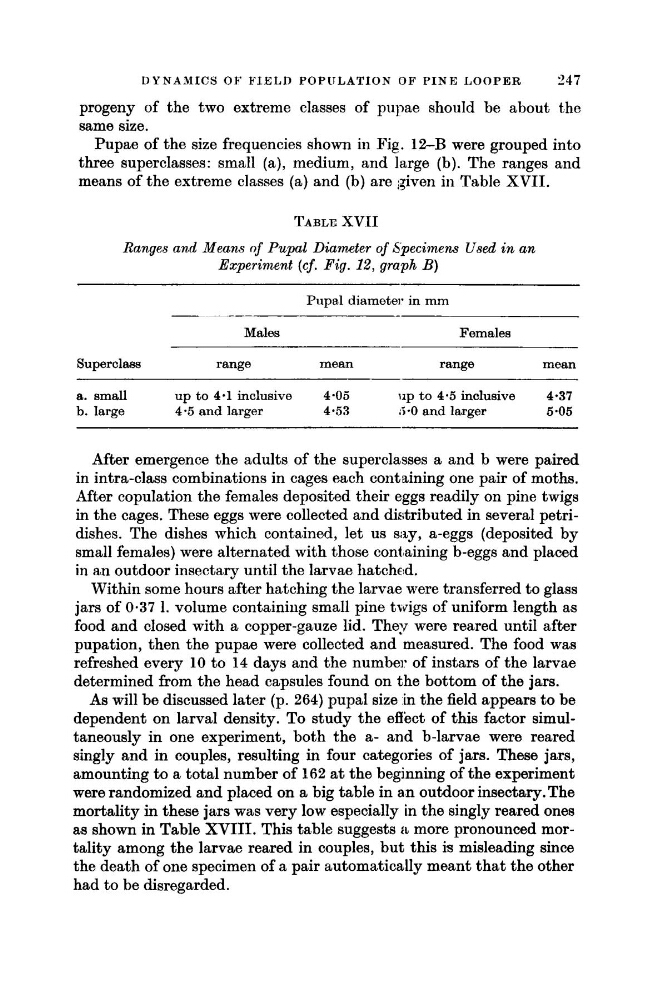
three superclasses: small (a), medium, and large (b). The ranges and
means of the extreme classes (a) and (b) are given in Table XVII.
TABLE XVTI
Ranges and Means i f Pupal Diameter of Specimens Used in an
Experiment (cf. Fig. 12, graph B )
Piipal diametei. in mm
Males
Females
Superclass
range
mean
range
mean
~~
a. small
up to 4.1 inclusive
4-06
lip to 4.5 inclusive
4.37
b. large
4.5 and larger
4-53
5.0 and larger
6-05
After emergence the adults of the superclasses a and b were paired
in intra-class combinations in cages each contsining one pair of moths.
After copulation the females deposited their eggs readily on pine twigs
in the cages. These eggs were collected and distributed in several petridishes. The dishes which conta,ined, let us say, a-eggs (deposited by
small females) were alternated with those containing b-eggs and placed
in an outdoor insectary until the larvae hatched.
Within some hours after hatching the larvae were transferred to glass
jars of 0.37 1. volume containing small pine twigs of uniform length as
food and closed with a copper-gauze lid. They were reared until after
pupation, then the pupae were collected and measured. The food was
refreshed every 10 to 14 days and the number of instars of the larvae
determined from the head capsules found on the bottom of the jars.
As will be discussed later (p. 264) pupal size in the field appears to be
dependent on larval density. To study the effect of this factor simultaneously in one experiment, both the a- and b-larvae were reared
singly and in couples, resulting in four categories of jars. These jars,
amounting to a total number of 162 at the beginning of the experiment
were randomized and placed on a big table in a n outdoor insectary. The
mortality in these jars was very low especially in the singly reared ones
as shown in Table XVIII. This ta.ble suggests i~ more pronounced mortality among the larvae reared in couples, but this is misleading since
the death of one specimen of a pair automatically meant that the other
had to be disregarded.
247
progeny of the two extreme classes of pupae should be about the
same size.
Pupae of the size frequencies shown in Fig. 12-B were grouped into
three superclasses: small (a), medium, and large (b). The ranges and
means of the extreme classes (a) and (b) are given in Table XVII.
TABLE XVTI
Ranges and Means i f Pupal Diameter of Specimens Used in an
Experiment (cf. Fig. 12, graph B )
Piipal diametei. in mm
Males
Females
Superclass
range
mean
range
mean
~~
a. small
up to 4.1 inclusive
4-06
lip to 4.5 inclusive
4.37
b. large
4.5 and larger
4-53
5.0 and larger
6-05
After emergence the adults of the superclasses a and b were paired
in intra-class combinations in cages each contsining one pair of moths.
After copulation the females deposited their eggs readily on pine twigs
in the cages. These eggs were collected and distributed in several petridishes. The dishes which conta,ined, let us say, a-eggs (deposited by
small females) were alternated with those containing b-eggs and placed
in an outdoor insectary until the larvae hatched.
Within some hours after hatching the larvae were transferred to glass
jars of 0.37 1. volume containing small pine twigs of uniform length as
food and closed with a copper-gauze lid. They were reared until after
pupation, then the pupae were collected and measured. The food was
refreshed every 10 to 14 days and the number of instars of the larvae
determined from the head capsules found on the bottom of the jars.
As will be discussed later (p. 264) pupal size in the field appears to be
dependent on larval density. To study the effect of this factor simultaneously in one experiment, both the a- and b-larvae were reared
singly and in couples, resulting in four categories of jars. These jars,
amounting to a total number of 162 at the beginning of the experiment
were randomized and placed on a big table in a n outdoor insectary. The
mortality in these jars was very low especially in the singly reared ones
as shown in Table XVIII. This ta.ble suggests i~ more pronounced mortality among the larvae reared in couples, but this is misleading since
the death of one specimen of a pair automatically meant that the other
had to be disregarded.