

T H E P R O D U C T I O N O F M A R I N E P L A N K T O N
165
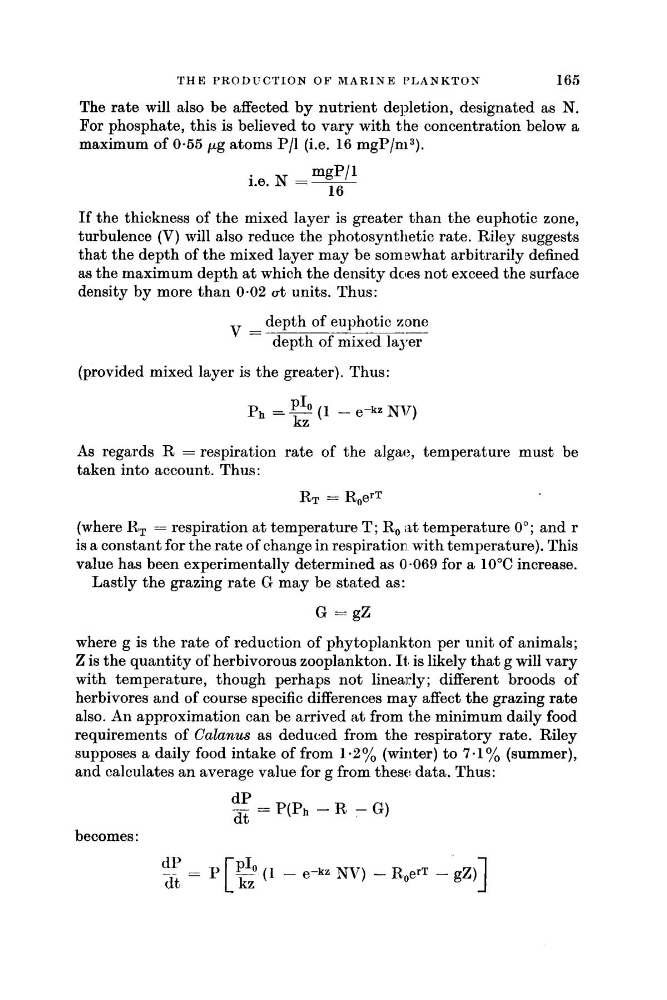
The rate will also be affected by nutrient depletion, designated as N.
For phosphate, this is believed to vary with the concentration below a
maximum of 0.55 pg atoms P/1 (i.e. 16 mgP/ni3).
If the thickness of the mixed layer is greater than the euphotic zone,
turbulence (V) will also reduce the photosynthetic rate. Riley suggests
that the depth of the mixed layer may be somewhat arbitrarily defined
as the maximum depth a t which the density does not exceed the surface
density by more than 0-02 at units. Thus:
depth of euphotic zone
depth of mixed layer
______
V =
(provided mixed layer is the greater). Thus:
As regards R =respiration rate of the algae, temperature must be
taken into account. Thus:
RT = RoerT
(where RT = respiration a t temperature T ; R, a t temperature 0 " ; and r
is a constant for the rate of change in respiration with temperature). This
value has been experimentally determined as 0.069 for a 10°C increase.
Lastly the grazing rate G may be stated as:
G = gZ
where g is the rate of reduction of phytoplankton per unit of animals;
Z is the quantity of herbivorous zooplankton. It' is likely that g will vary
with temperature, though perhaps not lineaiily ; different broods of
herbivores and of course specific differences may affect the grazing rate
also. An approximation can be arrived a t from the minimum daily food
requirements of Calanus as deduced from the respiratory rate. Riley
supposes a daily food intake of from 1'2% (winter) to 7.1% (summer),
and calculates an average value for g from these data. Thus:
dP
d t
- = P(Ph - R, - G )
becomes :
165
The rate will also be affected by nutrient depletion, designated as N.
For phosphate, this is believed to vary with the concentration below a
maximum of 0.55 pg atoms P/1 (i.e. 16 mgP/ni3).
If the thickness of the mixed layer is greater than the euphotic zone,
turbulence (V) will also reduce the photosynthetic rate. Riley suggests
that the depth of the mixed layer may be somewhat arbitrarily defined
as the maximum depth a t which the density does not exceed the surface
density by more than 0-02 at units. Thus:
depth of euphotic zone
depth of mixed layer
______
V =
(provided mixed layer is the greater). Thus:
As regards R =respiration rate of the algae, temperature must be
taken into account. Thus:
RT = RoerT
(where RT = respiration a t temperature T ; R, a t temperature 0 " ; and r
is a constant for the rate of change in respiration with temperature). This
value has been experimentally determined as 0.069 for a 10°C increase.
Lastly the grazing rate G may be stated as:
G = gZ
where g is the rate of reduction of phytoplankton per unit of animals;
Z is the quantity of herbivorous zooplankton. It' is likely that g will vary
with temperature, though perhaps not lineaiily ; different broods of
herbivores and of course specific differences may affect the grazing rate
also. An approximation can be arrived a t from the minimum daily food
requirements of Calanus as deduced from the respiratory rate. Riley
supposes a daily food intake of from 1'2% (winter) to 7.1% (summer),
and calculates an average value for g from these data. Thus:
dP
d t
- = P(Ph - R, - G )
becomes :