

ENERGETICS A N D ANIMAL PRODUCTIVITY
91
equals the log 10 of the oxygen consumed x
ml/individual/day, W
equals log 10 rate of the individuals in pg, 2 equals 1 x lo4 divided by
the temperature in degrees A. Using these formulae, data on numbers
and biomass of the oribatid mites, and data on the annual temperature
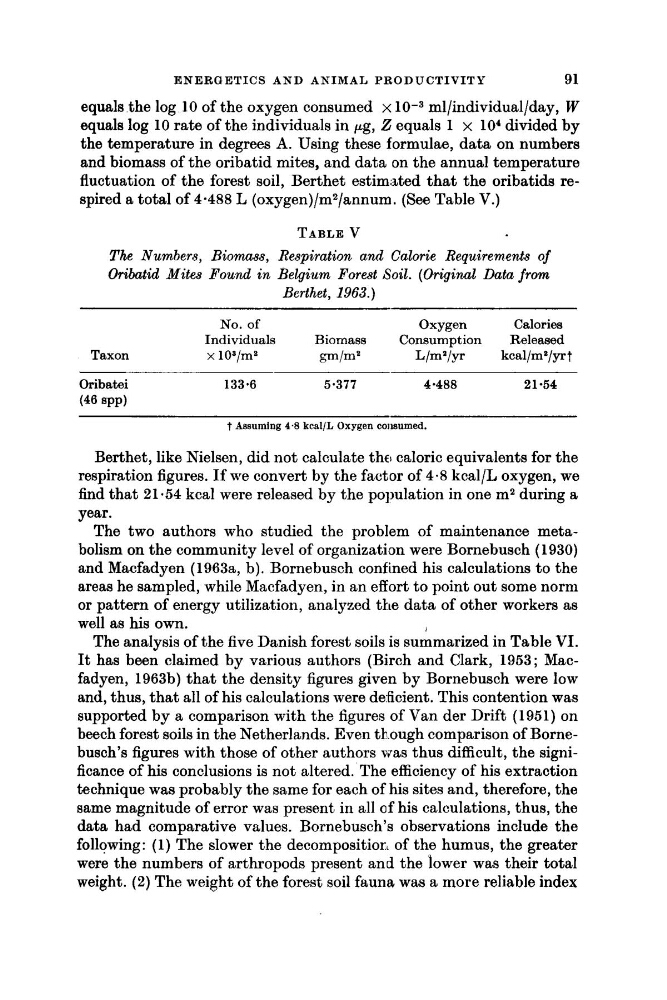
fluctuation of the forest soil, Berthet estim,%ted that the oribatids respired a total of 4.488 L (oxygen)/m2/annum. (See Table v.)
TABLE V
The Numbers, Biomass, Respiration and Calorie Requirements of
Oribatid Mites Found in Belgium Forest Soil. (Original Data from
Berthet, 1963.)
No. of
Oxygen
Calories
Individuals
Biomass
Consumption
Released
Taxon
x 103/me
&m/me
L/ma/yr
kcal/m*/yrf
Oribatei
133.6
5.377
4.488
21.54
(46 SPP)
t Assuming 4.8 kcal/L Oxygen coilsumed.
Berthet, like Nielsen, did not calculate the caloric equivalents for the
respiration figures. If we convert by the factor of 4.8 kcal/L oxygen, we
find that 21.54 kcal were released by the population in one m2 during a
year.
The two authors who studied the problem of maintenance metabolism on the community level of organization were Bornebusch (1930)
and Macfadyen (1963a, b). Bornebusch confined his calculations to the
areas he sampled, while Macfadyen, in an effort to point out some norm
or pattern of energy utilization, analyzed the data of other workers as
well as his own.
The analysis of the five Danish forest soils is summarized in Table VI.
It has been claimed by various authors (Birch and Clark, 1953; Macfadyen, 1963b) that the density figures given by Bornebusch were low
and, thus, that all of his calculations were deficient. This contention was
supported by a comparison with the figures of Van der Drift (1951) on
beech forest soils in the Netherlands. Even though comparison of Bornebusch’s figures with those of other authors was thus difficult, the significance of his conclusions is not altered. The efficiency of his extraction
technique was probably the same for each of his sites and, therefore, the
same magnitude of error was present in all of his calculations, thus, the
data had comparative values. Bomebusch’s observations include the
following: (1) The slower the decompositior, of the humus, the greater
were the numbers of arthropods present and the rower was their total
weight. (2) The weight of the forest soil fauna waa a more reliable index
91
equals the log 10 of the oxygen consumed x
ml/individual/day, W
equals log 10 rate of the individuals in pg, 2 equals 1 x lo4 divided by
the temperature in degrees A. Using these formulae, data on numbers
and biomass of the oribatid mites, and data on the annual temperature
fluctuation of the forest soil, Berthet estim,%ted that the oribatids respired a total of 4.488 L (oxygen)/m2/annum. (See Table v.)
TABLE V
The Numbers, Biomass, Respiration and Calorie Requirements of
Oribatid Mites Found in Belgium Forest Soil. (Original Data from
Berthet, 1963.)
No. of
Oxygen
Calories
Individuals
Biomass
Consumption
Released
Taxon
x 103/me
&m/me
L/ma/yr
kcal/m*/yrf
Oribatei
133.6
5.377
4.488
21.54
(46 SPP)
t Assuming 4.8 kcal/L Oxygen coilsumed.
Berthet, like Nielsen, did not calculate the caloric equivalents for the
respiration figures. If we convert by the factor of 4.8 kcal/L oxygen, we
find that 21.54 kcal were released by the population in one m2 during a
year.
The two authors who studied the problem of maintenance metabolism on the community level of organization were Bornebusch (1930)
and Macfadyen (1963a, b). Bornebusch confined his calculations to the
areas he sampled, while Macfadyen, in an effort to point out some norm
or pattern of energy utilization, analyzed the data of other workers as
well as his own.
The analysis of the five Danish forest soils is summarized in Table VI.
It has been claimed by various authors (Birch and Clark, 1953; Macfadyen, 1963b) that the density figures given by Bornebusch were low
and, thus, that all of his calculations were deficient. This contention was
supported by a comparison with the figures of Van der Drift (1951) on
beech forest soils in the Netherlands. Even though comparison of Bornebusch’s figures with those of other authors was thus difficult, the significance of his conclusions is not altered. The efficiency of his extraction
technique was probably the same for each of his sites and, therefore, the
same magnitude of error was present in all of his calculations, thus, the
data had comparative values. Bomebusch’s observations include the
following: (1) The slower the decompositior, of the humus, the greater
were the numbers of arthropods present and the rower was their total
weight. (2) The weight of the forest soil fauna waa a more reliable index