

92
MANFRED D . ENOELMANN
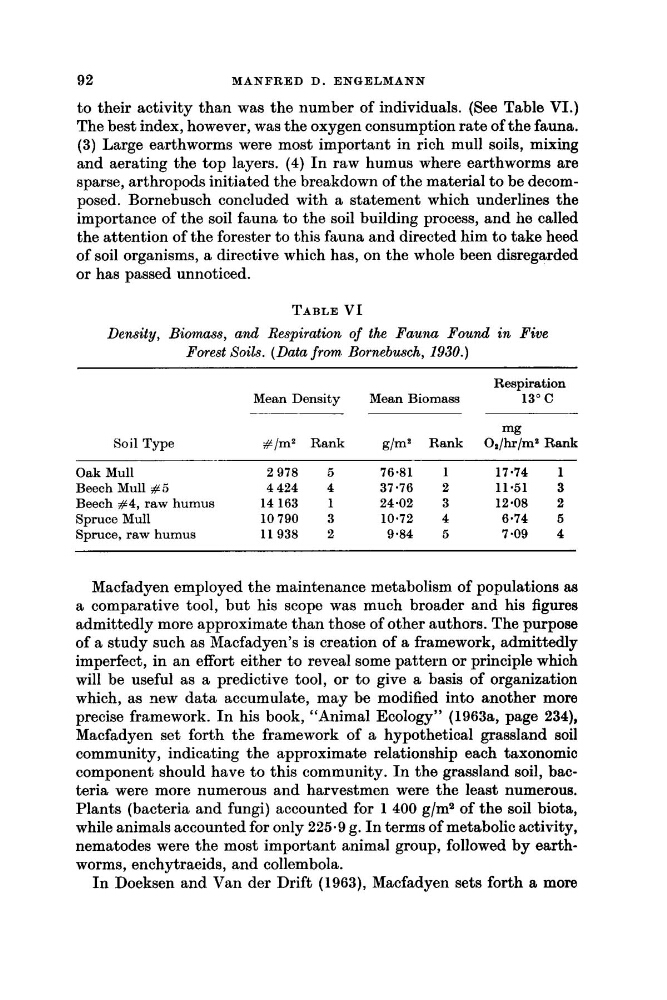
to their activity than was the number of individuals. (See Table VI.)
The best index, however, was the oxygen consumption rate of the fauna.
(3) Large earthworms were most important in rich mull soils, mixing
and aerating the top layers. (4) In raw humus where earthworms are
sparse, arthropods initiated the breakdown of the material to be decomposed. Bornebusch concluded with a statement which underlines the
importance of the soil fauna to the soil building process, and he called
the attention of the forester to this fauna and directed him to take heed
of soil organisms, a directive which has, on the whole been disregarded
or has passed unnoticed.
TABLE VI
Density, Biomass, and Respiration of the Fauna Found in Five
Forest Soils. (Data from. Bornebusch, 1930.)
Respiration
Mean Density
Mean Biomass
13” C -
mi3
Soil Type
#/m2 Rank
g/m2 Rank Ol/hr/ma Rank
Oak Mull
2978
5
76-81
1
17-74
1
Beech Mull f 5
4424
4
37-76
2
11-51
3
Beech #4, raw humus
14163
1
24-02
3
12.08
2
Spruce Mull
10790
3
10.72
4
6.74
6
Spruce, raw humus
11 938
2
9.84
5
7.09
4
Macfadyen employed the maintenance metabolism of populations as
a comparative tool, but his scope was much broader and his figures
admittedly more approximate than those of other authors. The purpose
of a study such as Macfadyen’s is creation of a framework, admittedly
imperfect, in an effort either to reveal some pattern or principle which
will be useful as a predictive tool, or to give a basis of organization
which, as new data accumulate, may be modified into another more
precise framework. In his book, “Animal Ecology’’ (1963a, page 234),
Macfadyen set forth the framework of a hypothetical grassland soil
community, indicating the approximate relationship each taxonomic
component should have to this community. In the grassland soil, bacteria were more numerous and harvestmen were the least numerous.
Plants (bacteria and fungi) accounted for 1 400 g/m2 of the soil biota,
while animals accounted for only 225.9 g. In terms of metabolic activity,
nematodes were the most important animal group, followed by earthworms, enchytraeids, and collembola.
In Doeksen and Van der Drift (1963), Macfadyen sets forth a more
MANFRED D . ENOELMANN
to their activity than was the number of individuals. (See Table VI.)
The best index, however, was the oxygen consumption rate of the fauna.
(3) Large earthworms were most important in rich mull soils, mixing
and aerating the top layers. (4) In raw humus where earthworms are
sparse, arthropods initiated the breakdown of the material to be decomposed. Bornebusch concluded with a statement which underlines the
importance of the soil fauna to the soil building process, and he called
the attention of the forester to this fauna and directed him to take heed
of soil organisms, a directive which has, on the whole been disregarded
or has passed unnoticed.
TABLE VI
Density, Biomass, and Respiration of the Fauna Found in Five
Forest Soils. (Data from. Bornebusch, 1930.)
Respiration
Mean Density
Mean Biomass
13” C -
mi3
Soil Type
#/m2 Rank
g/m2 Rank Ol/hr/ma Rank
Oak Mull
2978
5
76-81
1
17-74
1
Beech Mull f 5
4424
4
37-76
2
11-51
3
Beech #4, raw humus
14163
1
24-02
3
12.08
2
Spruce Mull
10790
3
10.72
4
6.74
6
Spruce, raw humus
11 938
2
9.84
5
7.09
4
Macfadyen employed the maintenance metabolism of populations as
a comparative tool, but his scope was much broader and his figures
admittedly more approximate than those of other authors. The purpose
of a study such as Macfadyen’s is creation of a framework, admittedly
imperfect, in an effort either to reveal some pattern or principle which
will be useful as a predictive tool, or to give a basis of organization
which, as new data accumulate, may be modified into another more
precise framework. In his book, “Animal Ecology’’ (1963a, page 234),
Macfadyen set forth the framework of a hypothetical grassland soil
community, indicating the approximate relationship each taxonomic
component should have to this community. In the grassland soil, bacteria were more numerous and harvestmen were the least numerous.
Plants (bacteria and fungi) accounted for 1 400 g/m2 of the soil biota,
while animals accounted for only 225.9 g. In terms of metabolic activity,
nematodes were the most important animal group, followed by earthworms, enchytraeids, and collembola.
In Doeksen and Van der Drift (1963), Macfadyen sets forth a more