

LITTER PRODUCTION I N FORESTS OF THE WORLD
129
the northern U.S.A. and Canada, although the European sites are on
average about 10 degrees farther north. The warming effect of the
Gulf Stream upon European climate is probably the major factor
involved, but it is also possible that the intensive management of
European as compared with North American forests is important in
this connection.
2. Altitude and Exposure
Ebermayer’s (1876) data for Fagus silvatica, Picea abies snd Pinus
silvestris have been summarized by 200 m altitude classes from 250 to
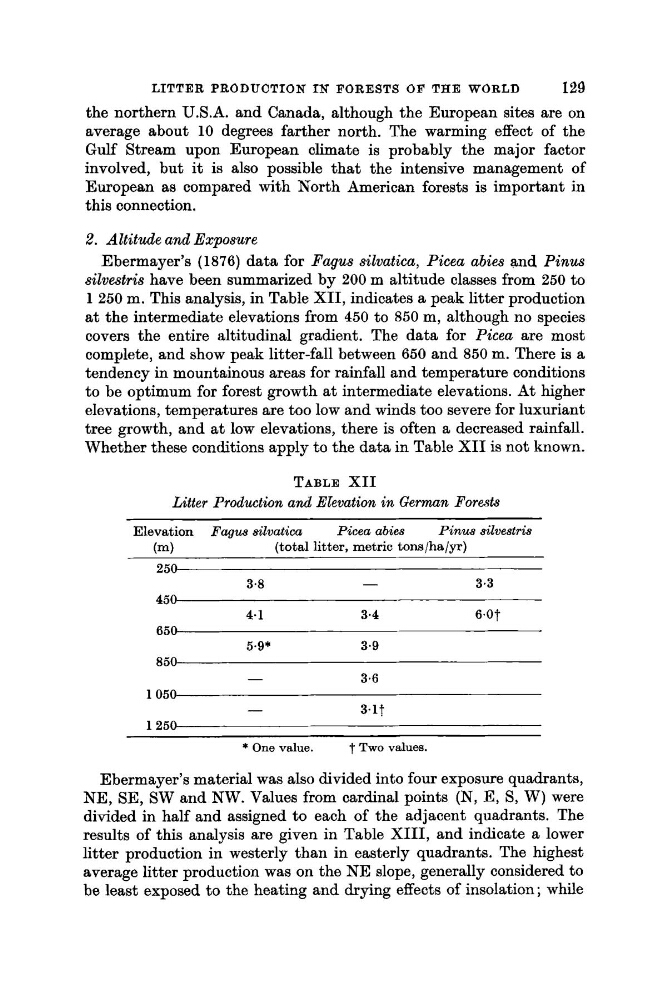
1 250 m. This analysis, in Table XII, indicates a peak litter production
at the intermediate elevations from 450 to 850 m, although no species
covers the entire altitudinal gradient. The data for Picea are most
complete, and show peak litter-fall between 650 and 850 m. There is a
tendency in mountainous areas for rainfall and temperature conditions
to be optimum for forest growth at intermediate elevations. At higher
elevations, temperatures are too low and winds too severe for luxuriant
tree growth, and at low elevations, there is often a decreased rainfall.
Whether these conditions apply to the data in Table XI1 is not known.
TABLE XI1
Litter Production and Elevation in German Porests
Elevation Fagua ailvatica
Picea abies
Pinw, silvestris
(4
(total litter, metric tons/ha/yr)
250
3.8
-
3.3
4.1
3.4
6.0t
5.9*
3.9
650
-
3.6
-
3.1t
1050
1250
* One value.
t Two values.
Ebermayer’s material was also divided into four exposure quadrants,
NE, SE, SW and NW. Values from cardinal points (N, E, S, W) were
divided in half and assigned to each of the adjacent quadrants. The
results of this analysis are given in Table XIII, and indicate a lower
litter production in westerly than in easterly quadrants. The highest
average litter production was on the NE slope, generally considered to
be least exposed to the heating and drying effects of insolation ; while
129
the northern U.S.A. and Canada, although the European sites are on
average about 10 degrees farther north. The warming effect of the
Gulf Stream upon European climate is probably the major factor
involved, but it is also possible that the intensive management of
European as compared with North American forests is important in
this connection.
2. Altitude and Exposure
Ebermayer’s (1876) data for Fagus silvatica, Picea abies snd Pinus
silvestris have been summarized by 200 m altitude classes from 250 to
1 250 m. This analysis, in Table XII, indicates a peak litter production
at the intermediate elevations from 450 to 850 m, although no species
covers the entire altitudinal gradient. The data for Picea are most
complete, and show peak litter-fall between 650 and 850 m. There is a
tendency in mountainous areas for rainfall and temperature conditions
to be optimum for forest growth at intermediate elevations. At higher
elevations, temperatures are too low and winds too severe for luxuriant
tree growth, and at low elevations, there is often a decreased rainfall.
Whether these conditions apply to the data in Table XI1 is not known.
TABLE XI1
Litter Production and Elevation in German Porests
Elevation Fagua ailvatica
Picea abies
Pinw, silvestris
(4
(total litter, metric tons/ha/yr)
250
3.8
-
3.3
4.1
3.4
6.0t
5.9*
3.9
650
-
3.6
-
3.1t
1050
1250
* One value.
t Two values.
Ebermayer’s material was also divided into four exposure quadrants,
NE, SE, SW and NW. Values from cardinal points (N, E, S, W) were
divided in half and assigned to each of the adjacent quadrants. The
results of this analysis are given in Table XIII, and indicate a lower
litter production in westerly than in easterly quadrants. The highest
average litter production was on the NE slope, generally considered to
be least exposed to the heating and drying effects of insolation ; while