

128
J . ROGER BRAY AND EVILLE QORHAM
nection it should be borne in mind that the three categories of litter
summarized in Table XI do not represent matched sets of data, for
some authors collected only leaf litter, and some of those collecting
total litter did not separate leaf and other litter.) Leaf litter ranges
from 0.7 tjha in Alpine Norwegian forest to nearly 7 t/ha in Equatorial
Africa, with the Cool and Warm Temperate zones intermediate a t 2.5
and 3.6 tjha respectively. Data for non-leaf litter are least satisfactory,
with less coverage and also less reliability because of the irregular and
' 4 t
NORTH OR SOUTH LATITUDE (degrees1
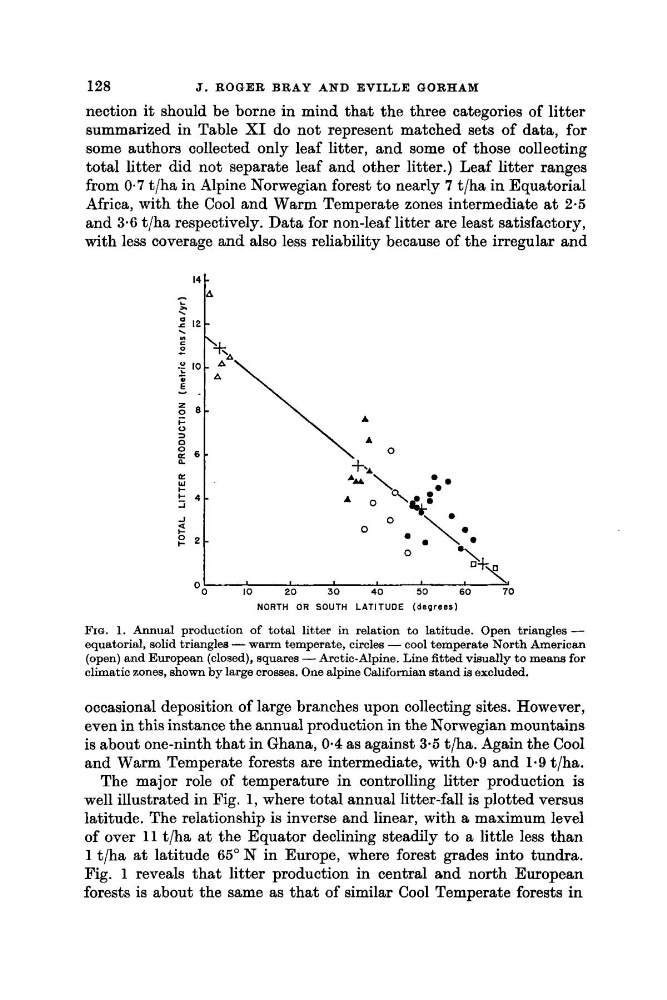
FIG. 1. Annual production of total litter in relation to latitude. Open triangles -
equatorial, solid triangles - warm temperate, circles - cool temperate North American
(open) and European (closed), squares - Arctic-Alpine. Line fitted visually to means for
climatic zones, shown by large crosses. One alpine Californian stand is excluded.
occasional deposition of large branches upon collecting sites. However,
even in this instance the annual production in the Norwegian mountains
is about one-ninth that in Ghana, 0.4 as against 3.5 tjha. Again the Cool
and Warm Temperate forests are intermediate, with 0.9 and 1.9 t/ha.
The major role of temperature in controlling litter production is
well illustrated in Fig. 1, where total annual litter-fall is plotted versus
latitude. The relationship is inverse and linear, with a maximum level
of over 11 t/ha at the Equator declining steadily to a little less than
1 t/ha a t latitude 65" N in Europe, where forest grades into tundra.
Fig. 1 reveals that litter production in central and north European
forests is about the same as that of similar Cool Temperate forests in
J . ROGER BRAY AND EVILLE QORHAM
nection it should be borne in mind that the three categories of litter
summarized in Table XI do not represent matched sets of data, for
some authors collected only leaf litter, and some of those collecting
total litter did not separate leaf and other litter.) Leaf litter ranges
from 0.7 tjha in Alpine Norwegian forest to nearly 7 t/ha in Equatorial
Africa, with the Cool and Warm Temperate zones intermediate a t 2.5
and 3.6 tjha respectively. Data for non-leaf litter are least satisfactory,
with less coverage and also less reliability because of the irregular and
' 4 t
NORTH OR SOUTH LATITUDE (degrees1
FIG. 1. Annual production of total litter in relation to latitude. Open triangles -
equatorial, solid triangles - warm temperate, circles - cool temperate North American
(open) and European (closed), squares - Arctic-Alpine. Line fitted visually to means for
climatic zones, shown by large crosses. One alpine Californian stand is excluded.
occasional deposition of large branches upon collecting sites. However,
even in this instance the annual production in the Norwegian mountains
is about one-ninth that in Ghana, 0.4 as against 3.5 tjha. Again the Cool
and Warm Temperate forests are intermediate, with 0.9 and 1.9 t/ha.
The major role of temperature in controlling litter production is
well illustrated in Fig. 1, where total annual litter-fall is plotted versus
latitude. The relationship is inverse and linear, with a maximum level
of over 11 t/ha at the Equator declining steadily to a little less than
1 t/ha a t latitude 65" N in Europe, where forest grades into tundra.
Fig. 1 reveals that litter production in central and north European
forests is about the same as that of similar Cool Temperate forests in