

76
L. B. SLOBODKIN
efficiency (or inverse of cost per calories of producing yield of the
sort i).
Ei requires further elucidation. The energetic cost of producing an
animal of age i is the total food energy consumed by that animal during
its free life plus the energy expended by its parents on its behalf between the moment of its inception and its freedom. The first of these
cost components is relatively simple t o determine. The second is more
difficult but has been done in at least one case (Armstrong, 1960) which
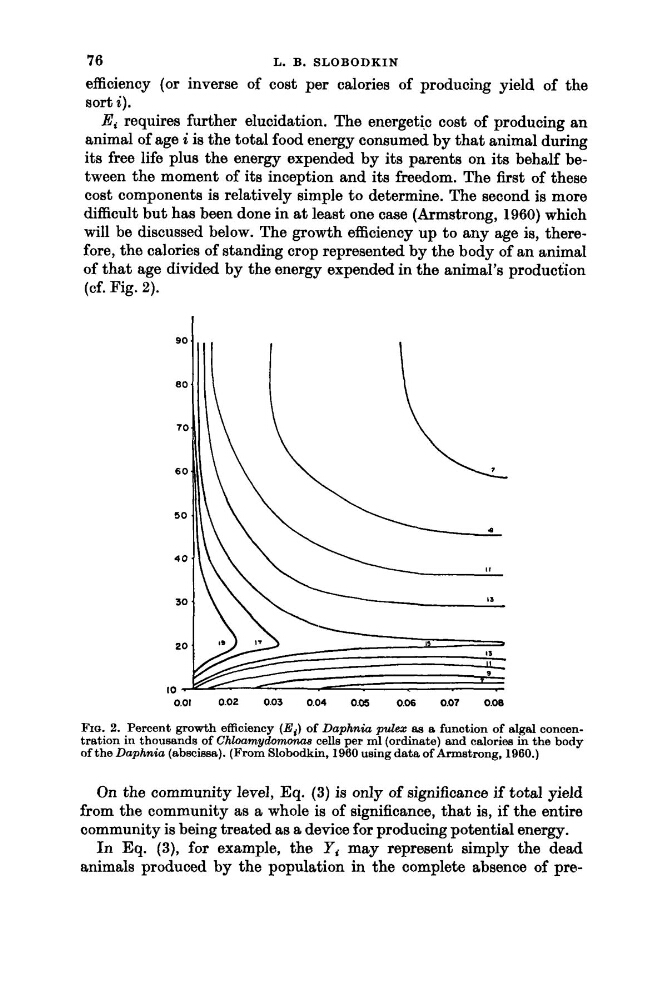
will be discussed below. The growth efficiency up t o any age is, therefore, the calories of standing crop represented by the body of an animal
of that age divided by the energy expended in the animal’s production
(cf. Fig. 2).
0.01
0.02
0.03
0.04
0.05
0.06
0.07
0.08
FIG. 2. Percent growth efficiency (E,) of Daphnia p d m as a function of algal concentration in thousands of Chloamydomonas cells per ml (ordinate) and calories in the body
of the Daphnia (abscissa). (From Slobodkin, 1960 using data of Armstrong, 1960.)
On the community level, Eq. (3) is only of significance if total yield
from the community as a whole is of significance, that is, if the entire
community is being treated as a device for producing potential energy.
I n Eq. (3), for example, the Yi may represent simply the dead
animals produced by the population in the complete absence of pre-
L. B. SLOBODKIN
efficiency (or inverse of cost per calories of producing yield of the
sort i).
Ei requires further elucidation. The energetic cost of producing an
animal of age i is the total food energy consumed by that animal during
its free life plus the energy expended by its parents on its behalf between the moment of its inception and its freedom. The first of these
cost components is relatively simple t o determine. The second is more
difficult but has been done in at least one case (Armstrong, 1960) which
will be discussed below. The growth efficiency up t o any age is, therefore, the calories of standing crop represented by the body of an animal
of that age divided by the energy expended in the animal’s production
(cf. Fig. 2).
0.01
0.02
0.03
0.04
0.05
0.06
0.07
0.08
FIG. 2. Percent growth efficiency (E,) of Daphnia p d m as a function of algal concentration in thousands of Chloamydomonas cells per ml (ordinate) and calories in the body
of the Daphnia (abscissa). (From Slobodkin, 1960 using data of Armstrong, 1960.)
On the community level, Eq. (3) is only of significance if total yield
from the community as a whole is of significance, that is, if the entire
community is being treated as a device for producing potential energy.
I n Eq. (3), for example, the Yi may represent simply the dead
animals produced by the population in the complete absence of pre-