

ENERGY IN ANIMAL ECOLOGY
77
dation. The total cost of this rain of dead animals is the same as the
cost of replacing these dead animals with a new supply of dead.
The advantage of Eq. (3) is that, in combination with Eq. (2), it is
most fruitful for the analysis of the effect of environmental change.
Consider that some new source of mortality, either a predator, exploiter or disease appears. There will be a period of transition in the
population and some new steady state will be achieved (except if the
population is completely eliminated).
That is, assuming I constant, we will have from Eq. (2)
I = P’(c + dc)
(4)
where Ac is the maintenance cost induced by the new mortality source.
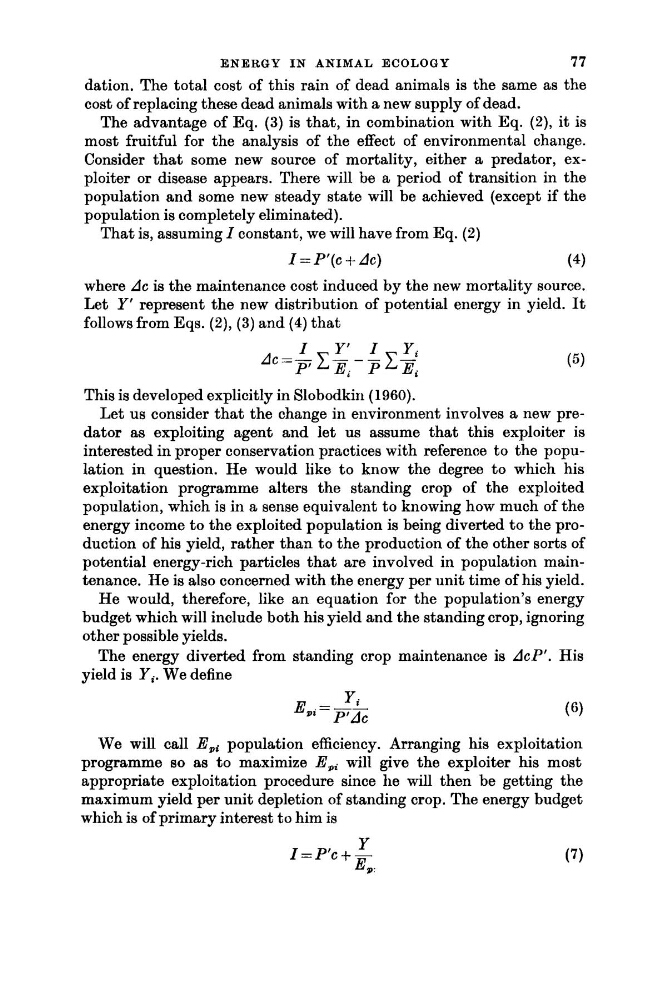
Let Y‘ represent the new distribution of potential energy in yield. It
follows from Eqs. (2), (3) and (4) that
This is developed explicitly in Slobodkiri (1960).
Let us consider that the change in environment involves a new predator as exploiting agent and let us assume that this exploiter is
interested in proper conservation practices with reference t o the population in question. He would like to know the degree t o which his
exploitation programme alters the standing crop of the exploited
population, which is in a sense equivalent to knowing how much of the
energy income t o the exploited population is being diverted t o the production of his yield, rather than t o the production of the other sorts of
potential energy-rich particles that are involved in population maintenance. He is also concerned with the energy per unit time of his yield.
He would, therefore, like an equation for the population’s energy
budget which will include both his yield and the standing crop, ignoring
other possible yields.
The energy diverted from standing crop maintenance is AcP’. His
yield is Y i . We define
(6)
’’ P’dc
We will call EDi population eficiency. Arranging his exploitation
programme so as t o maximize EPi will give the exploiter his most
appropriate exploitation procedure since he will then be getting the
maximum yield per unit depletion of standing crop. The energy budget
which is of primary interest t o him is
Yi
E ,=-Y
I = P’c + -
E,:
(7)
77
dation. The total cost of this rain of dead animals is the same as the
cost of replacing these dead animals with a new supply of dead.
The advantage of Eq. (3) is that, in combination with Eq. (2), it is
most fruitful for the analysis of the effect of environmental change.
Consider that some new source of mortality, either a predator, exploiter or disease appears. There will be a period of transition in the
population and some new steady state will be achieved (except if the
population is completely eliminated).
That is, assuming I constant, we will have from Eq. (2)
I = P’(c + dc)
(4)
where Ac is the maintenance cost induced by the new mortality source.
Let Y‘ represent the new distribution of potential energy in yield. It
follows from Eqs. (2), (3) and (4) that
This is developed explicitly in Slobodkiri (1960).
Let us consider that the change in environment involves a new predator as exploiting agent and let us assume that this exploiter is
interested in proper conservation practices with reference t o the population in question. He would like to know the degree t o which his
exploitation programme alters the standing crop of the exploited
population, which is in a sense equivalent to knowing how much of the
energy income t o the exploited population is being diverted t o the production of his yield, rather than t o the production of the other sorts of
potential energy-rich particles that are involved in population maintenance. He is also concerned with the energy per unit time of his yield.
He would, therefore, like an equation for the population’s energy
budget which will include both his yield and the standing crop, ignoring
other possible yields.
The energy diverted from standing crop maintenance is AcP’. His
yield is Y i . We define
(6)
’’ P’dc
We will call EDi population eficiency. Arranging his exploitation
programme so as t o maximize EPi will give the exploiter his most
appropriate exploitation procedure since he will then be getting the
maximum yield per unit depletion of standing crop. The energy budget
which is of primary interest t o him is
Yi
E ,=-Y
I = P’c + -
E,:
(7)