

ENERGY I N ANIMAL ECOLOGY
75
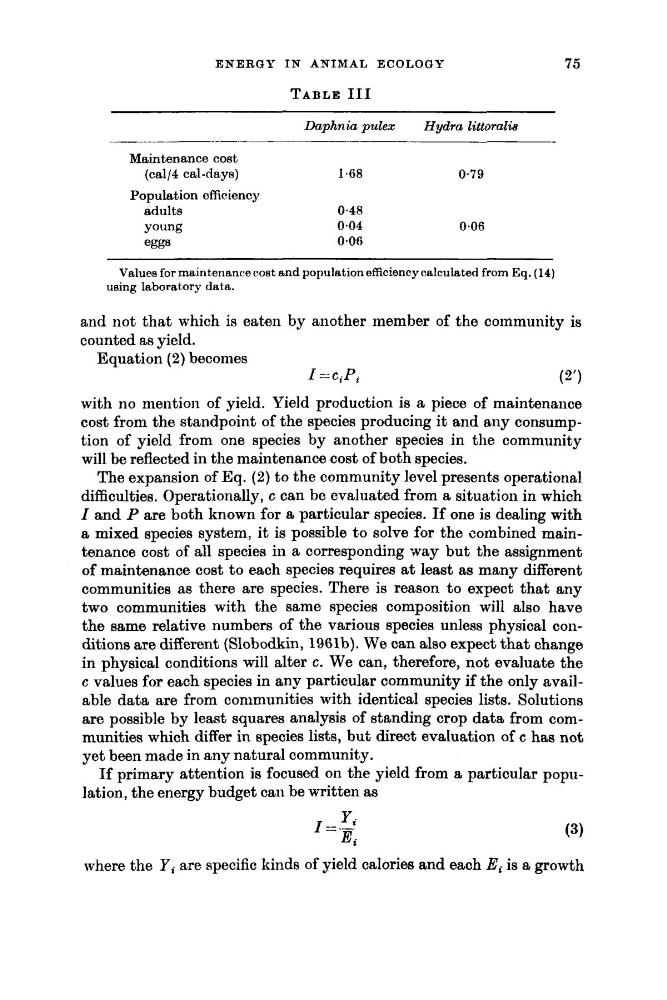
TABLE I11
Daphnia puler
Hydra littoralis
Maintenance cost
(ca1/4 cal-days)
l.G8
0.79
Population efficiency
adults
0.411
YOU%
0.04
0.06
eggs
0.06
Values for maintenanre cost end populationefficiency calculated from Eq. (14)
using laboratory data.
and not that which is eaten by another member of the community is
counted as yield.
Equation (2) becomes
I ===CiPC
(2')
with no mention of yield. Yield production is a piece of maintenance
cost from the standpoint of the species producing it and any consumption of yield from one species by another species in the community
will be reflected in the maintenance cost of both species.
The expansion of Eq. (2) t o the community level presents operational
difficulties. Operationally, c can be evaluated from a situation in which
I and P are both known for a particular species. If one is dealing with
a mixed species system, it is possible t o solve for the combined maintenance cost of all species in a corresponding v a y but the assignment
of maintenance cost t o each species requires at least as many different
communities as there are species. There is reason t o expect that any
two communities with the same species composition will also have
the same relative numbers of the various species unless physical conditions me different (Slobodkin, 196lb). We can also expect that change
in physical conditions will alter c. We can, therefore, not evaluate the
c values for each species in any particular community if the only available data are from conimunities with identical species lists. Solutions
are possible by least squares analysis of standing crop data from communities which differ in species lists, but direct evaluation of c has not
yet been made in any natural community.
If primary attention is focused on the yield from a particular population, the energy budget can be written as
where the Y i are specific kinds of yield calories and each Ei is a growth
75
TABLE I11
Daphnia puler
Hydra littoralis
Maintenance cost
(ca1/4 cal-days)
l.G8
0.79
Population efficiency
adults
0.411
YOU%
0.04
0.06
eggs
0.06
Values for maintenanre cost end populationefficiency calculated from Eq. (14)
using laboratory data.
and not that which is eaten by another member of the community is
counted as yield.
Equation (2) becomes
I ===CiPC
(2')
with no mention of yield. Yield production is a piece of maintenance
cost from the standpoint of the species producing it and any consumption of yield from one species by another species in the community
will be reflected in the maintenance cost of both species.
The expansion of Eq. (2) t o the community level presents operational
difficulties. Operationally, c can be evaluated from a situation in which
I and P are both known for a particular species. If one is dealing with
a mixed species system, it is possible t o solve for the combined maintenance cost of all species in a corresponding v a y but the assignment
of maintenance cost t o each species requires at least as many different
communities as there are species. There is reason t o expect that any
two communities with the same species composition will also have
the same relative numbers of the various species unless physical conditions me different (Slobodkin, 196lb). We can also expect that change
in physical conditions will alter c. We can, therefore, not evaluate the
c values for each species in any particular community if the only available data are from conimunities with identical species lists. Solutions
are possible by least squares analysis of standing crop data from communities which differ in species lists, but direct evaluation of c has not
yet been made in any natural community.
If primary attention is focused on the yield from a particular population, the energy budget can be written as
where the Y i are specific kinds of yield calories and each Ei is a growth