

74
L. B. SLOBODKIN
of both numerator and denominator are the same can two efficiencies
be legitimately compared.
There are three equations that have been commonly used t o represent the energy budget of populations. They all meet the requirements
of energy conservation but they differ seriously in emphasis and the
translation between them might well be made explicit.
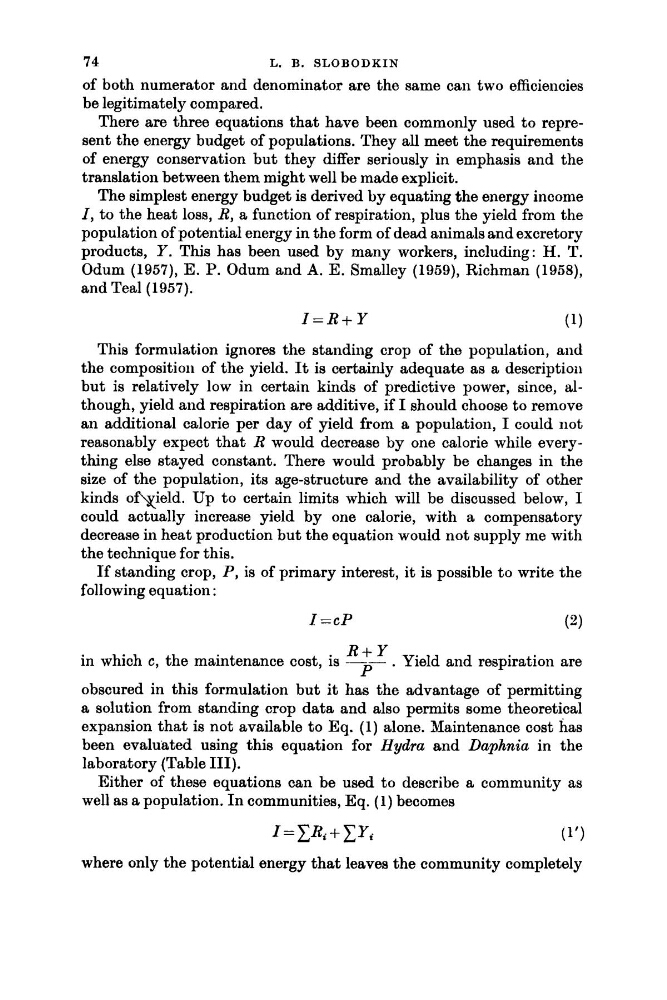
The simplest energy budget is derived by equating the energy income
I , to the heat loss, R, a function of respiration, plus the yield from the
population of potential energy in the form of dead animals and excretory
products, Y . This has been used by many workers, including: H. T.
Odum (1957), E. P. Odum and A. E. Smalley (1959), Richman (1958),
and Teal (1957).
I = R + Y
(1)
This formulation ignores the standing crop of the population, and
the composition of the yield. It is certainly adequate as a description
but is relatively low in certain kinds of predictive power, since, although, yield and respiration are additive, if I should choose t o remove
an additional calorie per day of yield from a population, I could not
reasonably expect that R would decrease by one calorie while everything else stayed constant. There would probably be changes in t.he
size of the population, its age-structure and the availability of other
kinds obield. Up t o certain limits which will be discussed below, I
could actually increase yield by one calorie, with a compensatory
decrease in heat production but the equation would not supply me with
the technique for this.
If standing crop, P , is of primary interest, it is possible t o write the
following equation :
I =cP
(2)
R + Y
P
in which c, the maintenance cost, is -- . Yield and respiration are
obscured in this formulation but it has the advantage of permitting
a solution from standing crop data and also permits some theoretical
expansion that is not available to Eq. (1) alone. Maintenance cost has
been evaluated using this equation for Hydra and Daphnia in the
laboratory (Table 111).
Either of these equations can be used t o describe a community as
well as a population. In communities, Eq. (1) becomes
I = CR, + C Y i
where only the potential energy that leaves the community completely
L. B. SLOBODKIN
of both numerator and denominator are the same can two efficiencies
be legitimately compared.
There are three equations that have been commonly used t o represent the energy budget of populations. They all meet the requirements
of energy conservation but they differ seriously in emphasis and the
translation between them might well be made explicit.
The simplest energy budget is derived by equating the energy income
I , to the heat loss, R, a function of respiration, plus the yield from the
population of potential energy in the form of dead animals and excretory
products, Y . This has been used by many workers, including: H. T.
Odum (1957), E. P. Odum and A. E. Smalley (1959), Richman (1958),
and Teal (1957).
I = R + Y
(1)
This formulation ignores the standing crop of the population, and
the composition of the yield. It is certainly adequate as a description
but is relatively low in certain kinds of predictive power, since, although, yield and respiration are additive, if I should choose t o remove
an additional calorie per day of yield from a population, I could not
reasonably expect that R would decrease by one calorie while everything else stayed constant. There would probably be changes in t.he
size of the population, its age-structure and the availability of other
kinds obield. Up t o certain limits which will be discussed below, I
could actually increase yield by one calorie, with a compensatory
decrease in heat production but the equation would not supply me with
the technique for this.
If standing crop, P , is of primary interest, it is possible t o write the
following equation :
I =cP
(2)
R + Y
P
in which c, the maintenance cost, is -- . Yield and respiration are
obscured in this formulation but it has the advantage of permitting
a solution from standing crop data and also permits some theoretical
expansion that is not available to Eq. (1) alone. Maintenance cost has
been evaluated using this equation for Hydra and Daphnia in the
laboratory (Table 111).
Either of these equations can be used t o describe a community as
well as a population. In communities, Eq. (1) becomes
I = CR, + C Y i
where only the potential energy that leaves the community completely