

4
A. MACFADYEN
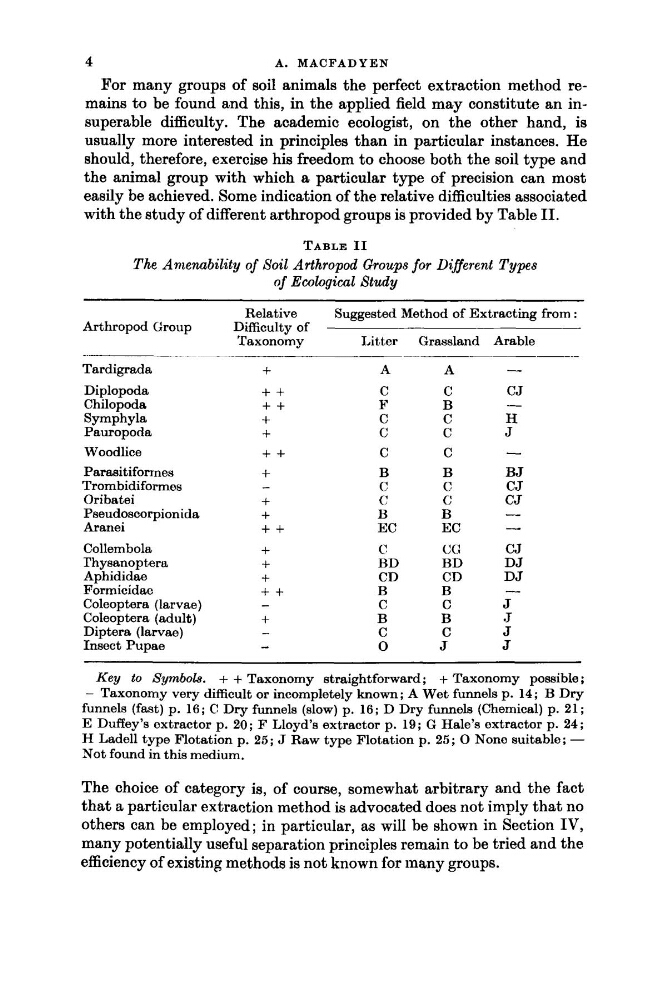
For many groups of soil animals the perfect extraction method remains to be found and this, in the applied field may constitute an insuperable difficulty. The academic ecologist, on the other hand, is
usually more interested in principles than in particular instances. He
should, therefore, exercise his freedom to choose both the soil type and
the animal group with which a particular type of precision can most
easily be achieved. Some indication of the relative difficulties associated
with the study of different arthropod groups is provided by Table 11.
TABLE I1
The Amenability of Soil Arthropod Groups for Different Types
of Ecological Study
Relative
Suggested Method of Extracting from :
Arthropod Group
Difficulty of
Taxonomy
Lit,ter Grassland Arable
-
Tardigrada
+
A
A
Chilopoda
+ +
F
B
SymPhYla
+
C
C
H
Pauropoda
+
c:
c
J
Woodlice
+ +
C
C
Parasitiformes
+
B
B
BJ
Trombidiformes
-
c
c
C J
Oribatei
+
c
c
C J
Pseudoscorpionida
+
B
B
Aranei
+ +
EC
EC
-Collembola
+
c?
c: G
CJ
Thysanoptera
+
BD
BD
DJ
Aphididae
+
CD
CD
D J
Formicidee
+ +
B
B
Coleoptera (larvae)
-
C
C
J
Coleoptera (adult)
+
B
B
J
Diptera (larvae)
-
C
C
J
Insect Pupae
-
0
J
J
Diplopoda
+ +
C
C
C J
-
-
-
-
K e y to Symbols. + + Taxonomy straightforward; + Taxonomy possible;
- Taxonomy very difficult or incompletely known; A Wet funnels p. 14; B Dry
funnels (fast) p. 16; C Dry funnels (slow) p. 16; D Dry funnels (Chemical) p. 21;
E Duffey’s extractor p. 20; F Lloyd’s extractor p. 19; G Hale’s extractor p. 24;
H Ladell type Flotation p. 25; J Raw type Flotation p. 25; 0 None suitable; -
Not found in this medium.
The choice of category is, of course, somewhat arbitrary and the fact
that a particular extraction method is advocated does not imply that no
others can be employed; in particular, as will be shown in Section IV,
many potentially useful separation principles remain to be tried and the
efficiency of existing methods is not known for inany groups.
A. MACFADYEN
For many groups of soil animals the perfect extraction method remains to be found and this, in the applied field may constitute an insuperable difficulty. The academic ecologist, on the other hand, is
usually more interested in principles than in particular instances. He
should, therefore, exercise his freedom to choose both the soil type and
the animal group with which a particular type of precision can most
easily be achieved. Some indication of the relative difficulties associated
with the study of different arthropod groups is provided by Table 11.
TABLE I1
The Amenability of Soil Arthropod Groups for Different Types
of Ecological Study
Relative
Suggested Method of Extracting from :
Arthropod Group
Difficulty of
Taxonomy
Lit,ter Grassland Arable
-
Tardigrada
+
A
A
Chilopoda
+ +
F
B
SymPhYla
+
C
C
H
Pauropoda
+
c:
c
J
Woodlice
+ +
C
C
Parasitiformes
+
B
B
BJ
Trombidiformes
-
c
c
C J
Oribatei
+
c
c
C J
Pseudoscorpionida
+
B
B
Aranei
+ +
EC
EC
-Collembola
+
c?
c: G
CJ
Thysanoptera
+
BD
BD
DJ
Aphididae
+
CD
CD
D J
Formicidee
+ +
B
B
Coleoptera (larvae)
-
C
C
J
Coleoptera (adult)
+
B
B
J
Diptera (larvae)
-
C
C
J
Insect Pupae
-
0
J
J
Diplopoda
+ +
C
C
C J
-
-
-
-
K e y to Symbols. + + Taxonomy straightforward; + Taxonomy possible;
- Taxonomy very difficult or incompletely known; A Wet funnels p. 14; B Dry
funnels (fast) p. 16; C Dry funnels (slow) p. 16; D Dry funnels (Chemical) p. 21;
E Duffey’s extractor p. 20; F Lloyd’s extractor p. 19; G Hale’s extractor p. 24;
H Ladell type Flotation p. 25; J Raw type Flotation p. 25; 0 None suitable; -
Not found in this medium.
The choice of category is, of course, somewhat arbitrary and the fact
that a particular extraction method is advocated does not imply that no
others can be employed; in particular, as will be shown in Section IV,
many potentially useful separation principles remain to be tried and the
efficiency of existing methods is not known for inany groups.