

SOIL A R T H R O P O D S A M P L I N G
5
111. THE DESIGN A N D EXECUTION O F A SI-RVEP
8 . S T A T I S T I C A L A S P E C T S
The main objective when planning a soil survey should surely be
to obtain the required information with a minimum of labour. To
achieve this, experiments must be devised in such a way that clear-cut
hypotheses are tested and the right number of sample-units is used in
relation to the desired degree of accuracy. Both these requirements are
usually difficult to meet in practice. In community work one cannot
know beforehand which species will occur in a given locality nor how
abundant the critical species will be. The number of replicates required
to show significant differences is also unpredictable because it depends
on total density and on the patchiness of distribution of the animals. In
the case of laboratory-based surveys it is possible to carry out a preliminary survey and to obtain rough estimates of density and patchiness
on which a rational sampling scheme can be based, but under expedition
conditions when the survey is of limited duration there is usually no
option but to fix the number of sample-units in the light of previous
experience or to take as many sample-units as possible consistent with
the labour available. Even here a choice between taking many small or
fewer large samples must be made.
When a preliminary survey is possible the mean number ?n and its
standard errors can be calculated in the normal way (see, e.g. Snedecor,
1946). Some idea of the number of samples required in order to achieve
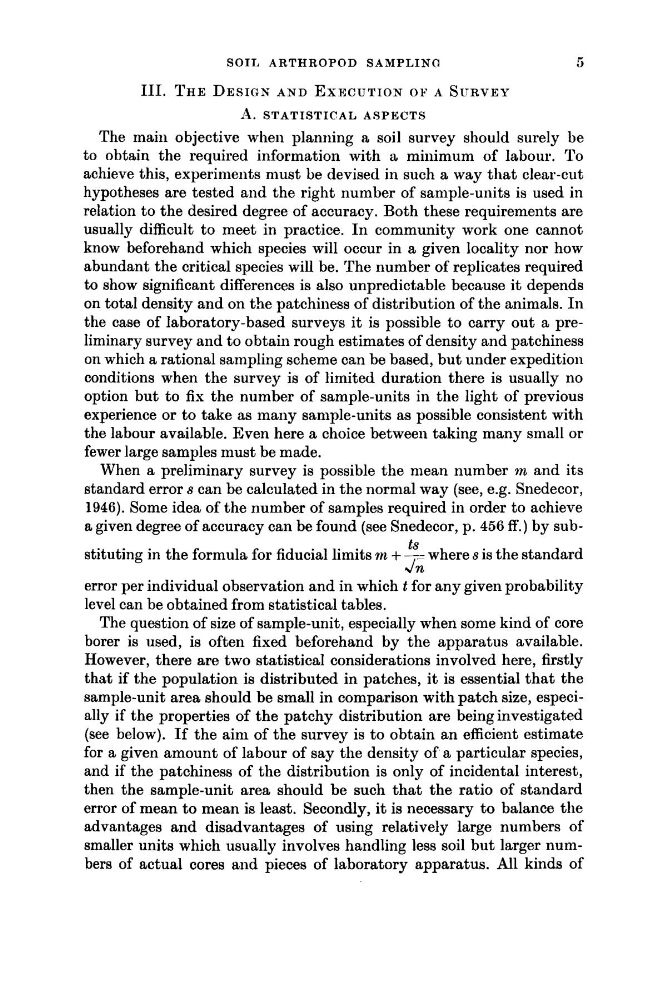
a given degree of accuracy can be found (see Snedecor, p. 456 ff.) by substituting in the formula for fiducial limits nt + - where s is the standard
error per individual observation and in which t for any given probability
level can be obtained from statistical tables.
The question of size of sample-unit, especially when some kind of core
borer is used, is often fixed beforehand by the apparatus available.
However, there are two statistical considerations involved here, firstly
that if the population is distributed in patches, it is essential that the
sample-unit area should be small in comparison with patch size, especially if the properties of the patchy distribution are being investigated
(see below). If the aim of the survey is to obtain an efficient estimate
for a given amount of labour of say the density of a particular species,
and if the patchiness of the distribution is only of incidental interest,
then the sample-unit area should be such that the ratio of standard
error of mean to mean is least. Secondly, it is necessary to balance the
advantages and disadvantages of using relatively large numbers of
smaller units which usually involves handling less soil but larger numbers of actual cores and pieces of laboratory apparatus. All kinds of
ts
J i
5
111. THE DESIGN A N D EXECUTION O F A SI-RVEP
8 . S T A T I S T I C A L A S P E C T S
The main objective when planning a soil survey should surely be
to obtain the required information with a minimum of labour. To
achieve this, experiments must be devised in such a way that clear-cut
hypotheses are tested and the right number of sample-units is used in
relation to the desired degree of accuracy. Both these requirements are
usually difficult to meet in practice. In community work one cannot
know beforehand which species will occur in a given locality nor how
abundant the critical species will be. The number of replicates required
to show significant differences is also unpredictable because it depends
on total density and on the patchiness of distribution of the animals. In
the case of laboratory-based surveys it is possible to carry out a preliminary survey and to obtain rough estimates of density and patchiness
on which a rational sampling scheme can be based, but under expedition
conditions when the survey is of limited duration there is usually no
option but to fix the number of sample-units in the light of previous
experience or to take as many sample-units as possible consistent with
the labour available. Even here a choice between taking many small or
fewer large samples must be made.
When a preliminary survey is possible the mean number ?n and its
standard errors can be calculated in the normal way (see, e.g. Snedecor,
1946). Some idea of the number of samples required in order to achieve
a given degree of accuracy can be found (see Snedecor, p. 456 ff.) by substituting in the formula for fiducial limits nt + - where s is the standard
error per individual observation and in which t for any given probability
level can be obtained from statistical tables.
The question of size of sample-unit, especially when some kind of core
borer is used, is often fixed beforehand by the apparatus available.
However, there are two statistical considerations involved here, firstly
that if the population is distributed in patches, it is essential that the
sample-unit area should be small in comparison with patch size, especially if the properties of the patchy distribution are being investigated
(see below). If the aim of the survey is to obtain an efficient estimate
for a given amount of labour of say the density of a particular species,
and if the patchiness of the distribution is only of incidental interest,
then the sample-unit area should be such that the ratio of standard
error of mean to mean is least. Secondly, it is necessary to balance the
advantages and disadvantages of using relatively large numbers of
smaller units which usually involves handling less soil but larger numbers of actual cores and pieces of laboratory apparatus. All kinds of
ts
J i