

SOIL ARTHROPOD SAMPLING
3
species is misidentified. On the other hand the trophic study may involve a wider range of taxonomic work because predators and competitors of different natural phyla cannot be excluded. Further, sampling
accuracy is usually more important and sampling difficulties are greater
because methods must give accurate information about ecologically related species regardless of taxonomic proximity. Again, the whole purpose of many trophic studies is the establishment of absolute abundance
figures and this frequently includes an analysis of age structure as well.
This is not to say that the community-type study lacks sampling problems. Most soil extraction methods operate with varying efficiency in
different soils, with the result that quantitative comparisons over a
wide range of soil types may even require the use of a series of different
techniques. Also, the ease with which even quite closely related groups
- for instance chilopods and diplopods or oribatid and parrtsitid mites
can be extracted - varies greatly, so that the use of imperfect extraction methods can seriously upset estimates of their relative abundance.
(Macfadyen, 1953, 1955.) However, when allowance is made for such
effects the fact remains that the community-type survey does not
usually demand that numbers be expressed in terms of absolute abundance on an area or volume basis such as is essential for the trophic
study. This is important because counting the fauna of sample-units is
often the most time-consuming part of ecological studies and if absolute
counts can be dispensed with the ecologist is free to consider alternative
measurements such as records of presence vemw absence and various
types of ranking which will be discussed in the next section. For all these
purposes a reasonably unbiased extraction method applied to a relatively large number of sample-units can provide more information about
community differences in a limited time than a full count of numbers
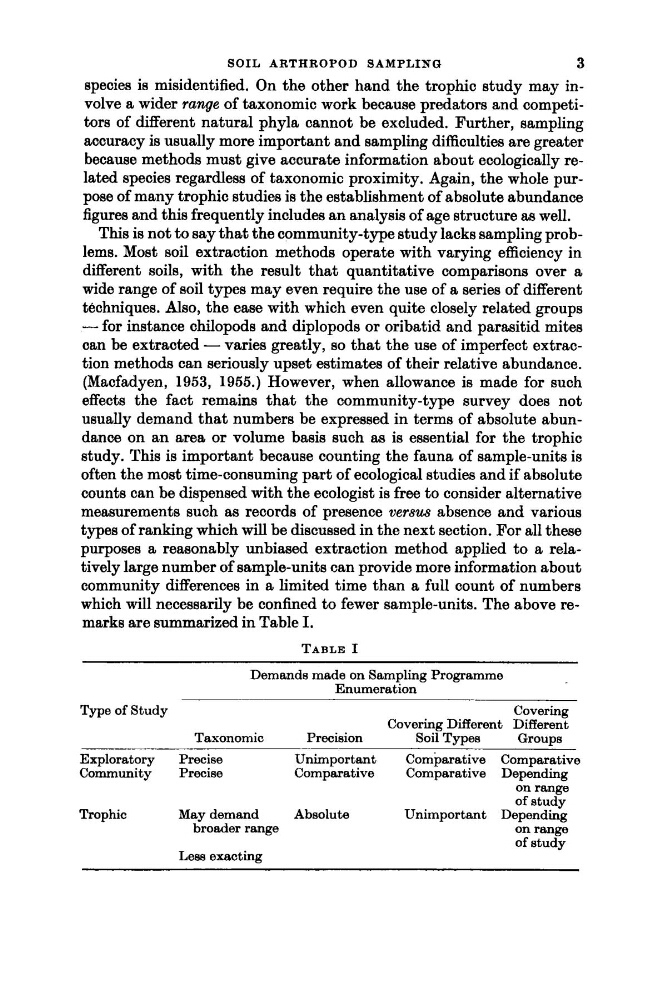
which will necessarily be confined to fewer sample-units. The above remarks are summarized in Table I.
TABLE I
~~
Demands made on Sampling Programme
Enumeration
Type of Study
Taxonomic
Exploratory
Precise
Community
Precise
Trophic
May demand
Less exacting
broader range
Covering
Covering Different Different
Precision
Soil Types
Groups
Unimportant
Comparative Comparative
Comparative
Comparative Depending
on range
of study
Absolute
Unimportant Depending
on range
of study
-~
3
species is misidentified. On the other hand the trophic study may involve a wider range of taxonomic work because predators and competitors of different natural phyla cannot be excluded. Further, sampling
accuracy is usually more important and sampling difficulties are greater
because methods must give accurate information about ecologically related species regardless of taxonomic proximity. Again, the whole purpose of many trophic studies is the establishment of absolute abundance
figures and this frequently includes an analysis of age structure as well.
This is not to say that the community-type study lacks sampling problems. Most soil extraction methods operate with varying efficiency in
different soils, with the result that quantitative comparisons over a
wide range of soil types may even require the use of a series of different
techniques. Also, the ease with which even quite closely related groups
- for instance chilopods and diplopods or oribatid and parrtsitid mites
can be extracted - varies greatly, so that the use of imperfect extraction methods can seriously upset estimates of their relative abundance.
(Macfadyen, 1953, 1955.) However, when allowance is made for such
effects the fact remains that the community-type survey does not
usually demand that numbers be expressed in terms of absolute abundance on an area or volume basis such as is essential for the trophic
study. This is important because counting the fauna of sample-units is
often the most time-consuming part of ecological studies and if absolute
counts can be dispensed with the ecologist is free to consider alternative
measurements such as records of presence vemw absence and various
types of ranking which will be discussed in the next section. For all these
purposes a reasonably unbiased extraction method applied to a relatively large number of sample-units can provide more information about
community differences in a limited time than a full count of numbers
which will necessarily be confined to fewer sample-units. The above remarks are summarized in Table I.
TABLE I
~~
Demands made on Sampling Programme
Enumeration
Type of Study
Taxonomic
Exploratory
Precise
Community
Precise
Trophic
May demand
Less exacting
broader range
Covering
Covering Different Different
Precision
Soil Types
Groups
Unimportant
Comparative Comparative
Comparative
Comparative Depending
on range
of study
Absolute
Unimportant Depending
on range
of study
-~