

68
Ν. G. PON
accumulates gluconate and ketodeoxy gluconate in the ribose medium.
[An independent worker found that cell-free extracts of this type of
bacteria can convert pentose phosphates to glucose phosphate and triose
phosphate (85).] On the other hand, cell-free extracts of the glucosestrain form fructose-6-phosphate and glucose-6-phosphate in the presence
of ribose-5-phosphate or ATP plus ribose-5-phosphate, but not ribose
plus ATP. The parent strain, containing no 6-phosphogluconate dehydrase and no 6-PG DH (85, 440), seems not to be able to catabolize
carbohydrates via the oxidative pentose phosphate cycle and the EntnerDoudoroff route.
XV. Algae
The occurrence of G-6-P DH and 6-PG DH in tissues and organisms
has been used as an indicator for the potential operation of the oxidative
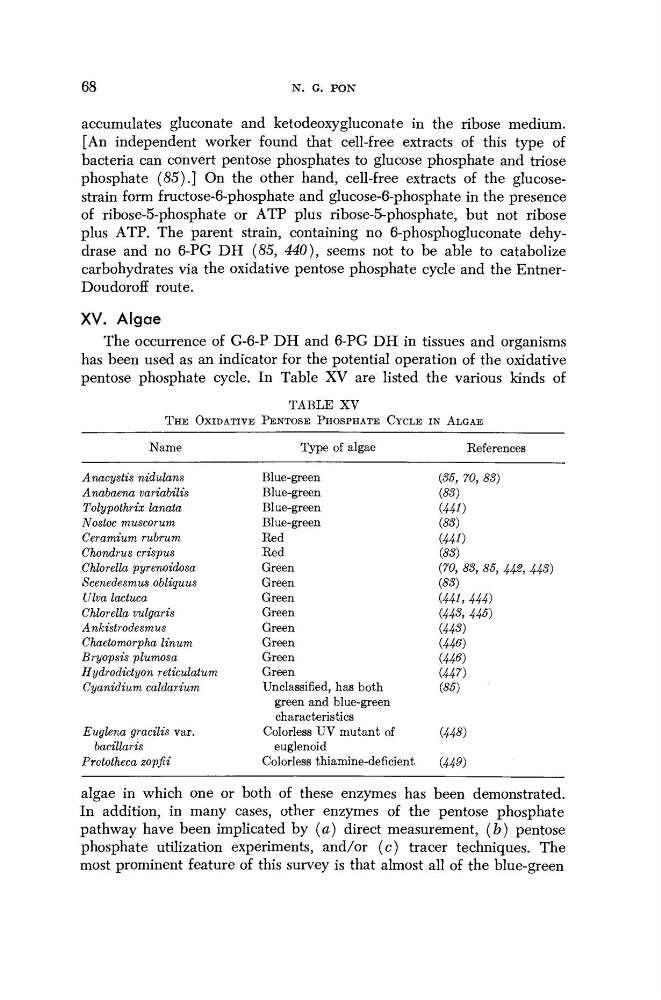
pentose phosphate cycle. In Table XV are listed the various kinds of
TABLE XV
THE OXIDATIVE PENTOSE PHOSPHATE CYCLE IN ALGAE
Name
Type of algae
References
Anacystis nidulans
Blue-green
(35, 70, 83)
Anabaena variabilis
Blue-green
(83)
Tolypothrix lanata
Blue-green
(441)
Nostoc muscorum
Blue-green
(83)
Ceramium rubrum
Red
(44D
Chondrus crispus
Red
(83)
Chlorella pyrenoidosa
Green
(70, 83, 85, 442, 443)
Scenedesmus obliquus
Green
(83)
Viva lactuca
Green
(441, 444)
Chlorella vulgaris
Green
(443, 445)
Ankistrodesmus
Green
(443)
Chaetomorpha linum
Green
(446)
Bryopsis plumosa
Green
(446)
Hydrodictyon reticulatum
Green
(447)
Cyanidium caldarium
Unclassified, has both
(85)
green and blue-green
characteristics
Euglena gracilis var.
Colorless UV mutant of
(448)
bacillaris
euglenoid
Prototheca zopfii
Colorless thiamine-deficient
(449)
algae in which one or both of these enzymes has been demonstrated.
In addition, in many cases, other enzymes of the pentose phosphate
pathway have been implicated by (a) direct measurement, (b) pentose
phosphate utilization experiments, and/or (c) tracer techniques. The
most prominent feature of this survey is that almost all of the blue-green
Ν. G. PON
accumulates gluconate and ketodeoxy gluconate in the ribose medium.
[An independent worker found that cell-free extracts of this type of
bacteria can convert pentose phosphates to glucose phosphate and triose
phosphate (85).] On the other hand, cell-free extracts of the glucosestrain form fructose-6-phosphate and glucose-6-phosphate in the presence
of ribose-5-phosphate or ATP plus ribose-5-phosphate, but not ribose
plus ATP. The parent strain, containing no 6-phosphogluconate dehydrase and no 6-PG DH (85, 440), seems not to be able to catabolize
carbohydrates via the oxidative pentose phosphate cycle and the EntnerDoudoroff route.
XV. Algae
The occurrence of G-6-P DH and 6-PG DH in tissues and organisms
has been used as an indicator for the potential operation of the oxidative
pentose phosphate cycle. In Table XV are listed the various kinds of
TABLE XV
THE OXIDATIVE PENTOSE PHOSPHATE CYCLE IN ALGAE
Name
Type of algae
References
Anacystis nidulans
Blue-green
(35, 70, 83)
Anabaena variabilis
Blue-green
(83)
Tolypothrix lanata
Blue-green
(441)
Nostoc muscorum
Blue-green
(83)
Ceramium rubrum
Red
(44D
Chondrus crispus
Red
(83)
Chlorella pyrenoidosa
Green
(70, 83, 85, 442, 443)
Scenedesmus obliquus
Green
(83)
Viva lactuca
Green
(441, 444)
Chlorella vulgaris
Green
(443, 445)
Ankistrodesmus
Green
(443)
Chaetomorpha linum
Green
(446)
Bryopsis plumosa
Green
(446)
Hydrodictyon reticulatum
Green
(447)
Cyanidium caldarium
Unclassified, has both
(85)
green and blue-green
characteristics
Euglena gracilis var.
Colorless UV mutant of
(448)
bacillaris
euglenoid
Prototheca zopfii
Colorless thiamine-deficient
(449)
algae in which one or both of these enzymes has been demonstrated.
In addition, in many cases, other enzymes of the pentose phosphate
pathway have been implicated by (a) direct measurement, (b) pentose
phosphate utilization experiments, and/or (c) tracer techniques. The
most prominent feature of this survey is that almost all of the blue-green