

1. PENTOSE PHOSPHATE CYCLE
69
algae have high levels of both G-6-P DH and 6-PG DH (83), suggesting
that the major pathway for the dissimilation of hexose might be the
oxidative pentose phosphate cycle. It is noteworthy also that these same
dehydrogenases occur in a red alga Chondrus with very low activities.
It is interesting to note further that the two colorless mutants exhibit
oxidative pentose phosphate activity while a naturally occurring one,
Astasia longa, strain J, metabolizes glucose solely via glycolysis
(450).
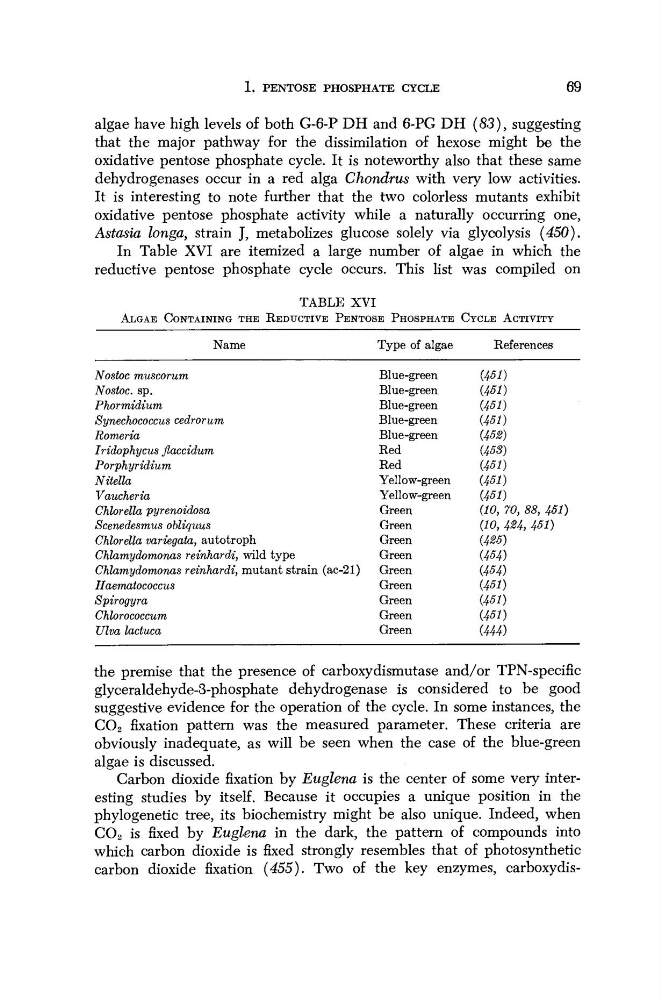
In Table XVI are itemized a large number of algae in which the
reductive pentose phosphate cycle occurs. This list was compiled on
TABLE XVI
ALGAE CONTAINING THE REDUCTIVE PENTOSE PHOSPHATE CYCLE ACTIVITY
Name
Type of algae
References
Nostoc muscorum
Blue-green
(451)
Nostoc. sp.
Blue-green
(451)
Phormidium
Blue-green
(451)
Synechococcus cedrorum
Blue-green
(451)
Romeria
Blue-green
(452)
Iridophycus flaccidum
Red
(453)
Porphyridium
Red
(451)
Nitella
Yellow-green
(451)
Vaucheria
Yellow-green
(451)
Chlorella pyrenoidosa
Green
(10, 70, 88, 451)
Scenedesmiis obliquus
Green
(10, 424, 451)
Chlorella variegata, autotroph
Green
(425)
Chlamydomonas reinhardi, wild type
Green
(454)
Chlamydomonas reinhardi, mutant strain (ac-21) Green
(454)
Haematococcus
Green
(451)
Spirogyra
Green
(451)
Chlorococcum
Green
(451)
Ulva lactuca
Green
(444)
the premise that the presence of carboxydismutase and/or TPN-specific
glyceraldehyde-3-phosphate dehydrogenase is considered to be good
suggestive evidence for the operation of the cycle. In some instances, the
C0 2 fixation pattern was the measured parameter. These criteria are
obviously inadequate, as will be seen when the case of the blue-green
algae is discussed.
Carbon dioxide fixation by Euglena is the center of some very interesting studies by itself. Because it occupies a unique position in the
phylogenetic tree, its biochemistry might be also unique. Indeed, when
C0 2 is fixed by Euglena in the dark, the pattern of compounds into
which carbon dioxide is fixed strongly resembles that of photosynthetic
carbon dioxide fixation (455). Two of the key enzymes, carboxydis-
69
algae have high levels of both G-6-P DH and 6-PG DH (83), suggesting
that the major pathway for the dissimilation of hexose might be the
oxidative pentose phosphate cycle. It is noteworthy also that these same
dehydrogenases occur in a red alga Chondrus with very low activities.
It is interesting to note further that the two colorless mutants exhibit
oxidative pentose phosphate activity while a naturally occurring one,
Astasia longa, strain J, metabolizes glucose solely via glycolysis
(450).
In Table XVI are itemized a large number of algae in which the
reductive pentose phosphate cycle occurs. This list was compiled on
TABLE XVI
ALGAE CONTAINING THE REDUCTIVE PENTOSE PHOSPHATE CYCLE ACTIVITY
Name
Type of algae
References
Nostoc muscorum
Blue-green
(451)
Nostoc. sp.
Blue-green
(451)
Phormidium
Blue-green
(451)
Synechococcus cedrorum
Blue-green
(451)
Romeria
Blue-green
(452)
Iridophycus flaccidum
Red
(453)
Porphyridium
Red
(451)
Nitella
Yellow-green
(451)
Vaucheria
Yellow-green
(451)
Chlorella pyrenoidosa
Green
(10, 70, 88, 451)
Scenedesmiis obliquus
Green
(10, 424, 451)
Chlorella variegata, autotroph
Green
(425)
Chlamydomonas reinhardi, wild type
Green
(454)
Chlamydomonas reinhardi, mutant strain (ac-21) Green
(454)
Haematococcus
Green
(451)
Spirogyra
Green
(451)
Chlorococcum
Green
(451)
Ulva lactuca
Green
(444)
the premise that the presence of carboxydismutase and/or TPN-specific
glyceraldehyde-3-phosphate dehydrogenase is considered to be good
suggestive evidence for the operation of the cycle. In some instances, the
C0 2 fixation pattern was the measured parameter. These criteria are
obviously inadequate, as will be seen when the case of the blue-green
algae is discussed.
Carbon dioxide fixation by Euglena is the center of some very interesting studies by itself. Because it occupies a unique position in the
phylogenetic tree, its biochemistry might be also unique. Indeed, when
C0 2 is fixed by Euglena in the dark, the pattern of compounds into
which carbon dioxide is fixed strongly resembles that of photosynthetic
carbon dioxide fixation (455). Two of the key enzymes, carboxydis-