

1. PENTOSE PHOSPHATE CYCLE
67
mutase whereas the organism is rich in this enzyme when grown photoheterotrophically in malate-glutamate medium under anaerobic conditions (438). The same conditions also apply for R. palustris in order to
obtain maximum carboxydismutase activity. Although the C0 2 fixation
rate by R. capsulatum in the light is about ten times the rate of fixation
in the dark, photoreduction still functions in the dark (439). Other
enzymes besides carboxydismutase were found in cell-free extracts of
Chlorobium and Chromatium. These include transketolase, transaldolase,
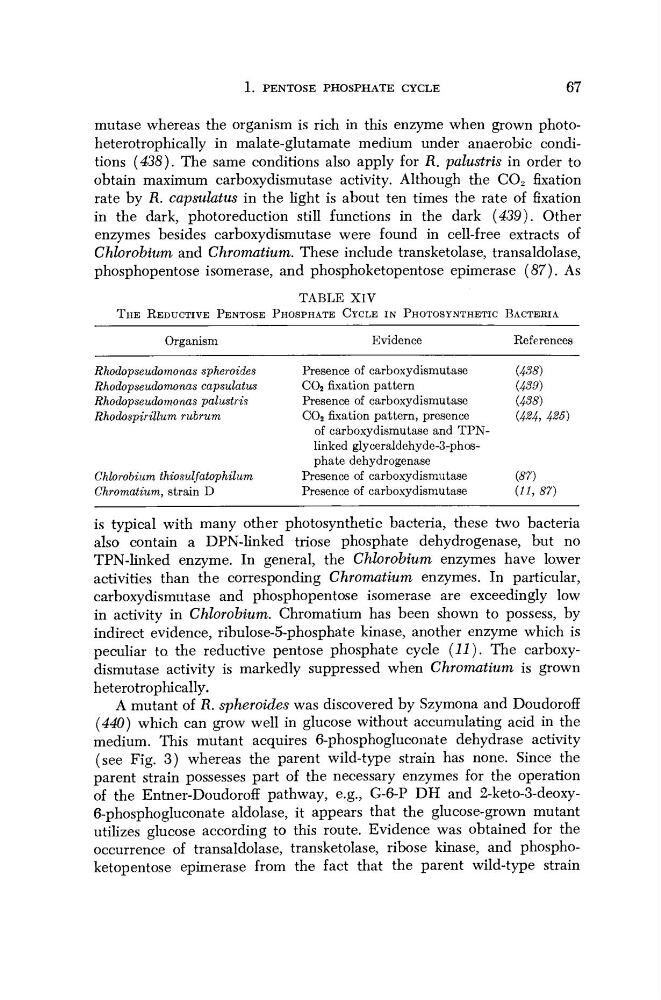
phosphopentose isomerase, and phosphoketopentose epimerase (87). As
TABLE XIV
THE REDUCTIVE PENTOSE PHOSPHATE CYCLE IN PHOTOSYNTHETIC BACTERIA
Organism
Evidence
References
Rhodopseudomonas spheroides
Presence of carboxydismutase
(438)
Rhodopseudomonas capsulatus
CO2 fixation pattern
(439)
Rhodopseudomonas palustris
Presence of carboxydismutase
(438)
Rhodospirülum rubrum
CO2 fixation pattern, presence
(424, 425)
of carboxydismutase and TPNlinked glyceraldehyde-3-phosphate dehydrogenase
Chlorobium thiosulfatophilum
Presence of carboxydismutase
(87)
Chromatium, strain D
Presence of carboxydismutase
(11, 87)
is typical with many other photosynthetic bacteria, these two bacteria
also contain a DPN-linked triose phosphate dehydrogenase, but no
TPN-linked enzyme. In general, the Chlorobium enzymes have lower
activities than the corresponding Chromatium enzymes. In particular,
carboxydismutase and phosphopentose isomerase are exceedingly low
in activity in Chlorobium. Chromatium has been shown to possess, by
indirect evidence, ribulose-5-phosphate kinase, another enzyme which is
peculiar to. the reductive pentose phosphate cycle (11). The carboxydismutase activity is markedly suppressed when Chromatium is grown
heterotrophically.
A mutant of R. spheroides was discovered by Szymona and Doudoroff
(440) which can grow well in glucose without accumulating acid in the
medium. This mutant acquires 6-phosphogluconate dehydrase activity
(see Fig. 3) whereas the parent wild-type strain has none. Since the
parent strain possesses part of the necessary enzymes for the operation
of the Entner-Doudoroff pathway, e.g., G-6-P DH and 2-keto-3-deoxy6-phosphogluconate aldolase, it appears that the glucose-grown mutant
utilizes glucose according to this route. Evidence was obtained for the
occurrence of transaldolase, transketolase, ribose kinase, and phosphoketopentose epimerase from the fact that the parent wild-type strain
67
mutase whereas the organism is rich in this enzyme when grown photoheterotrophically in malate-glutamate medium under anaerobic conditions (438). The same conditions also apply for R. palustris in order to
obtain maximum carboxydismutase activity. Although the C0 2 fixation
rate by R. capsulatum in the light is about ten times the rate of fixation
in the dark, photoreduction still functions in the dark (439). Other
enzymes besides carboxydismutase were found in cell-free extracts of
Chlorobium and Chromatium. These include transketolase, transaldolase,
phosphopentose isomerase, and phosphoketopentose epimerase (87). As
TABLE XIV
THE REDUCTIVE PENTOSE PHOSPHATE CYCLE IN PHOTOSYNTHETIC BACTERIA
Organism
Evidence
References
Rhodopseudomonas spheroides
Presence of carboxydismutase
(438)
Rhodopseudomonas capsulatus
CO2 fixation pattern
(439)
Rhodopseudomonas palustris
Presence of carboxydismutase
(438)
Rhodospirülum rubrum
CO2 fixation pattern, presence
(424, 425)
of carboxydismutase and TPNlinked glyceraldehyde-3-phosphate dehydrogenase
Chlorobium thiosulfatophilum
Presence of carboxydismutase
(87)
Chromatium, strain D
Presence of carboxydismutase
(11, 87)
is typical with many other photosynthetic bacteria, these two bacteria
also contain a DPN-linked triose phosphate dehydrogenase, but no
TPN-linked enzyme. In general, the Chlorobium enzymes have lower
activities than the corresponding Chromatium enzymes. In particular,
carboxydismutase and phosphopentose isomerase are exceedingly low
in activity in Chlorobium. Chromatium has been shown to possess, by
indirect evidence, ribulose-5-phosphate kinase, another enzyme which is
peculiar to. the reductive pentose phosphate cycle (11). The carboxydismutase activity is markedly suppressed when Chromatium is grown
heterotrophically.
A mutant of R. spheroides was discovered by Szymona and Doudoroff
(440) which can grow well in glucose without accumulating acid in the
medium. This mutant acquires 6-phosphogluconate dehydrase activity
(see Fig. 3) whereas the parent wild-type strain has none. Since the
parent strain possesses part of the necessary enzymes for the operation
of the Entner-Doudoroff pathway, e.g., G-6-P DH and 2-keto-3-deoxy6-phosphogluconate aldolase, it appears that the glucose-grown mutant
utilizes glucose according to this route. Evidence was obtained for the
occurrence of transaldolase, transketolase, ribose kinase, and phosphoketopentose epimerase from the fact that the parent wild-type strain