

66
Ν. G. PON
phosphate cycle is operative. The assay was generally for carboxydismutase activity, usually by determining the C0 2 fixed in the presence of
ribulose-l,5-diphosphate or in the presence of ribose-5-phosphate plus
ATP. The products were examined chromatographically, in some cases.
In this regard Quayle (424) has raised an objection to the interpretation
of the data obtained in the experiment with E. coli grown on pentose on
the grounds that the amount of radioactive 3-phosphoglycerate formed
from HC
14 0 3 ~ and ribulose diphosphate is less than 10% of the total
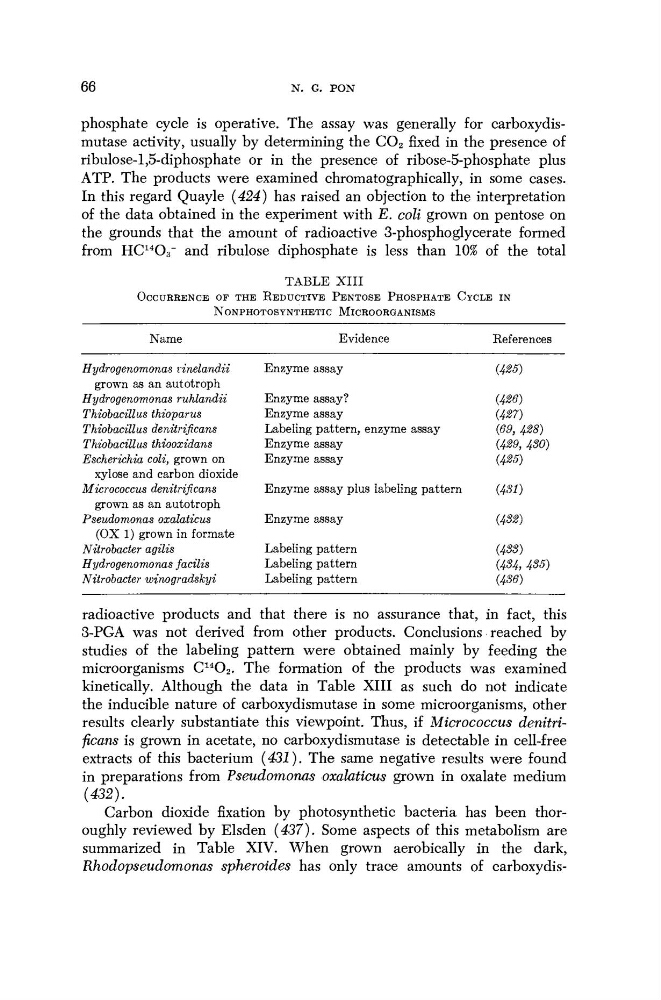
TABLE XIII
OCCURRENCE OF THE REDUCTIVE PENTOSE PHOSPHATE CYCLE IN
NONPHOTOSYNTHETIC MICROORGANISMS
Name
Evidence
References
Hydrogenomonas vinelandii
Enzyme assay
(425)
grown as an autotroph
Hydrogenomonas ruhlandii
Enzyme assay?
(426)
Thiobacillus thioparus
Enzyme assay
(4*7)
Thiobacillus denitrificans
Labeling pattern, enzyme assay
(69, 428)
Thiobacillus thiooxidans
Enzyme assay
(429, 480)
Escherichia colt, grown on
Enzyme assay
(425)
xylose and carbon dioxide
Micrococcus denitrificans
Enzyme assay plus labeling pattern
(4SI)
grown as an autotroph
Pseudomonas oxalaticus
Enzyme assay
(432)
(OX 1) grown in formate
Nitrobacter agilis
Labeling pattern
(433)
Hydrogenomonas facilis
Labeling pattern
(434, 435)
Nitrobacter winogradskyi
Labeling pattern
(436)
radioactive products and that there is no assurance that, in fact, this
3-PGA was not derived from other products. Conclusions reached by
studies of the labeling pattern were obtained mainly by feeding the
microorganisms C
1 4 0 2 . The formation of the products was examined
kinetically. Although the data in Table XIII as such do not indicate
the inducible nature of carboxydismutase in some microorganisms, other
results clearly substantiate this viewpoint. Thus, if Micrococcus denitrificans is grown in acetate, no carboxydismutase is detectable in cell-free
extracts of this bacterium (431). The same negative results were found
in preparations from Pseudomonas oxahticus grown in oxalate medium
(432).
Carbon dioxide fixation by photosynthetic bacteria has been thoroughly reviewed by Elsden (437). Some aspects of this metabolism are
summarized in Table XIV. When grown aerobically in the dark,
Rhodopseudomonas spheroides has only trace amounts of carboxydis-
Ν. G. PON
phosphate cycle is operative. The assay was generally for carboxydismutase activity, usually by determining the C0 2 fixed in the presence of
ribulose-l,5-diphosphate or in the presence of ribose-5-phosphate plus
ATP. The products were examined chromatographically, in some cases.
In this regard Quayle (424) has raised an objection to the interpretation
of the data obtained in the experiment with E. coli grown on pentose on
the grounds that the amount of radioactive 3-phosphoglycerate formed
from HC
14 0 3 ~ and ribulose diphosphate is less than 10% of the total
TABLE XIII
OCCURRENCE OF THE REDUCTIVE PENTOSE PHOSPHATE CYCLE IN
NONPHOTOSYNTHETIC MICROORGANISMS
Name
Evidence
References
Hydrogenomonas vinelandii
Enzyme assay
(425)
grown as an autotroph
Hydrogenomonas ruhlandii
Enzyme assay?
(426)
Thiobacillus thioparus
Enzyme assay
(4*7)
Thiobacillus denitrificans
Labeling pattern, enzyme assay
(69, 428)
Thiobacillus thiooxidans
Enzyme assay
(429, 480)
Escherichia colt, grown on
Enzyme assay
(425)
xylose and carbon dioxide
Micrococcus denitrificans
Enzyme assay plus labeling pattern
(4SI)
grown as an autotroph
Pseudomonas oxalaticus
Enzyme assay
(432)
(OX 1) grown in formate
Nitrobacter agilis
Labeling pattern
(433)
Hydrogenomonas facilis
Labeling pattern
(434, 435)
Nitrobacter winogradskyi
Labeling pattern
(436)
radioactive products and that there is no assurance that, in fact, this
3-PGA was not derived from other products. Conclusions reached by
studies of the labeling pattern were obtained mainly by feeding the
microorganisms C
1 4 0 2 . The formation of the products was examined
kinetically. Although the data in Table XIII as such do not indicate
the inducible nature of carboxydismutase in some microorganisms, other
results clearly substantiate this viewpoint. Thus, if Micrococcus denitrificans is grown in acetate, no carboxydismutase is detectable in cell-free
extracts of this bacterium (431). The same negative results were found
in preparations from Pseudomonas oxahticus grown in oxalate medium
(432).
Carbon dioxide fixation by photosynthetic bacteria has been thoroughly reviewed by Elsden (437). Some aspects of this metabolism are
summarized in Table XIV. When grown aerobically in the dark,
Rhodopseudomonas spheroides has only trace amounts of carboxydis-