

5. ANTIBIOSIS AND ANTIBIOTICS
329
Citromycetin
Fuscin
(CLn)
(CLm)
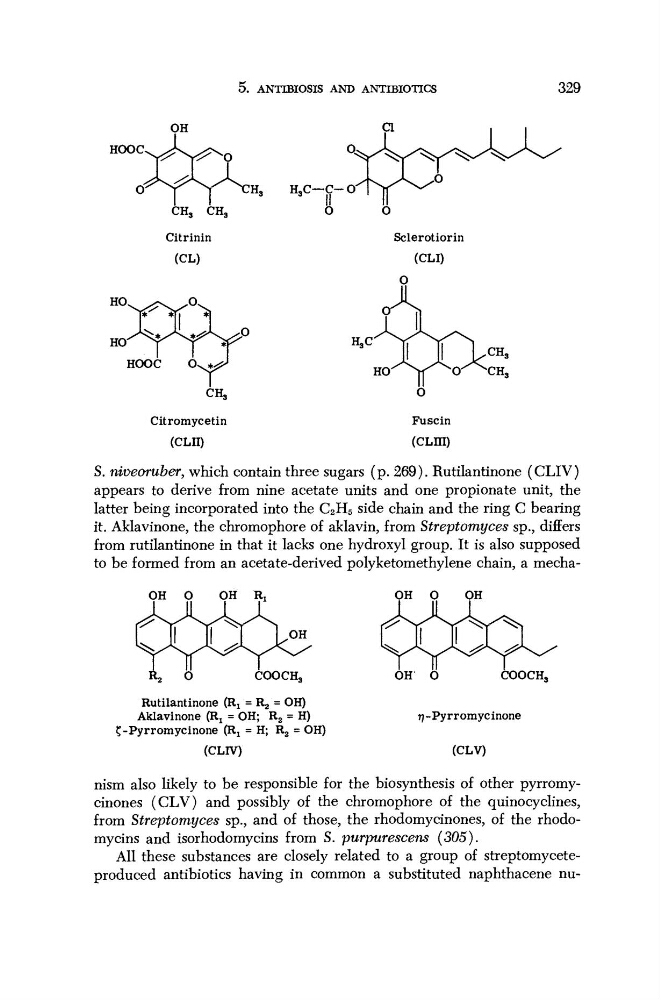
S. niveoruber, which contain three sugars (p. 269). Rutilantinone (CLIV)
appears to derive from nine acetate units and one propionate unit, the
latter being incorporated into the C 2 H 5 side chain and the ring C bearing
it. Aklavinone, the chromophore of aklavin, from Streptomyces sp., differs
from rutilantinone in that it lacks one hydroxyl group. It is also supposed
to be formed from an acetate-derived polyketomethylene chain, a mechaRutilantinone (R A = R 2 = OH)
Aklavinone (R x = OH; R 2 = H)
77-Pyrromycinone
ζ-Pyrromycinone (R x = H; R 2 = OH)
(CLIV)
(CLV)
nism also likely to be responsible for the biosynthesis of other pyrromycinones (CLV) and possibly of the chromophore of the quinocyclines,
from Streptomyces sp., and of those, the rhodomycinones, of the rhodomycins and isorhodomycins from S. purpurescens
(305).
All these substances are closely related to a group of streptomyceteproduced antibiotics having in common a substituted naphthacene nu-
329
Citromycetin
Fuscin
(CLn)
(CLm)
S. niveoruber, which contain three sugars (p. 269). Rutilantinone (CLIV)
appears to derive from nine acetate units and one propionate unit, the
latter being incorporated into the C 2 H 5 side chain and the ring C bearing
it. Aklavinone, the chromophore of aklavin, from Streptomyces sp., differs
from rutilantinone in that it lacks one hydroxyl group. It is also supposed
to be formed from an acetate-derived polyketomethylene chain, a mechaRutilantinone (R A = R 2 = OH)
Aklavinone (R x = OH; R 2 = H)
77-Pyrromycinone
ζ-Pyrromycinone (R x = H; R 2 = OH)
(CLIV)
(CLV)
nism also likely to be responsible for the biosynthesis of other pyrromycinones (CLV) and possibly of the chromophore of the quinocyclines,
from Streptomyces sp., and of those, the rhodomycinones, of the rhodomycins and isorhodomycins from S. purpurescens
(305).
All these substances are closely related to a group of streptomyceteproduced antibiotics having in common a substituted naphthacene nu-