

328
MAURICE WELSCH
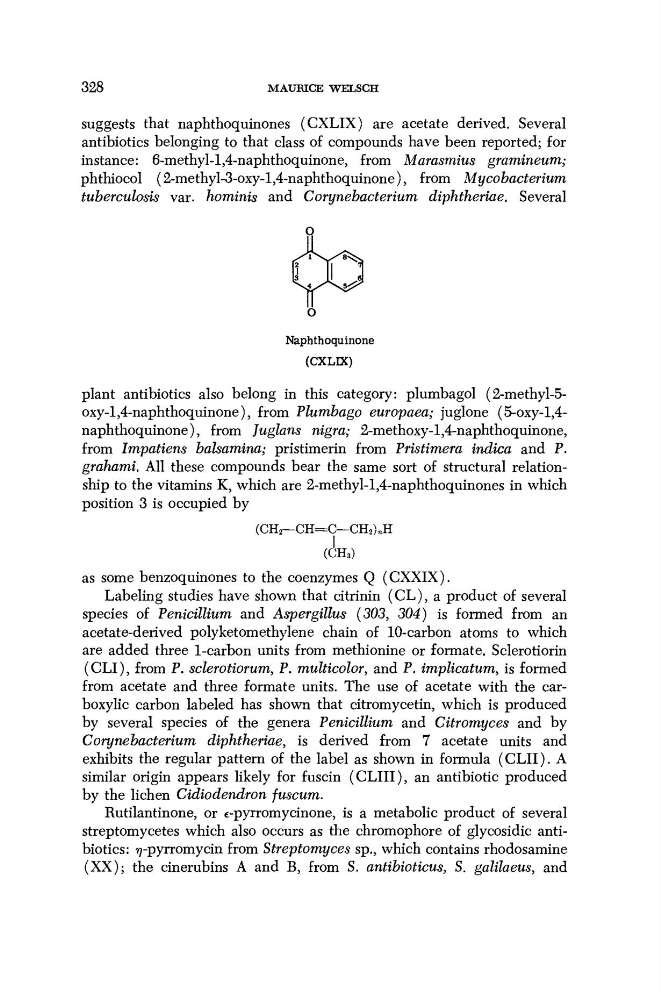
suggests that naphthoquinones (CXLIX) are acetate derived. Several
antibiotics belonging to that class of compounds have been reported; for
instance: 6-methyl-l,4-naphthoquinone, from Marasmius
gramineum;
phthiocol (2-methyl-3-oxy-l,4-naphthoquinone), from
Mycobacterium
tuberculosis var. hominis and Corynebacterium
diphtheriae. Several
Q
Naphthoquinone
(CXLDC)
plant antibiotics also belong in this category: plumbagol (2-methyl-5oxy-l,4-naphthoquinone), from Plumbago europaea; juglone (5-oxy-l,4naphthoquinone), from Juglans nigra; 2-methoxy-l,4-naphthoquinone,
from Impatiens balsamina; pristimerin from Pristimera indica and P.
grahami. All these compounds bear the same sort of structural relationship to the vitamins K, which are 2-methyl-l,4-naphthoquinones in which
position 3 is occupied by
(CH 2 —CH=C—CH 2 ) il H
(CH 3 )
as some benzoquinones to the coenzymes Q (CXXIX).
Labeling studies have shown that citrinin (CL), a product of several
species of Penicillium and Aspergillus (303, 304) is formed from an
acetate-derived polyketomethylene chain of 10-carbon atoms to which
are added three 1-carbon units from methionine or formate. Sclerotiorin
(CLI), from P. sclerotiorum, P. multicolor, and P. implicatum, is formed
from acetate and three formate units. The use of acetate with the carboxylic carbon labeled has shown that citromycetin, which is produced
by several species of the genera Penicillium and Citromyces and by
Corynebacterium
diphtheriae, is derived from 7 acetate units and
exhibits the regular pattern of the label as shown in formula (CLII). A
similar origin appears likely for fuscin (CLIII), an antibiotic produced
by the lichen Cidiodendron fuscum.
Rutilantinone, or e-pyrromycinone, is a metabolic product of several
streptomycetes which also occurs as the chromophore of glycosidic antibiotics: 97-pyrromycin from Streptomyces sp., which contains rhodosamine
(XX); the cinerubins A and B, from S. antibioticus, S. galüaeus, and
MAURICE WELSCH
suggests that naphthoquinones (CXLIX) are acetate derived. Several
antibiotics belonging to that class of compounds have been reported; for
instance: 6-methyl-l,4-naphthoquinone, from Marasmius
gramineum;
phthiocol (2-methyl-3-oxy-l,4-naphthoquinone), from
Mycobacterium
tuberculosis var. hominis and Corynebacterium
diphtheriae. Several
Q
Naphthoquinone
(CXLDC)
plant antibiotics also belong in this category: plumbagol (2-methyl-5oxy-l,4-naphthoquinone), from Plumbago europaea; juglone (5-oxy-l,4naphthoquinone), from Juglans nigra; 2-methoxy-l,4-naphthoquinone,
from Impatiens balsamina; pristimerin from Pristimera indica and P.
grahami. All these compounds bear the same sort of structural relationship to the vitamins K, which are 2-methyl-l,4-naphthoquinones in which
position 3 is occupied by
(CH 2 —CH=C—CH 2 ) il H
(CH 3 )
as some benzoquinones to the coenzymes Q (CXXIX).
Labeling studies have shown that citrinin (CL), a product of several
species of Penicillium and Aspergillus (303, 304) is formed from an
acetate-derived polyketomethylene chain of 10-carbon atoms to which
are added three 1-carbon units from methionine or formate. Sclerotiorin
(CLI), from P. sclerotiorum, P. multicolor, and P. implicatum, is formed
from acetate and three formate units. The use of acetate with the carboxylic carbon labeled has shown that citromycetin, which is produced
by several species of the genera Penicillium and Citromyces and by
Corynebacterium
diphtheriae, is derived from 7 acetate units and
exhibits the regular pattern of the label as shown in formula (CLII). A
similar origin appears likely for fuscin (CLIII), an antibiotic produced
by the lichen Cidiodendron fuscum.
Rutilantinone, or e-pyrromycinone, is a metabolic product of several
streptomycetes which also occurs as the chromophore of glycosidic antibiotics: 97-pyrromycin from Streptomyces sp., which contains rhodosamine
(XX); the cinerubins A and B, from S. antibioticus, S. galüaeus, and