

330
MAURICE WELSCH
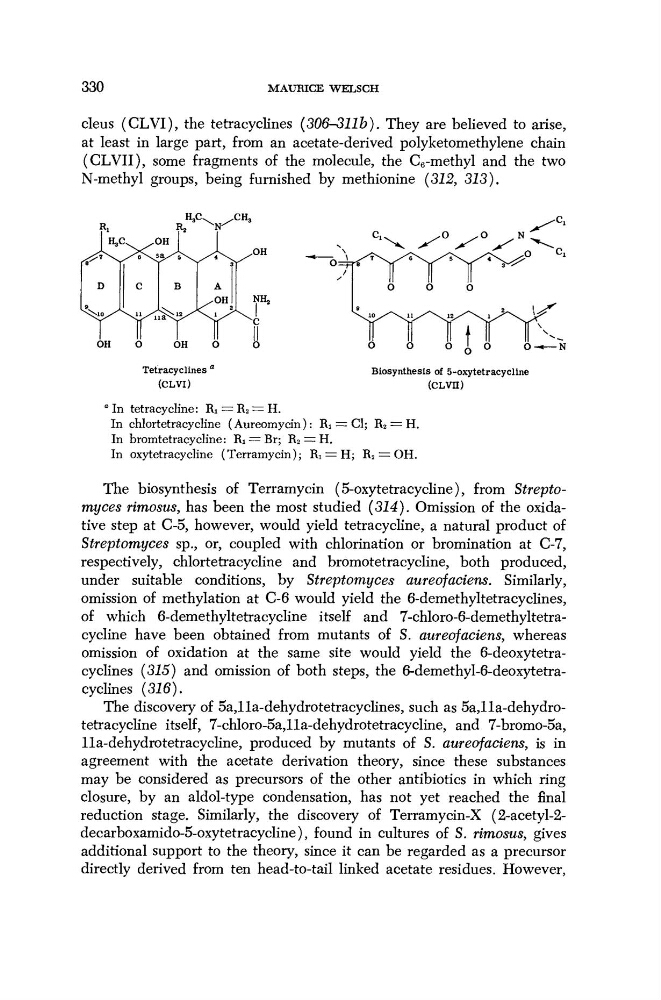
cleus (CLVI), the tetracyclines (306-311b).
They are believed to arise,
at least in large part, from an acetate-derived polyketomethylene chain
(CLVII), some fragments of the molecule, the C 6 -methyl and the two
N-methyl groups, being furnished by methionine (312, 313).
Tetracyclines
a
Biosynthesis of 5-oxytetracycline
(CLVI)
(CLVH)
° In tetracycline: Ri = R 2 = H.
In Chlortetracycline (Aureomycin): Ri = CI; R 2 = H.
In bromtetracycline: Ri = Br; R 2 = H.
In Oxytetracycline (Terramycin); Ri = H; R 2 = OH.
The biosynthesis of Terramycin (5-oxytetracycline), from Streptomyces rimosus, has been the most studied (314). Omission of the oxidative step at C-5, however, would yield tetracycline, a natural product of
Streptomyces sp., or, coupled with chlorination or bromination at C-7,
respectively, Chlortetracycline and bromotetracycline, both produced,
under suitable conditions, by Streptomyces
aureofaciens. Similarly,
omission of methylation at C-6 would yield the 6-demethyltetracyclines,
of which 6-demethyltetracycline itself and 7-chloro-6-demethyltetracycline have been obtained from mutants of S. aureofaciens, whereas
omission of oxidation at the same site would yield the 6-deoxytetracyclines (315) and omission of both steps, the 6-demethyl-6-deoxytetracyclines (316).
The discovery of 5a,lla-dehydrotetracyclines, such as 5a,lla-dehydrotetracycline itself, 7-chloro-5a,lla-dehydrotetracycline, and 7-bromo-5a,
lla-dehydrotetracycline, produced by mutants of S. aureofaciens, is in
agreement with the acetate derivation theory, since these substances
may be considered as precursors of the other antibiotics in which ring
closure, by an aldol-type condensation, has not yet reached the final
reduction stage. Similarly, the discovery of Terramycin-X (2-acetyl-2decarboxamido-5-oxytetracycline), found in cultures of S. rimosus, gives
additional support to the theory, since it can be regarded as a precursor
directly derived from ten head-to-tail linked acetate residues. However,
MAURICE WELSCH
cleus (CLVI), the tetracyclines (306-311b).
They are believed to arise,
at least in large part, from an acetate-derived polyketomethylene chain
(CLVII), some fragments of the molecule, the C 6 -methyl and the two
N-methyl groups, being furnished by methionine (312, 313).
Tetracyclines
a
Biosynthesis of 5-oxytetracycline
(CLVI)
(CLVH)
° In tetracycline: Ri = R 2 = H.
In Chlortetracycline (Aureomycin): Ri = CI; R 2 = H.
In bromtetracycline: Ri = Br; R 2 = H.
In Oxytetracycline (Terramycin); Ri = H; R 2 = OH.
The biosynthesis of Terramycin (5-oxytetracycline), from Streptomyces rimosus, has been the most studied (314). Omission of the oxidative step at C-5, however, would yield tetracycline, a natural product of
Streptomyces sp., or, coupled with chlorination or bromination at C-7,
respectively, Chlortetracycline and bromotetracycline, both produced,
under suitable conditions, by Streptomyces
aureofaciens. Similarly,
omission of methylation at C-6 would yield the 6-demethyltetracyclines,
of which 6-demethyltetracycline itself and 7-chloro-6-demethyltetracycline have been obtained from mutants of S. aureofaciens, whereas
omission of oxidation at the same site would yield the 6-deoxytetracyclines (315) and omission of both steps, the 6-demethyl-6-deoxytetracyclines (316).
The discovery of 5a,lla-dehydrotetracyclines, such as 5a,lla-dehydrotetracycline itself, 7-chloro-5a,lla-dehydrotetracycline, and 7-bromo-5a,
lla-dehydrotetracycline, produced by mutants of S. aureofaciens, is in
agreement with the acetate derivation theory, since these substances
may be considered as precursors of the other antibiotics in which ring
closure, by an aldol-type condensation, has not yet reached the final
reduction stage. Similarly, the discovery of Terramycin-X (2-acetyl-2decarboxamido-5-oxytetracycline), found in cultures of S. rimosus, gives
additional support to the theory, since it can be regarded as a precursor
directly derived from ten head-to-tail linked acetate residues. However,