

5. ANTIBIOSIS AND ANTIBIOTICS
323
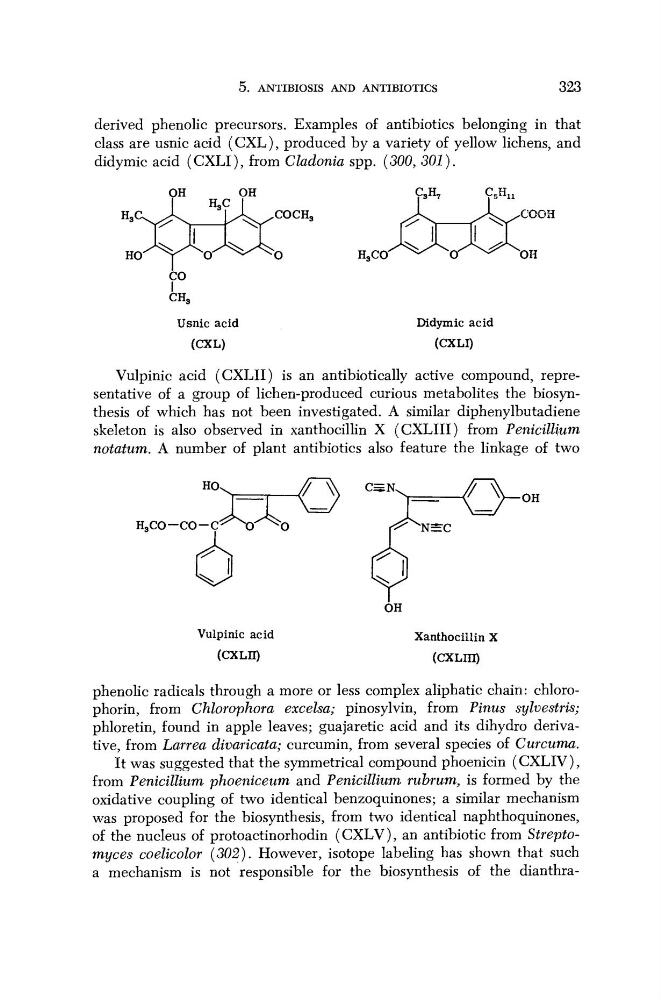
derived phenolic precursors. Examples of antibiotics belonging in that
class are usnic acid (CXL), produced by a variety of yellow lichens, and
didymic acid (CXLI), from Cladonia spp. (300, 301).
Usnic acid
Didymic acid
(CXL)
(CXLI)
Vulpinic acid (CXLII) is an antibiotically active compound, representative of a group of lichen-produced curious metabolites the biosynthesis of which has not been investigated. A similar diphenylbutadiene
skeleton is also observed in xanthocillin X (CXLIII) from Penicillium
notatum. A number of plant antibiotics also feature the linkage of two
OH
Vulpinic acid
Xanthocillin X
(CXLII)
(CXLIII)
phenolic radicals through a more or less complex aliphatic chain: chlorophorin, from Chlorophora excelsa; pinosylvin, from Pinus sylvestris;
phloretin, found in apple leaves; guajaretic acid and its dihydro derivative, from Larrea divaricata; curcumin, from several species of Curcuma.
It was suggested that the symmetrical compound phoenicin (CXLIV),
from Penicillium phoeniceum and Penicillium rubrum, is formed by the
oxidative coupling of two identical benzoquinones; a similar mechanism
was proposed for the biosynthesis, from two identical naphthoquinones,
of the nucleus of protoactinorhodin (CXLV), an antibiotic from Streptomyces coelicolor (302). However, isotope labeling has shown that such
a mechanism is not responsible for the biosynthesis of the dianthra-
323
derived phenolic precursors. Examples of antibiotics belonging in that
class are usnic acid (CXL), produced by a variety of yellow lichens, and
didymic acid (CXLI), from Cladonia spp. (300, 301).
Usnic acid
Didymic acid
(CXL)
(CXLI)
Vulpinic acid (CXLII) is an antibiotically active compound, representative of a group of lichen-produced curious metabolites the biosynthesis of which has not been investigated. A similar diphenylbutadiene
skeleton is also observed in xanthocillin X (CXLIII) from Penicillium
notatum. A number of plant antibiotics also feature the linkage of two
OH
Vulpinic acid
Xanthocillin X
(CXLII)
(CXLIII)
phenolic radicals through a more or less complex aliphatic chain: chlorophorin, from Chlorophora excelsa; pinosylvin, from Pinus sylvestris;
phloretin, found in apple leaves; guajaretic acid and its dihydro derivative, from Larrea divaricata; curcumin, from several species of Curcuma.
It was suggested that the symmetrical compound phoenicin (CXLIV),
from Penicillium phoeniceum and Penicillium rubrum, is formed by the
oxidative coupling of two identical benzoquinones; a similar mechanism
was proposed for the biosynthesis, from two identical naphthoquinones,
of the nucleus of protoactinorhodin (CXLV), an antibiotic from Streptomyces coelicolor (302). However, isotope labeling has shown that such
a mechanism is not responsible for the biosynthesis of the dianthra-