

322
MAURICE WELSCH
The wide use of griseofulvin as a therapeutic agent (289b,c) attracted
attention to this antibiotic, and several derivatives have been prepared
recently (290-298). The ( + )-griseofulvin obtained synthetically has the
same biological activity as the natural compound whereas the antifungal
action of the ( — )-isomer is negligible (299).
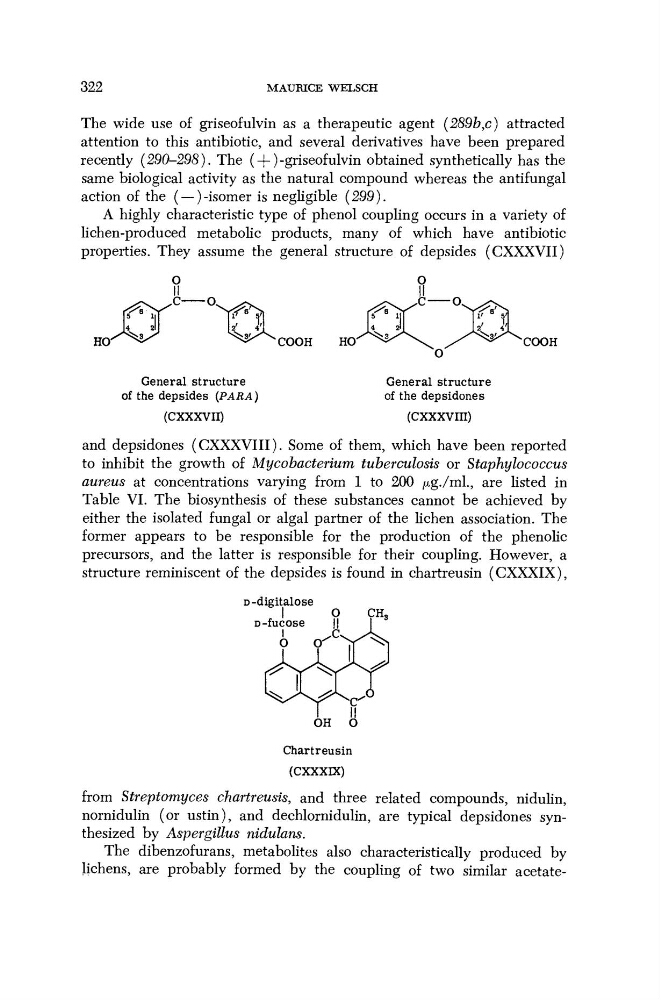
A highly characteristic type of phenol coupling occurs in a variety of
lichen-produced metabolic products, many of which have antibiotic
properties. They assume the general structure of depsides (CXXXVII)
COOH
General structure
General structure
of the depsides (PARA)
of the depsidones
(CXXXVII)
(CXXXVIII)
and depsidones (CXXXVIII). Some of them, which have been reported
to inhibit the growth of Mycobacterium tuberculosis or Staphylococcus
aureus at concentrations varying from 1 to 200 ^g./ml., are listed in
Table VI. The biosynthesis of these substances cannot be achieved by
either the isolated fungal or algal partner of the lichen association. The
former appears to be responsible for the production of the phenolic
precursors, and the latter is responsible for their coupling. However, a
structure reminiscent of the depsides is found in chartreusin (CXXXIX),
OH Ο
Chartreusin
(CXXXIX)
from Streptomyces chartreusis, and three related compounds, nidulin,
nornidulin (or ustin), and dechlornidulin, are typical depsidones synthesized by Aspergillus niduhns.
The dibenzofurans, metabolites also characteristically produced by
lichens, are probably formed by the coupling of two similar acetate-
MAURICE WELSCH
The wide use of griseofulvin as a therapeutic agent (289b,c) attracted
attention to this antibiotic, and several derivatives have been prepared
recently (290-298). The ( + )-griseofulvin obtained synthetically has the
same biological activity as the natural compound whereas the antifungal
action of the ( — )-isomer is negligible (299).
A highly characteristic type of phenol coupling occurs in a variety of
lichen-produced metabolic products, many of which have antibiotic
properties. They assume the general structure of depsides (CXXXVII)
COOH
General structure
General structure
of the depsides (PARA)
of the depsidones
(CXXXVII)
(CXXXVIII)
and depsidones (CXXXVIII). Some of them, which have been reported
to inhibit the growth of Mycobacterium tuberculosis or Staphylococcus
aureus at concentrations varying from 1 to 200 ^g./ml., are listed in
Table VI. The biosynthesis of these substances cannot be achieved by
either the isolated fungal or algal partner of the lichen association. The
former appears to be responsible for the production of the phenolic
precursors, and the latter is responsible for their coupling. However, a
structure reminiscent of the depsides is found in chartreusin (CXXXIX),
OH Ο
Chartreusin
(CXXXIX)
from Streptomyces chartreusis, and three related compounds, nidulin,
nornidulin (or ustin), and dechlornidulin, are typical depsidones synthesized by Aspergillus niduhns.
The dibenzofurans, metabolites also characteristically produced by
lichens, are probably formed by the coupling of two similar acetate-