

310
MAURICE WELSCH
the production of several members of the group—for instance, antimycin,
from S. aureus, antibiotics S-8, from Streptomyces 3832, and candidin—is
stimulated by mevalonic acid (CVI), a common intermediate on the
biosynthetic pathways of carotenoids, terpenoids, and steroids
(271b,c,d).
A terpenoid moiety (271e) is observed in mycelianamide (LXXI).
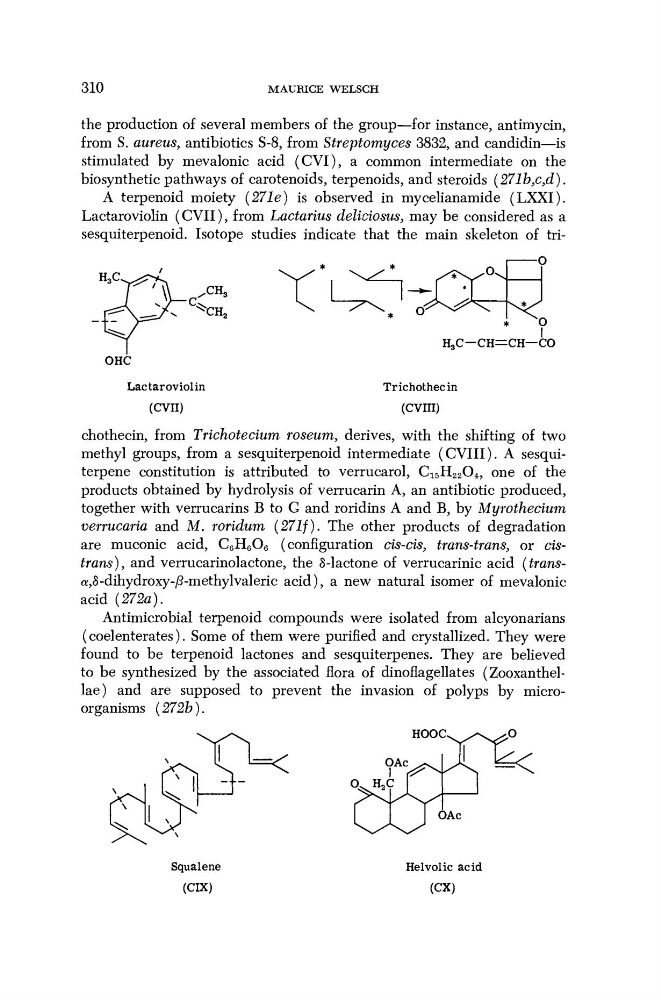
Lactaroviolin (CVII), from Lactarius deliciosus, may be considered as a
sesquiterpenoid. Isotope studies indicate that the main skeleton of triOHC
Lactaroviolin
Trichothecin
(CVII)
(CVin)
chothecin, from Trichotecium roseum, derives, with the shifting of two
methyl groups, from a sesquiterpenoid intermediate (CVIII). A sesquiterpene constitution is attributed to verrucarol, Ci 5 H 22 0 4 , one of the
products obtained by hydrolysis of verrucarin A, an antibiotic produced,
together with verrucarins Β to G and roridins A and B, by Myrothecium
verrucaria and M. roridum (27If). The other products of degradation
are muconic acid, C 6 H 6 0 6 (configuration cis-cis, trans-trans, or eistrans), and verrucarinolactone, the δ-lactone of verrucarinic acid (transα,δ-dihydroxy-^-methylvaleric acid), a new natural isomer of mevalonic
acid (272a).
Antimicrobial terpenoid compounds were isolated from alcyonarians
(coelenterates). Some of them were purified and crystallized. They were
found to be terpenoid lactones and sesquiterpenes. They are believed
to be synthesized by the associated flora of dinoflagellates (Zooxanthellae) and are supposed to prevent the invasion of polyps by microorganisms
(272b).
Squalene
(CK)
Helvolic acid
(CX)
MAURICE WELSCH
the production of several members of the group—for instance, antimycin,
from S. aureus, antibiotics S-8, from Streptomyces 3832, and candidin—is
stimulated by mevalonic acid (CVI), a common intermediate on the
biosynthetic pathways of carotenoids, terpenoids, and steroids
(271b,c,d).
A terpenoid moiety (271e) is observed in mycelianamide (LXXI).
Lactaroviolin (CVII), from Lactarius deliciosus, may be considered as a
sesquiterpenoid. Isotope studies indicate that the main skeleton of triOHC
Lactaroviolin
Trichothecin
(CVII)
(CVin)
chothecin, from Trichotecium roseum, derives, with the shifting of two
methyl groups, from a sesquiterpenoid intermediate (CVIII). A sesquiterpene constitution is attributed to verrucarol, Ci 5 H 22 0 4 , one of the
products obtained by hydrolysis of verrucarin A, an antibiotic produced,
together with verrucarins Β to G and roridins A and B, by Myrothecium
verrucaria and M. roridum (27If). The other products of degradation
are muconic acid, C 6 H 6 0 6 (configuration cis-cis, trans-trans, or eistrans), and verrucarinolactone, the δ-lactone of verrucarinic acid (transα,δ-dihydroxy-^-methylvaleric acid), a new natural isomer of mevalonic
acid (272a).
Antimicrobial terpenoid compounds were isolated from alcyonarians
(coelenterates). Some of them were purified and crystallized. They were
found to be terpenoid lactones and sesquiterpenes. They are believed
to be synthesized by the associated flora of dinoflagellates (Zooxanthellae) and are supposed to prevent the invasion of polyps by microorganisms
(272b).
Squalene
(CK)
Helvolic acid
(CX)