

5. ANTIBIOSIS AND ANTIBIOTICS
311
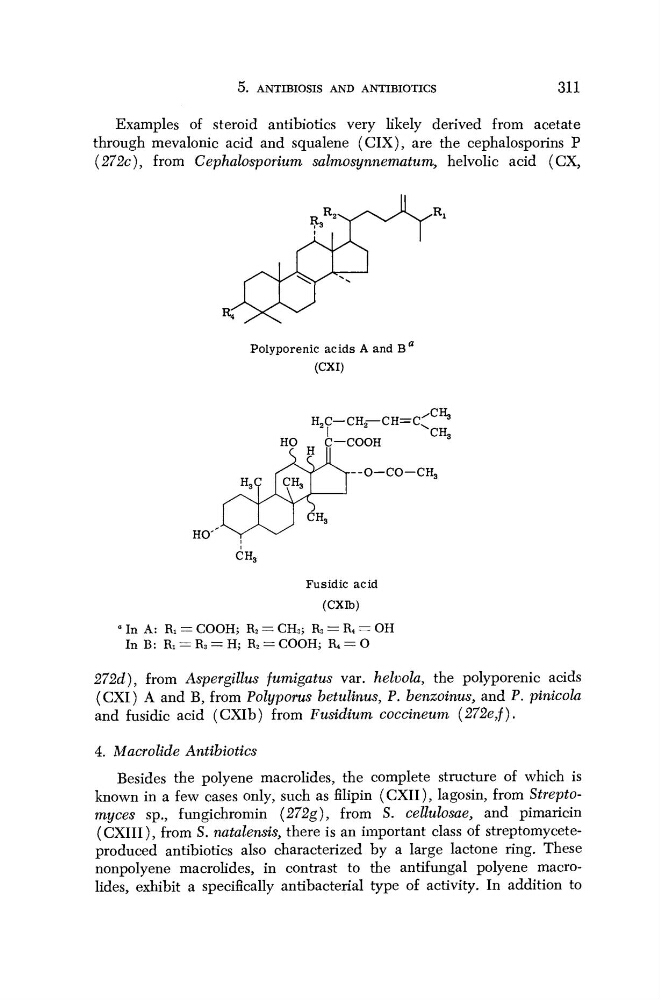
Examples of steroid antibiotics very likely derived from acetate
through mevalonic acid and squalene (CIX), are the cephalosporins Ρ
(272c), from Cephalosporium salmosynnematum,
helvolic acid (CX,
Polyporenic acids A and B
a
(CXI)
Fusidic acid
(CXIb)
° In A: Ri = COOH; R 2 = CH 3 ; R 3 = R 4 = OH
In B: Ri = R 3 = H; R 2 = COOH; R 4 = Ο
272d), from Aspergillus fumigatus var. helvola, the polyporenic acids
(CXI) A and B, from Polyporus betulinus, P. benzoinus, and P. pinicola
and fusidic acid (CXIb) from Fusidium coccineum
(272e,f).
4. Macrolide Antibiotics
Besides the polyene macrolides, the complete structure of which is
known in a few cases only, such as filipin (CXII), lagosin, from Streptomyces sp., fungichromin (272g),
from S. cellulosae, and pimaricin
(CXIII), from S. natalensis, there is an important class of streptomyceteproduced antibiotics also characterized by a large lactone ring. These
nonpolyene macrolides, in contrast to the antifungal polyene macrolides, exhibit a specifically antibacterial type of activity. In addition to
311
Examples of steroid antibiotics very likely derived from acetate
through mevalonic acid and squalene (CIX), are the cephalosporins Ρ
(272c), from Cephalosporium salmosynnematum,
helvolic acid (CX,
Polyporenic acids A and B
a
(CXI)
Fusidic acid
(CXIb)
° In A: Ri = COOH; R 2 = CH 3 ; R 3 = R 4 = OH
In B: Ri = R 3 = H; R 2 = COOH; R 4 = Ο
272d), from Aspergillus fumigatus var. helvola, the polyporenic acids
(CXI) A and B, from Polyporus betulinus, P. benzoinus, and P. pinicola
and fusidic acid (CXIb) from Fusidium coccineum
(272e,f).
4. Macrolide Antibiotics
Besides the polyene macrolides, the complete structure of which is
known in a few cases only, such as filipin (CXII), lagosin, from Streptomyces sp., fungichromin (272g),
from S. cellulosae, and pimaricin
(CXIII), from S. natalensis, there is an important class of streptomyceteproduced antibiotics also characterized by a large lactone ring. These
nonpolyene macrolides, in contrast to the antifungal polyene macrolides, exhibit a specifically antibacterial type of activity. In addition to