

5. ANTIBIOSIS AND ANTIBIOTICS
309
brane and thus increases its permeability to small ions (266a). Its leishmanicidal activity is attributed to its action on the surface of the
protozoan followed by lysis (266b). It has also been reported to inhibit
the production of induced amylase, the step of the process which is
blocked being the one immediately preceding protein synthesis
(267).
Another tetraene, etruscomycin, from S. lucensis, is supposed to inhibit
sterol utilization by yeasts, an activity which was also suggested for the
pentaene filipin, from S. filipinensis, and other polyenes
(268a,b).
Heptaenes have also been the subject of some research. Amphotericin
Β was shown to inhibit protein synthesis (264) and energy-yielding
mechanisms as an antagonist of riboflavin (269). Heptamycin from
Streptomyces sp., inhibits the active transport of pyruvate, lactate, and
trehalose into the cell. As do other heptaenes, it also prevents the uptake
of phosphate. These effects are interpreted as the result of an action
taking place at the cell surface (270). However, inhibition of phosphate
uptake, observed with the heptaene ascosin, from S. canescus, was considered to be the consequence of the blocking of respiration, since this
antibiotic was shown to inhibit the cytochrome-linked electron transfer
in a way similar to that of antimycin A. The site of its action is located
between coenzyme Q or cytochrome b and cytochrome c. Its ineffectiveness against bacteria, in contrast to its activity against fungi, is explained
by the lack, in bacteria, of the specifically sensitive receptor system
3. Terpenoids and Steroids in Antibiotics
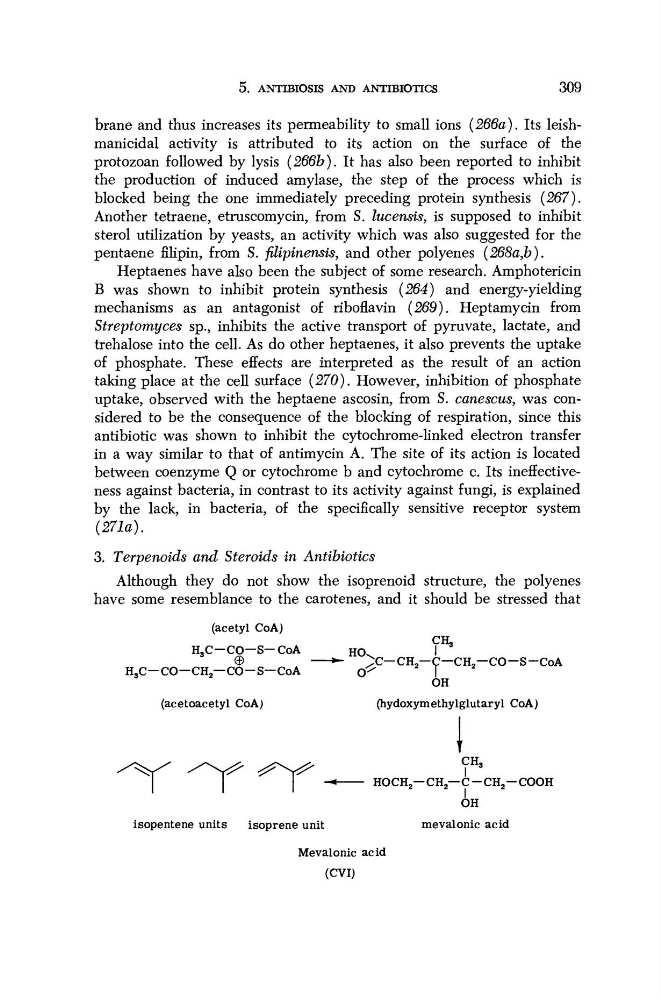
Although they do not show the isoprenoid structure, the polyenes
have some resemblance to the carotenes, and it should be stressed that
(271a).
(acetyl CoA)
H 3
C—CO—S— CoA
H 3
C— CO—CH 2
— CO - S—CoA
'C—CH 2 —
1
^—CH 2 —CO—S-CoA
OH
(acetoacetyl CoA)
(hydoxymethylglutaryl CoA)
OH
isopentene units isoprene unit
mevalonic acid
Mevalonic acid
(CVI)
309
brane and thus increases its permeability to small ions (266a). Its leishmanicidal activity is attributed to its action on the surface of the
protozoan followed by lysis (266b). It has also been reported to inhibit
the production of induced amylase, the step of the process which is
blocked being the one immediately preceding protein synthesis
(267).
Another tetraene, etruscomycin, from S. lucensis, is supposed to inhibit
sterol utilization by yeasts, an activity which was also suggested for the
pentaene filipin, from S. filipinensis, and other polyenes
(268a,b).
Heptaenes have also been the subject of some research. Amphotericin
Β was shown to inhibit protein synthesis (264) and energy-yielding
mechanisms as an antagonist of riboflavin (269). Heptamycin from
Streptomyces sp., inhibits the active transport of pyruvate, lactate, and
trehalose into the cell. As do other heptaenes, it also prevents the uptake
of phosphate. These effects are interpreted as the result of an action
taking place at the cell surface (270). However, inhibition of phosphate
uptake, observed with the heptaene ascosin, from S. canescus, was considered to be the consequence of the blocking of respiration, since this
antibiotic was shown to inhibit the cytochrome-linked electron transfer
in a way similar to that of antimycin A. The site of its action is located
between coenzyme Q or cytochrome b and cytochrome c. Its ineffectiveness against bacteria, in contrast to its activity against fungi, is explained
by the lack, in bacteria, of the specifically sensitive receptor system
3. Terpenoids and Steroids in Antibiotics
Although they do not show the isoprenoid structure, the polyenes
have some resemblance to the carotenes, and it should be stressed that
(271a).
(acetyl CoA)
H 3
C—CO—S— CoA
H 3
C— CO—CH 2
— CO - S—CoA
'C—CH 2 —
1
^—CH 2 —CO—S-CoA
OH
(acetoacetyl CoA)
(hydoxymethylglutaryl CoA)
OH
isopentene units isoprene unit
mevalonic acid
Mevalonic acid
(CVI)