

308
MAURICE WELSCH
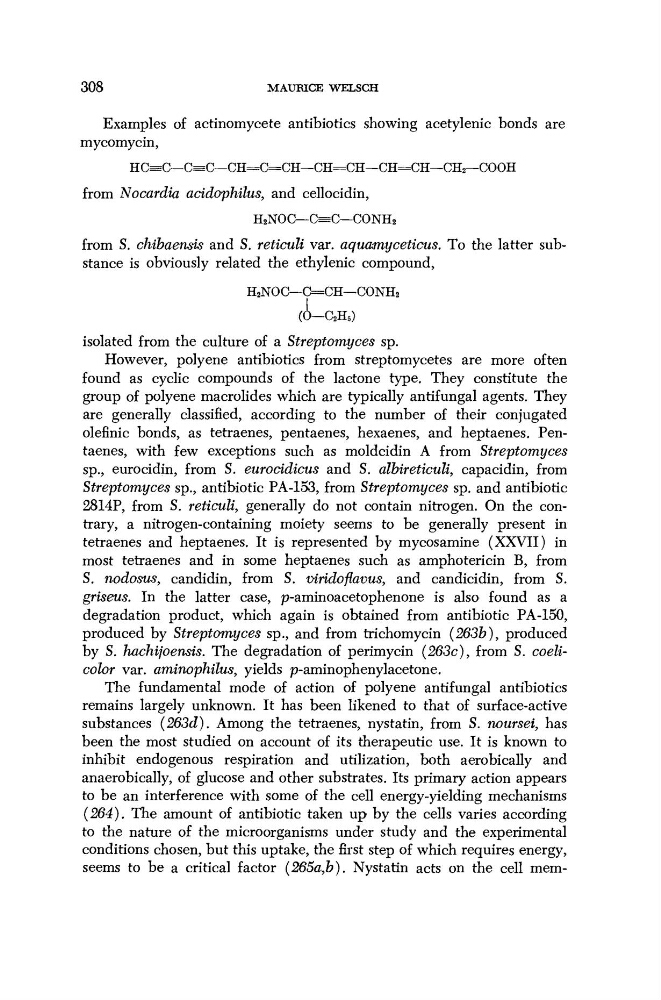
Examples of actinomycete antibiotics showing acetylenic bonds are
mycomycin,
HC=C—C=C—CH=C=CH—CH=CH—CH=CH—CH 2 —COOH
from Nocardia acidophilus, and cellocidin,
H 2 NOC—C=C—CONH 2
from S. chihaensis and S. reticuli var. aquamyceticus. To the latter substance is obviously related the ethylenic compound,
H 2 NOC—C=CH—CONH 2
(A-C 2 H 5 )
isolated from the culture of a Streptomyces sp.
However, polyene antibiotics from streptomycetes are more often
found as cyclic compounds of the lactone type. They constitute the
group of polyene macrolides which are typically antifungal agents. They
are generally classified, according to the number of their conjugated
olefinic bonds, as tetraenes, pentaenes, hexaenes, and heptaenes. Pentaenes, with few exceptions such as moldcidin A from Streptomyces
sp., eurocidin, from S. eurocidicus and S. albireticuli, capacidin, from
Streptomyces sp., antibiotic PA-153, from Streptomyces sp. and antibiotic
2814P, from S. reticuli, generally do not contain nitrogen. On the contrary, a nitrogen-containing moiety seems to be generally present in
tetraenes and heptaenes. It is represented by mycosamine (XXVII) in
most tetraenes and in some heptaenes such as amphotericin B, from
S. nodosus, candidin, from S. viridoflavus, and candicidin, from S.
griseus. In the latter case, p-aminoacetophenone is also found as a
degradation product, which again is obtained from antibiotic PA-150,
produced by Streptomyces sp., and from trichomycin (263b), produced
by S. hachijoensis. The degradation of perimycin (263c), from S. coelicolor var. aminophilus, yields p-aminophenylacetone.
The fundamental mode of action of polyene antifungal antibiotics
remains largely unknown. It has been likened to that of surface-active
substances (263d). Among the tetraenes, nystatin, from S. noursei, has
been the most studied on account of its therapeutic use. It is known to
inhibit endogenous respiration and utilization, both aerobically and
anaerobically, of glucose and other substrates. Its primary action appears
to be an interference with some of the cell energy-yielding mechanisms
(264). The amount of antibiotic taken up by the cells varies according
to the nature of the microorganisms under study and the experimental
conditions chosen, but this uptake, the first step of which requires energy,
seems to be a critical factor (265a,b). Nystatin acts on the cell mem-
MAURICE WELSCH
Examples of actinomycete antibiotics showing acetylenic bonds are
mycomycin,
HC=C—C=C—CH=C=CH—CH=CH—CH=CH—CH 2 —COOH
from Nocardia acidophilus, and cellocidin,
H 2 NOC—C=C—CONH 2
from S. chihaensis and S. reticuli var. aquamyceticus. To the latter substance is obviously related the ethylenic compound,
H 2 NOC—C=CH—CONH 2
(A-C 2 H 5 )
isolated from the culture of a Streptomyces sp.
However, polyene antibiotics from streptomycetes are more often
found as cyclic compounds of the lactone type. They constitute the
group of polyene macrolides which are typically antifungal agents. They
are generally classified, according to the number of their conjugated
olefinic bonds, as tetraenes, pentaenes, hexaenes, and heptaenes. Pentaenes, with few exceptions such as moldcidin A from Streptomyces
sp., eurocidin, from S. eurocidicus and S. albireticuli, capacidin, from
Streptomyces sp., antibiotic PA-153, from Streptomyces sp. and antibiotic
2814P, from S. reticuli, generally do not contain nitrogen. On the contrary, a nitrogen-containing moiety seems to be generally present in
tetraenes and heptaenes. It is represented by mycosamine (XXVII) in
most tetraenes and in some heptaenes such as amphotericin B, from
S. nodosus, candidin, from S. viridoflavus, and candicidin, from S.
griseus. In the latter case, p-aminoacetophenone is also found as a
degradation product, which again is obtained from antibiotic PA-150,
produced by Streptomyces sp., and from trichomycin (263b), produced
by S. hachijoensis. The degradation of perimycin (263c), from S. coelicolor var. aminophilus, yields p-aminophenylacetone.
The fundamental mode of action of polyene antifungal antibiotics
remains largely unknown. It has been likened to that of surface-active
substances (263d). Among the tetraenes, nystatin, from S. noursei, has
been the most studied on account of its therapeutic use. It is known to
inhibit endogenous respiration and utilization, both aerobically and
anaerobically, of glucose and other substrates. Its primary action appears
to be an interference with some of the cell energy-yielding mechanisms
(264). The amount of antibiotic taken up by the cells varies according
to the nature of the microorganisms under study and the experimental
conditions chosen, but this uptake, the first step of which requires energy,
seems to be a critical factor (265a,b). Nystatin acts on the cell mem-