

5. ANTIBIOSIS AND ANTIBIOTICS
301
way for the biosynthesis of cytosine is from L-glutamine amination of
uracil, itself derived from decarboxylation of orotic acid which arises,
through ureidosuccinic acid and L-dihydroorotic acid, from the condensation of L-aspartic acid and carbamyl phosphate.
The occurrence of antibiotics containing, as their basic ring system,
the pyrimido-( 5,4-£)-as-triazine nucleus should be mentioned here. They
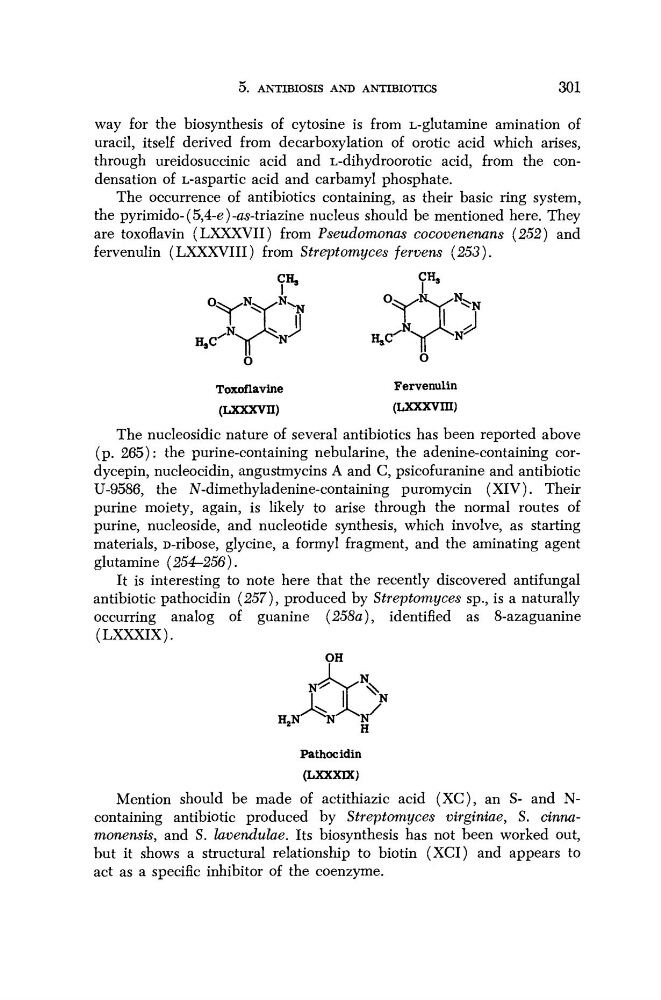
are toxoflavin (LXXXVII) from Pseudomonas cocovenenans (252) and
fervenulin (LXXXVIII) from Streptomyces fervens
(253).
Toxoflavine
Fervenulin
(LXXXVH)
(LXXXVIII)
The nucleosidic nature of several antibiotics has been reported above
(p. 265): the purine-containing nebularine, the adenine-containing cordycepin, nucleocidin, angustmycins A and C, psicofuranine and antibiotic
U-9586, the N-dimethyladenine-containing puromycin (XIV). Their
purine moiety, again, is likely to arise through the normal routes of
purine, nucleoside, and nucleotide synthesis, which involve, as starting
materials, D-ribose, glycine, a formyl fragment, and the aminating agent
glutamine
(254-256).
It is interesting to note here that the recently discovered antifungal
antibiotic pathocidin (257), produced by Streptomyces sp., is a naturally
occurring analog of guanine (258a),
identified as 8-azaguanine
(LXXXIX).
OH
Pathocidin
(LXXXIX)
Mention should be made of actithiazic acid (XC), an S- and Ncontaining antibiotic produced by Streptomyces virginiae, S. cinnamonensis, and S. lavendulae. Its biosynthesis has not been worked out,
but it shows a structural relationship to biotin (XCI) and appears to
act as a specific inhibitor of the coenzyme.
301
way for the biosynthesis of cytosine is from L-glutamine amination of
uracil, itself derived from decarboxylation of orotic acid which arises,
through ureidosuccinic acid and L-dihydroorotic acid, from the condensation of L-aspartic acid and carbamyl phosphate.
The occurrence of antibiotics containing, as their basic ring system,
the pyrimido-( 5,4-£)-as-triazine nucleus should be mentioned here. They
are toxoflavin (LXXXVII) from Pseudomonas cocovenenans (252) and
fervenulin (LXXXVIII) from Streptomyces fervens
(253).
Toxoflavine
Fervenulin
(LXXXVH)
(LXXXVIII)
The nucleosidic nature of several antibiotics has been reported above
(p. 265): the purine-containing nebularine, the adenine-containing cordycepin, nucleocidin, angustmycins A and C, psicofuranine and antibiotic
U-9586, the N-dimethyladenine-containing puromycin (XIV). Their
purine moiety, again, is likely to arise through the normal routes of
purine, nucleoside, and nucleotide synthesis, which involve, as starting
materials, D-ribose, glycine, a formyl fragment, and the aminating agent
glutamine
(254-256).
It is interesting to note here that the recently discovered antifungal
antibiotic pathocidin (257), produced by Streptomyces sp., is a naturally
occurring analog of guanine (258a),
identified as 8-azaguanine
(LXXXIX).
OH
Pathocidin
(LXXXIX)
Mention should be made of actithiazic acid (XC), an S- and Ncontaining antibiotic produced by Streptomyces virginiae, S. cinnamonensis, and S. lavendulae. Its biosynthesis has not been worked out,
but it shows a structural relationship to biotin (XCI) and appears to
act as a specific inhibitor of the coenzyme.