

300
MAURICE WELSCH
for the antibacterial activity of chloramphenicol has been stressed by
Hahn and collaborators (248b).
Chloramphenicol can be prepared by chemical synthesis and, of the
four possible isomers, only the naturally occurring one, the O( — )-threo
form, has appreciable antibiotic activity and inhibitory effect on most
ordinary protein syntheses. But, on the contrary, as shown by Hahn,
Wiseman, and Hopps, its antipode, the L( + )-erythro compound, is much
more active as a specific inhibitor of the biosynthesis of the D-glutamyl
polypeptide found in the capsular material of Bacillus subtilis. This
interesting observation stresses the high degree of stereospecificity of
the antibiotic. If the ring structure appears to be necessary for antibiotic activity, the position, and even the presence, of the aryl nitro
group are not essential, since it can be shifted from the para to the
ortho or meta positions or replaced by a halogen without much impairment of activity. On the contrary, even slight changes in the side chain
are generally accompanied by an almost total loss of activity.
8. Nitrogen-Containing Heterocyclic Moieties of Antibiotics
The pyrrole ring occurs in netropsin (XXXIX) an antibiotic produced
by several streptomycetes (S. netropsis, S. ambofaciens, S. reticuli), and
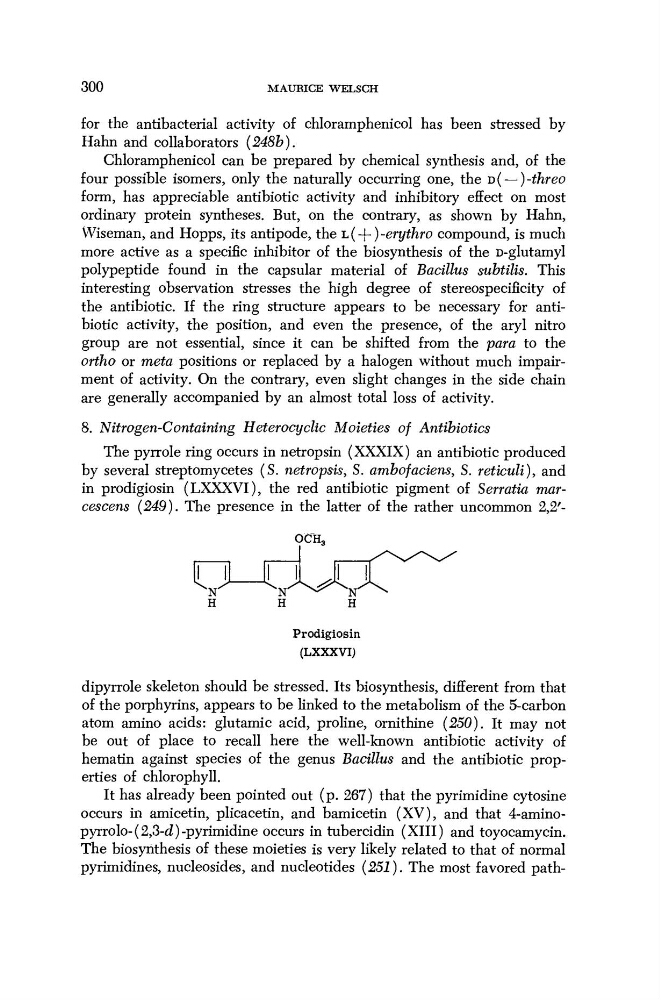
in prodigiosin (LXXXVI), the red antibiotic pigment of Serratia marcescens (249). The presence in the latter of the rather uncommon 2,2'OCH,
Prodigiosin
(LXXXVI)
dipyrrole skeleton should be stressed. Its biosynthesis, different from that
of the porphyrins, appears to be linked to the metabolism of the 5-carbon
atom amino acids: glutamic acid, proline, ornithine (250). It may not
be out of place to recall here the well-known antibiotic activity of
hematin against species of the genus Bacillus and the antibiotic properties of chlorophyll.
It has already been pointed out (p. 267) that the pyrimidine cytosine
occurs in amicetin, plicacetin, and bamicetin (XV), and that 4-aminopyrrolo-(2,3-ci) -pyrimidine occurs in tubercidin (XIII) and toyocamycin.
The biosynthesis of these moieties is very likely related to that of normal
pyrimidines, nucleosides, and nucleotides (251). The most favored path-
MAURICE WELSCH
for the antibacterial activity of chloramphenicol has been stressed by
Hahn and collaborators (248b).
Chloramphenicol can be prepared by chemical synthesis and, of the
four possible isomers, only the naturally occurring one, the O( — )-threo
form, has appreciable antibiotic activity and inhibitory effect on most
ordinary protein syntheses. But, on the contrary, as shown by Hahn,
Wiseman, and Hopps, its antipode, the L( + )-erythro compound, is much
more active as a specific inhibitor of the biosynthesis of the D-glutamyl
polypeptide found in the capsular material of Bacillus subtilis. This
interesting observation stresses the high degree of stereospecificity of
the antibiotic. If the ring structure appears to be necessary for antibiotic activity, the position, and even the presence, of the aryl nitro
group are not essential, since it can be shifted from the para to the
ortho or meta positions or replaced by a halogen without much impairment of activity. On the contrary, even slight changes in the side chain
are generally accompanied by an almost total loss of activity.
8. Nitrogen-Containing Heterocyclic Moieties of Antibiotics
The pyrrole ring occurs in netropsin (XXXIX) an antibiotic produced
by several streptomycetes (S. netropsis, S. ambofaciens, S. reticuli), and
in prodigiosin (LXXXVI), the red antibiotic pigment of Serratia marcescens (249). The presence in the latter of the rather uncommon 2,2'OCH,
Prodigiosin
(LXXXVI)
dipyrrole skeleton should be stressed. Its biosynthesis, different from that
of the porphyrins, appears to be linked to the metabolism of the 5-carbon
atom amino acids: glutamic acid, proline, ornithine (250). It may not
be out of place to recall here the well-known antibiotic activity of
hematin against species of the genus Bacillus and the antibiotic properties of chlorophyll.
It has already been pointed out (p. 267) that the pyrimidine cytosine
occurs in amicetin, plicacetin, and bamicetin (XV), and that 4-aminopyrrolo-(2,3-ci) -pyrimidine occurs in tubercidin (XIII) and toyocamycin.
The biosynthesis of these moieties is very likely related to that of normal
pyrimidines, nucleosides, and nucleotides (251). The most favored path-