

5. ANTIBIOSIS AND ANTIBIOTICS
299
Chloramphenicol is believed to act primarily as an inhibitor of
protein synthesis (243ar-d), since much higher concentrations are necessary to prevent RNA synthesis as well. In spite of its structural analogy
with phenylalanine, chloramphenicol does not act as a specific antagonist
of the particular amino acid. It interferes with a late stage of protein
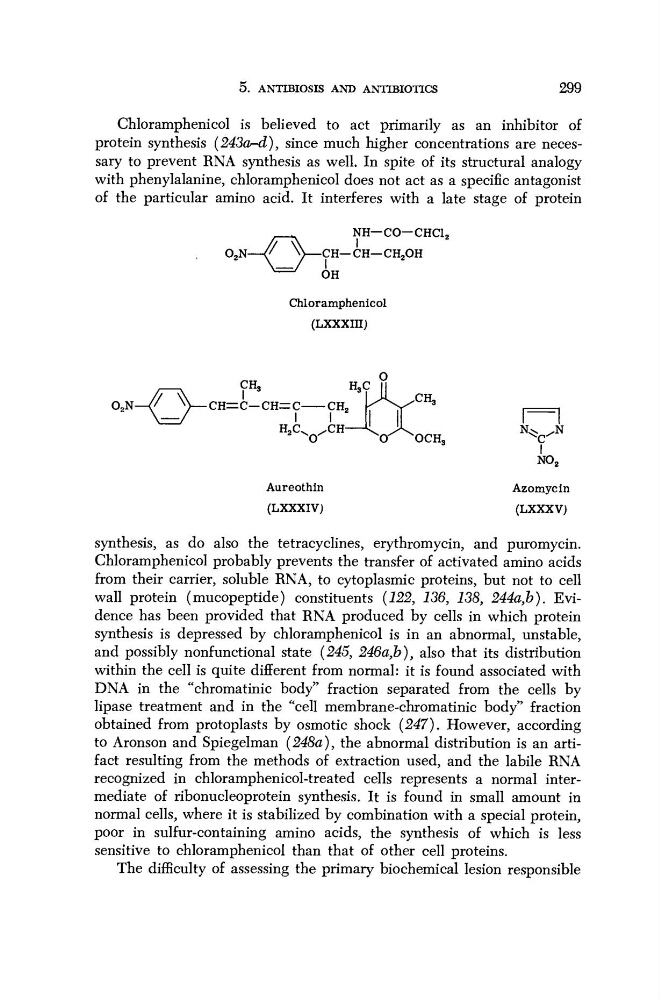
NH—CO—CHCl 2
— CH— CILOH
I
OH
Chloramphenicol
(LXXXIII)
N0 2
Aureothin
Azomycin
(LXXXIVj
(LXXXV)
synthesis, as do also the tetracyclines, erythromycin, and puromycin.
Chloramphenicol probably prevents the transfer of activated amino acids
from their carrier, soluble RNA, to cytoplasmic proteins, but not to cell
wall protein (mucopeptide) constituents (122, 136, 138, 244a,b). Evidence has been provided that RNA produced by cells in which protein
synthesis is depressed by chloramphenicol is in an abnormal, unstable,
and possibly nonfunctional state (245, 246a,b), also that its distribution
within the cell is quite different from normal: it is found associated with
DNA in the "chromatinic body" fraction separated from the cells by
lipase treatment and in the "cell membrane-chromatinic body" fraction
obtained from protoplasts by osmotic shock (247). However, according
to Aronson and Spiegelman (248a), the abnormal distribution is an artifact resulting from the methods of extraction used, and the labile RNA
recognized in chloramphenicol-treated cells represents a normal intermediate of ribonucleoprotein synthesis. It is found in small amount in
normal cells, where it is stabilized by combination with a special protein,
poor in sulfur-containing amino acids, the synthesis of which is less
sensitive to chloramphenicol than that of other cell proteins.
The difficulty of assessing the primary biochemical lesion responsible
299
Chloramphenicol is believed to act primarily as an inhibitor of
protein synthesis (243ar-d), since much higher concentrations are necessary to prevent RNA synthesis as well. In spite of its structural analogy
with phenylalanine, chloramphenicol does not act as a specific antagonist
of the particular amino acid. It interferes with a late stage of protein
NH—CO—CHCl 2
— CH— CILOH
I
OH
Chloramphenicol
(LXXXIII)
N0 2
Aureothin
Azomycin
(LXXXIVj
(LXXXV)
synthesis, as do also the tetracyclines, erythromycin, and puromycin.
Chloramphenicol probably prevents the transfer of activated amino acids
from their carrier, soluble RNA, to cytoplasmic proteins, but not to cell
wall protein (mucopeptide) constituents (122, 136, 138, 244a,b). Evidence has been provided that RNA produced by cells in which protein
synthesis is depressed by chloramphenicol is in an abnormal, unstable,
and possibly nonfunctional state (245, 246a,b), also that its distribution
within the cell is quite different from normal: it is found associated with
DNA in the "chromatinic body" fraction separated from the cells by
lipase treatment and in the "cell membrane-chromatinic body" fraction
obtained from protoplasts by osmotic shock (247). However, according
to Aronson and Spiegelman (248a), the abnormal distribution is an artifact resulting from the methods of extraction used, and the labile RNA
recognized in chloramphenicol-treated cells represents a normal intermediate of ribonucleoprotein synthesis. It is found in small amount in
normal cells, where it is stabilized by combination with a special protein,
poor in sulfur-containing amino acids, the synthesis of which is less
sensitive to chloramphenicol than that of other cell proteins.
The difficulty of assessing the primary biochemical lesion responsible