

302
MAURICE WELSCH
Although nothing is known of their biosynthesis, antibiotics of the
mitomycin group may also be conveniently mentioned here. They were
C NH
I
I
H 2 C^ C /CH—(CH 2 ) 5 -COOH
Actithiazic acid
(XC)
HN
/C SNH
HC
I
-CH
I
I
H 2 Cv_/CH— (CH 2 ) 4 — COOH
S
Biotin
(XCI)
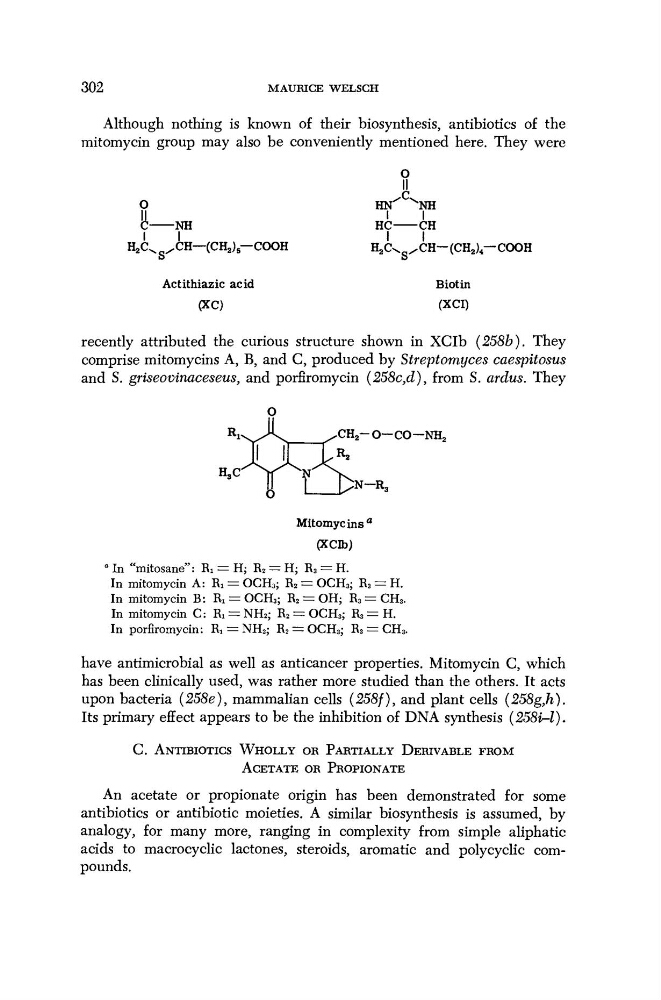
recently attributed the curious structure shown in XCIb (258b). They
comprise mitomycins A, B, and C, produced by Streptomyces caespitosus
and S. griseomnaceseus, and porfiromycin (258c,d), from S. ardus. They
CH 2 -0—CO—NH 2
R 2
N—R,
Mitomycins
a
(XCIb)
1 In "mitosane": R t = H; R 2 = H; R 3 = H.
In mitomycin A: Ri = OCH 3 ; R 2 = OCH 3 ; R 3 = H.
In mitomycin B: R* = OCH 3 ; R 2 = OH; R 3 = CH 3 .
In mitomycin C: Rt = NH 2 ; R 2 = OCH 3 ; R 3 = H.
In porfiromycin: Ri = NH 2 ; R 2 = OCH 3 ; R 3 = CH 3 .
have antimicrobial as well as anticancer properties. Mitomycin C, which
has been clinically used, was rather more studied than the others. It acts
upon bacteria (258e), mammalian cells (258/), and plant cells
(258g,h).
Its primary effect appears to be the inhibition of DNA synthesis (258ir-l).
C. ANTIBIOTICS WHOLLY OR PARTIALLY DERIVABLE FROM
ACETATE OR PROPIONATE
An acetate or propionate origin has been demonstrated for some
antibiotics or antibiotic moieties. A similar biosynthesis is assumed, by
analogy, for many more, ranging in complexity from simple aliphatic
acids to macroeyclic lactones, steroids, aromatic and polycyclic compounds.
MAURICE WELSCH
Although nothing is known of their biosynthesis, antibiotics of the
mitomycin group may also be conveniently mentioned here. They were
C NH
I
I
H 2 C^ C /CH—(CH 2 ) 5 -COOH
Actithiazic acid
(XC)
HN
/C SNH
HC
I
-CH
I
I
H 2 Cv_/CH— (CH 2 ) 4 — COOH
S
Biotin
(XCI)
recently attributed the curious structure shown in XCIb (258b). They
comprise mitomycins A, B, and C, produced by Streptomyces caespitosus
and S. griseomnaceseus, and porfiromycin (258c,d), from S. ardus. They
CH 2 -0—CO—NH 2
R 2
N—R,
Mitomycins
a
(XCIb)
1 In "mitosane": R t = H; R 2 = H; R 3 = H.
In mitomycin A: Ri = OCH 3 ; R 2 = OCH 3 ; R 3 = H.
In mitomycin B: R* = OCH 3 ; R 2 = OH; R 3 = CH 3 .
In mitomycin C: Rt = NH 2 ; R 2 = OCH 3 ; R 3 = H.
In porfiromycin: Ri = NH 2 ; R 2 = OCH 3 ; R 3 = CH 3 .
have antimicrobial as well as anticancer properties. Mitomycin C, which
has been clinically used, was rather more studied than the others. It acts
upon bacteria (258e), mammalian cells (258/), and plant cells
(258g,h).
Its primary effect appears to be the inhibition of DNA synthesis (258ir-l).
C. ANTIBIOTICS WHOLLY OR PARTIALLY DERIVABLE FROM
ACETATE OR PROPIONATE
An acetate or propionate origin has been demonstrated for some
antibiotics or antibiotic moieties. A similar biosynthesis is assumed, by
analogy, for many more, ranging in complexity from simple aliphatic
acids to macroeyclic lactones, steroids, aromatic and polycyclic compounds.