

296
MAURICE WELSCH
acid (LXXIII), from leucine and isoleucine, by Aspergillus flavus. The
same organism also produces flavacol, which arises through the same
route from two molecules of leucine; further oxidation, however, results
in aromatization to a pyrazine. It is worth noting that pulcherrimic acid,
which, iron complexed, constitutes the red pigment pulcherrimin of
Candida pulcherrima, is dioxyflavacol-N,2V'-dioxide.
7. Antibiotics Bio genetically Belated to the Pathways of Biosynthesis
of Aromatic Amino Acids
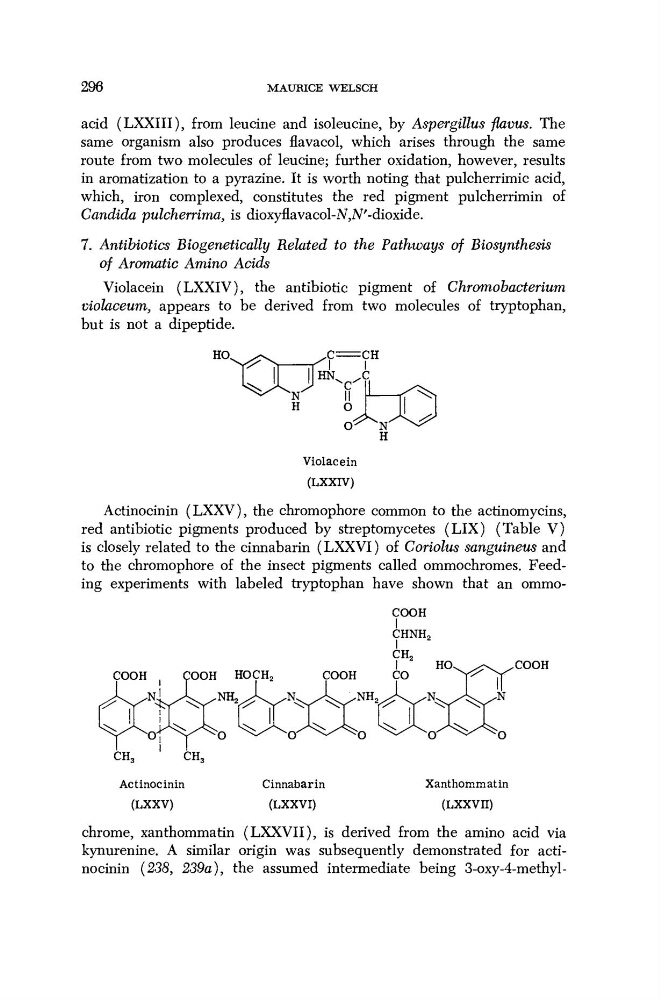
Violacein (LXXIV), the antibiotic pigment of
Chromobacterium
viohceum, appears to be derived from two molecules of tryptophan,
but is not a dipeptide.
Η
Violacein
(LXXIV)
Actinocinin (LXXV), the chromophore common to the actinomycins,
red antibiotic pigments produced by streptomycetes (LIX) (Table V)
is closely related to the cinnabarin (LXXVI) of Coriolus sanguineus and
to the chromophore of the insect pigments called ommochromes. Feeding experiments with labeled tryptophan have shown that an ommoCOOH
I
CHNH 2
COOH
Actinocinin
Cinnabarin
Xanthommatin
(LXXV)
(LXXVI)
(LXXVn)
chrome, xanthommatin (LXXVII), is derived from the amino acid via
kynurenine. A similar origin was subsequently demonstrated for actinocinin (238, 239a), the assumed intermediate being 3-oxy-4-methyl-
MAURICE WELSCH
acid (LXXIII), from leucine and isoleucine, by Aspergillus flavus. The
same organism also produces flavacol, which arises through the same
route from two molecules of leucine; further oxidation, however, results
in aromatization to a pyrazine. It is worth noting that pulcherrimic acid,
which, iron complexed, constitutes the red pigment pulcherrimin of
Candida pulcherrima, is dioxyflavacol-N,2V'-dioxide.
7. Antibiotics Bio genetically Belated to the Pathways of Biosynthesis
of Aromatic Amino Acids
Violacein (LXXIV), the antibiotic pigment of
Chromobacterium
viohceum, appears to be derived from two molecules of tryptophan,
but is not a dipeptide.
Η
Violacein
(LXXIV)
Actinocinin (LXXV), the chromophore common to the actinomycins,
red antibiotic pigments produced by streptomycetes (LIX) (Table V)
is closely related to the cinnabarin (LXXVI) of Coriolus sanguineus and
to the chromophore of the insect pigments called ommochromes. Feeding experiments with labeled tryptophan have shown that an ommoCOOH
I
CHNH 2
COOH
Actinocinin
Cinnabarin
Xanthommatin
(LXXV)
(LXXVI)
(LXXVn)
chrome, xanthommatin (LXXVII), is derived from the amino acid via
kynurenine. A similar origin was subsequently demonstrated for actinocinin (238, 239a), the assumed intermediate being 3-oxy-4-methyl-