

5. ANTIBIOSIS AND ANTIBIOTICS
297
anthranilic acid, which may stem from the normal biosynthetic route of
tryptophan. It is probable that the peptide chains of the actinomycins
are bound to the actinocinin precursors before their condensation to
form the phenoxazone chromophore.
Although few experimental data are available, it is generally surmised, by analogy, that other phenazine and phenoxazone antibiotics also
arise through the shikimic acid pathway (239b). Such would be the case
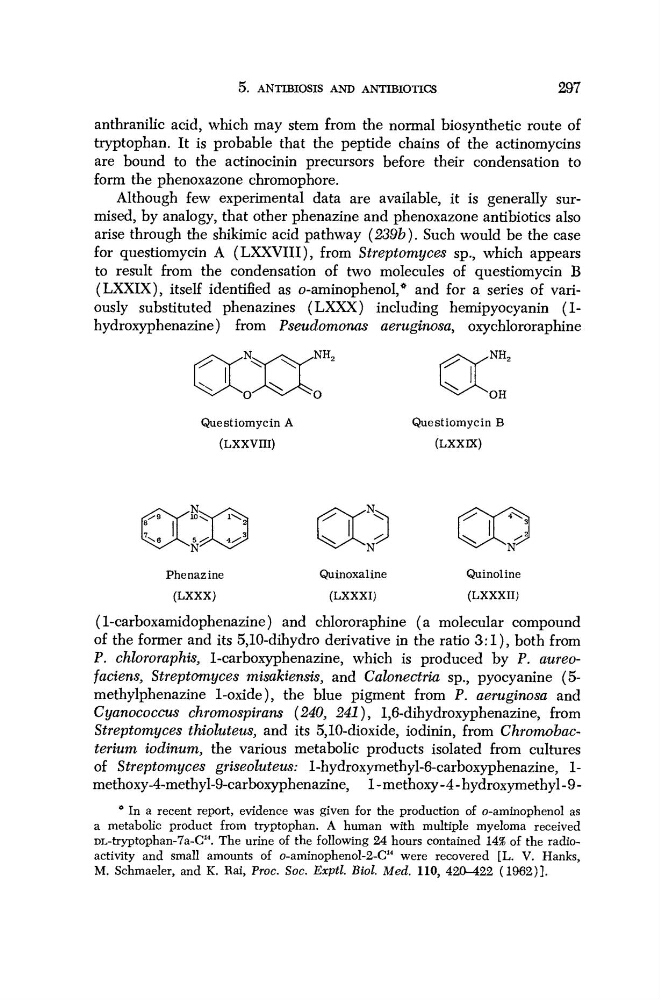
for questiomycin A (LXXVIII), from Streptomyces sp., which appears
to result from the condensation of two molecules of questiomycin Β
(LXXIX), itself identified as o-aminophenol,* and for a series of variously substituted phenazines (LXXX) including hemipyocyanin (1hydroxyphenazine) from Pseudomonas aeruginosa, oxychlororaphine
Questiomycin A
Questiomycin Β
(LXXVni)
(LXXLX)
Phenazine
Quinoxaline
Quinoline
(LXXX)
(LXXXI)
(LXXXII)
(1-carboxamidophenazine) and chlororaphine (a molecular compound
of the former and its 5,10-dihydro derivative in the ratio 3:1), both from
P. chlororaphis, 1-carboxyphenazine, which is produced by P. aureofaciens, Streptomyces misakiensis, and Calonectria sp., pyocyanine (5methylphenazine 1-oxide), the blue pigment from P. aeruginosa and
Cyanococcus chromospirans (240, 241), 1,6-dihydroxyphenazine, from
Streptomyces thioluteus, and its 5,10-dioxide, iodinin, from Chromobacterium iodinum, the various metabolic products isolated from cultures
of Streptomyces griseoluteus: l-hydroxymethyl-6-carboxyphenazine, 1methoxy-4-methyl-9-carboxyphenazine, 1 - methoxy - 4 - hydroxymethyl - 9 -
* In a recent report, evidence was given for the production of o-aminophenol as
a metabolic product from tryptophan. A human with multiple myeloma received
DL-tryptophan-7a-C
14
. The urine of the following 24 hours contained 14% of the radioactivity and small amounts of o-aminophenol-2-C
14 were recovered [L. V. Hanks,
M. Schmaeler, and K. Rai, Proc. Soc. Exptl. Biol. Med. 110, 420-422 (1962)].
297
anthranilic acid, which may stem from the normal biosynthetic route of
tryptophan. It is probable that the peptide chains of the actinomycins
are bound to the actinocinin precursors before their condensation to
form the phenoxazone chromophore.
Although few experimental data are available, it is generally surmised, by analogy, that other phenazine and phenoxazone antibiotics also
arise through the shikimic acid pathway (239b). Such would be the case
for questiomycin A (LXXVIII), from Streptomyces sp., which appears
to result from the condensation of two molecules of questiomycin Β
(LXXIX), itself identified as o-aminophenol,* and for a series of variously substituted phenazines (LXXX) including hemipyocyanin (1hydroxyphenazine) from Pseudomonas aeruginosa, oxychlororaphine
Questiomycin A
Questiomycin Β
(LXXVni)
(LXXLX)
Phenazine
Quinoxaline
Quinoline
(LXXX)
(LXXXI)
(LXXXII)
(1-carboxamidophenazine) and chlororaphine (a molecular compound
of the former and its 5,10-dihydro derivative in the ratio 3:1), both from
P. chlororaphis, 1-carboxyphenazine, which is produced by P. aureofaciens, Streptomyces misakiensis, and Calonectria sp., pyocyanine (5methylphenazine 1-oxide), the blue pigment from P. aeruginosa and
Cyanococcus chromospirans (240, 241), 1,6-dihydroxyphenazine, from
Streptomyces thioluteus, and its 5,10-dioxide, iodinin, from Chromobacterium iodinum, the various metabolic products isolated from cultures
of Streptomyces griseoluteus: l-hydroxymethyl-6-carboxyphenazine, 1methoxy-4-methyl-9-carboxyphenazine, 1 - methoxy - 4 - hydroxymethyl - 9 -
* In a recent report, evidence was given for the production of o-aminophenol as
a metabolic product from tryptophan. A human with multiple myeloma received
DL-tryptophan-7a-C
14
. The urine of the following 24 hours contained 14% of the radioactivity and small amounts of o-aminophenol-2-C
14 were recovered [L. V. Hanks,
M. Schmaeler, and K. Rai, Proc. Soc. Exptl. Biol. Med. 110, 420-422 (1962)].