

5. ANTIBIOSIS AND ANTIBIOTICS
295
animal tissues, e.g., phagocytin (235) and especially protamines (236)
and histones (237a), are responsible for various antimicrobial effects.
6. Diketopiperazine
Antibiotics
Echinulin, a metabolic product of Aspergillus echinuhtus, A. chevalieri, and members of the Aspergillus glaucus group, contains a moiety
which appears as a diketopiperazine formed from alanine and leucine.
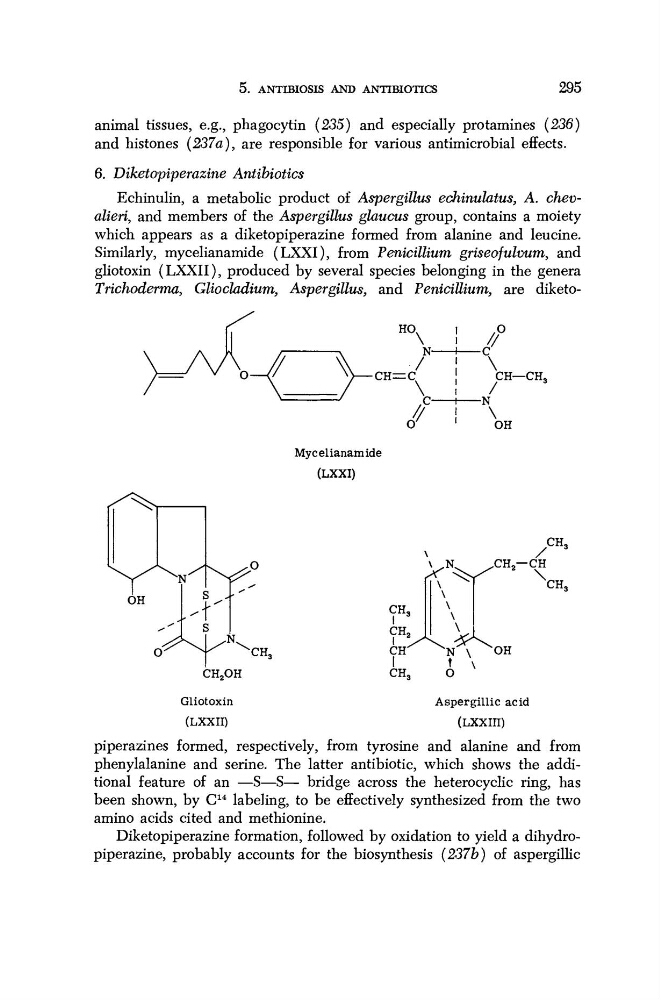
Similarly, mycelianamide (LXXI), from Penicillium griseofulvum, and
gliotoxin (LXXII), produced by several species belonging in the genera
Trichoderma, Gliocladium, Aspergillus, and Penicillium, are diketoH0 V
)
< CH— CH,
/
-N
OH
Mycelianamide
(LXXI)
CH 2 OH
Gliotoxin
(LXXII)
CH,
CH,
Aspergillie acid
(LXXin)
piperazines formed, respectively, from tyrosine and alanine and from
phenylalanine and serine. The latter antibiotic, which shows the additional feature of an —S—S— bridge across the heterocyclic ring, has
been shown, by C
14 labeling, to be effectively synthesized from the two
amino acids cited and methionine.
Diketopiperazine formation, followed by oxidation to yield a dihydropiperazine, probably accounts for the biosynthesis (237b) of aspergillic
295
animal tissues, e.g., phagocytin (235) and especially protamines (236)
and histones (237a), are responsible for various antimicrobial effects.
6. Diketopiperazine
Antibiotics
Echinulin, a metabolic product of Aspergillus echinuhtus, A. chevalieri, and members of the Aspergillus glaucus group, contains a moiety
which appears as a diketopiperazine formed from alanine and leucine.
Similarly, mycelianamide (LXXI), from Penicillium griseofulvum, and
gliotoxin (LXXII), produced by several species belonging in the genera
Trichoderma, Gliocladium, Aspergillus, and Penicillium, are diketoH0 V
)
< CH— CH,
/
-N
OH
Mycelianamide
(LXXI)
CH 2 OH
Gliotoxin
(LXXII)
CH,
CH,
Aspergillie acid
(LXXin)
piperazines formed, respectively, from tyrosine and alanine and from
phenylalanine and serine. The latter antibiotic, which shows the additional feature of an —S—S— bridge across the heterocyclic ring, has
been shown, by C
14 labeling, to be effectively synthesized from the two
amino acids cited and methionine.
Diketopiperazine formation, followed by oxidation to yield a dihydropiperazine, probably accounts for the biosynthesis (237b) of aspergillic