

288
MAURICE WELSCH
believed to induce damage to the cytoplasmic membrane by virtue of
their tensioactive properties. Newton's experiments (174c), realized with
an antibiotically active fluorescent derivative of polymyxin Β obtained by
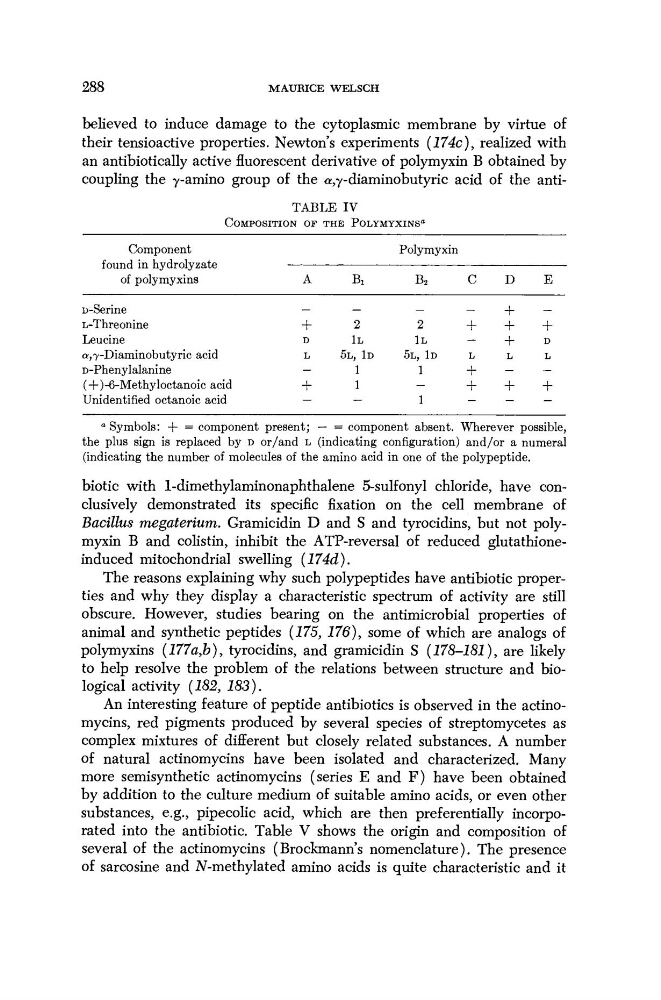
coupling the γ-amino group of the α,γ-diaminobutyric acid of the antiTABLE IV
COMPOSITION OF THE POLYMYXINS"
Component
Polymyxin
found in hydrolyzate
of polymyxins
A
Bi
B 2
C
D
Ε
D-Serine
+
L-Threonine
+
2
2
+ + +
Leucine
D
iL
iL
—
+
D
a,7-Diaminobutyric acid
L
5L, ID
5L, ID
L
L
L
D-Phenylalanine
-
1
1
+ -
-
(+)-6-Methyloctanoic acid
+
1
-
+ + +
Unidentified octanoic acid
—
—
1
—
—
—
° Symbols: + = component present; — = component absent. Wherever possible,
the plus sign is replaced by D or/and L (indicating configuration) and/or a numeral
(indicating the number of molecules of the amino acid in one of the polypeptide.
biotic with 1-dimethylaminonaphthalene 5-sulfonyl chloride, have conclusively demonstrated its specific fixation on the cell membrane of
Bacillus megaterium. Gramicidin D and S and tyrocidins, but not polymyxin Β and Colistin, inhibit the ATP-reversal of reduced glutathioneinduced mitochondrial swelling (174d).
The reasons explaining why such polypeptides have antibiotic properties and why they display a characteristic spectrum of activity are still
obscure. However, studies bearing on the antimicrobial properties of
animal and synthetic peptides (175, 176), some of which are analogs of
polymyxins (177a Jo), tyrocidins, and gramicidin S (178-181), are likely
to help resolve the problem of the relations between structure and biological activity (182, 183).
An interesting feature of peptide antibiotics is observed in the actinomycins, red pigments produced by several species of streptomycetes as
complex mixtures of different but closely related substances. A number
of natural actinomycins have been isolated and characterized. Many
more semisynthetic actinomycins (series Ε and F) have been obtained
by addition to the culture medium of suitable amino acids, or even other
substances, e.g., pipecolic acid, which are then preferentially incorporated into the antibiotic. Table V shows the origin and composition of
several of the actinomycins (Brockmann's nomenclature). The presence
of sarcosine and N-methylated amino acids is quite characteristic and it
MAURICE WELSCH
believed to induce damage to the cytoplasmic membrane by virtue of
their tensioactive properties. Newton's experiments (174c), realized with
an antibiotically active fluorescent derivative of polymyxin Β obtained by
coupling the γ-amino group of the α,γ-diaminobutyric acid of the antiTABLE IV
COMPOSITION OF THE POLYMYXINS"
Component
Polymyxin
found in hydrolyzate
of polymyxins
A
Bi
B 2
C
D
Ε
D-Serine
+
L-Threonine
+
2
2
+ + +
Leucine
D
iL
iL
—
+
D
a,7-Diaminobutyric acid
L
5L, ID
5L, ID
L
L
L
D-Phenylalanine
-
1
1
+ -
-
(+)-6-Methyloctanoic acid
+
1
-
+ + +
Unidentified octanoic acid
—
—
1
—
—
—
° Symbols: + = component present; — = component absent. Wherever possible,
the plus sign is replaced by D or/and L (indicating configuration) and/or a numeral
(indicating the number of molecules of the amino acid in one of the polypeptide.
biotic with 1-dimethylaminonaphthalene 5-sulfonyl chloride, have conclusively demonstrated its specific fixation on the cell membrane of
Bacillus megaterium. Gramicidin D and S and tyrocidins, but not polymyxin Β and Colistin, inhibit the ATP-reversal of reduced glutathioneinduced mitochondrial swelling (174d).
The reasons explaining why such polypeptides have antibiotic properties and why they display a characteristic spectrum of activity are still
obscure. However, studies bearing on the antimicrobial properties of
animal and synthetic peptides (175, 176), some of which are analogs of
polymyxins (177a Jo), tyrocidins, and gramicidin S (178-181), are likely
to help resolve the problem of the relations between structure and biological activity (182, 183).
An interesting feature of peptide antibiotics is observed in the actinomycins, red pigments produced by several species of streptomycetes as
complex mixtures of different but closely related substances. A number
of natural actinomycins have been isolated and characterized. Many
more semisynthetic actinomycins (series Ε and F) have been obtained
by addition to the culture medium of suitable amino acids, or even other
substances, e.g., pipecolic acid, which are then preferentially incorporated into the antibiotic. Table V shows the origin and composition of
several of the actinomycins (Brockmann's nomenclature). The presence
of sarcosine and N-methylated amino acids is quite characteristic and it