

5. ANTIBIOSIS AND ANTIBIOTICS
287
serratamic acid from Serratia spp. and to an open-chain peptide in
viscosin from Pseudomonas viscosa: 3-oxydecanoic acid —» Leu —» Gly -»
Ser
Val -> Threo —» Leu. More important is () -6-methyloctanoic
acid (MeOct), found as a side chain in several cyclic polypeptides in
which it is combined to the γ-amino group of α,γ-diaminobutyric acid
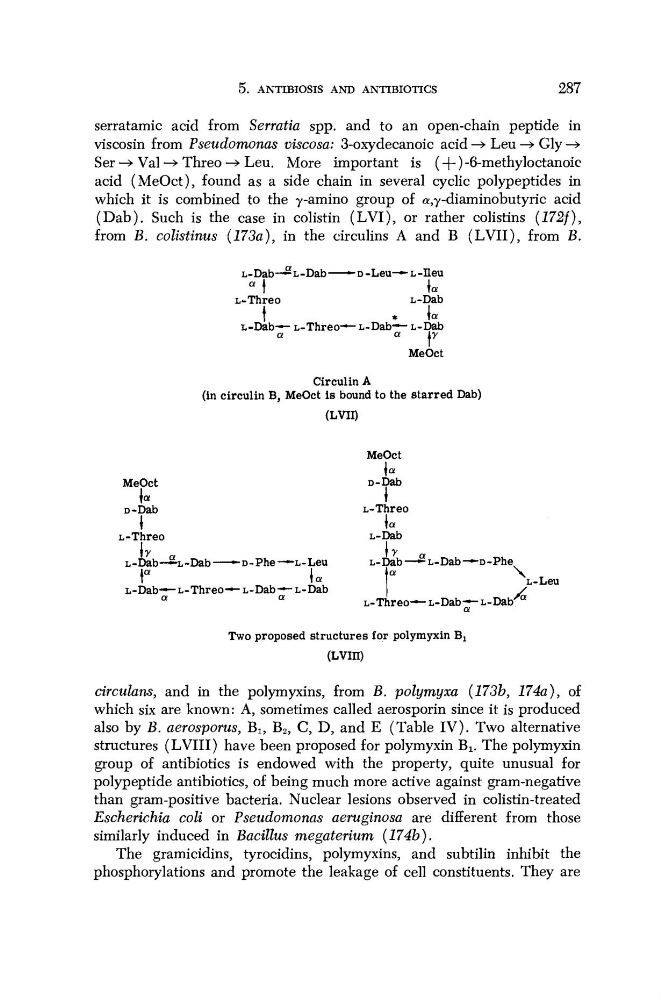
(Dab). Such is the case in Colistin (LVI), or rather Colistins (172f),
from B. colistinus (173a), in the circulins A and Β (LVII), from B.
-D-Leu— L-Üeu
L-Threo
L-Dab
t
.
la
L-Dab— L-Threo— L-Dab— L-Dab
a
a
jy
MeOct
Circulin A
(in circulin B, MeOct is bound to the starred Dab)
(LVII)
MeOct
D-Dab
\
L-Threo
Ir
L -Dab~^L -Dab
- D - Phe —~L - Leu
Ρ
\«
L-Dab—L-Threo— L-Dab— L-Dab
a
a
Two proposed structures for polymyxin Bi
(LVin)
circulans, and in the polymyxins, from B. poly my xa (173b, 174a), of
which six are known: A, sometimes called aerosporin since it is produced
also by B. aerosporus, B l9 B 2 , C, D, and Ε (Table IV). Two alternative
structures (LVIII) have been proposed for polymyxin Bi. The polymyxin
group of antibiotics is endowed with the property, quite unusual for
polypeptide antibiotics, of being much more active against gram-negative
than gram-positive bacteria. Nuclear lesions observed in colistin-treated
Escherichia coli or Pseudomonas aeruginosa are different from those
similarly induced in Bacillus megaterium
(174b).
The gramicidins, tyrocidins, polymyxins, and subtilin inhibit the
phosphorylations and promote the leakage of cell constituents. They are
MeOct
D-Dab
L-Threo
la
L-Dab
\y
L-Dab —^ L-Dab —~D-Phe
L-Leu
L-Threo— L-Dab— L-Dab^
a
287
serratamic acid from Serratia spp. and to an open-chain peptide in
viscosin from Pseudomonas viscosa: 3-oxydecanoic acid —» Leu —» Gly -»
Ser
Val -> Threo —» Leu. More important is () -6-methyloctanoic
acid (MeOct), found as a side chain in several cyclic polypeptides in
which it is combined to the γ-amino group of α,γ-diaminobutyric acid
(Dab). Such is the case in Colistin (LVI), or rather Colistins (172f),
from B. colistinus (173a), in the circulins A and Β (LVII), from B.
-D-Leu— L-Üeu
L-Threo
L-Dab
t
.
la
L-Dab— L-Threo— L-Dab— L-Dab
a
a
jy
MeOct
Circulin A
(in circulin B, MeOct is bound to the starred Dab)
(LVII)
MeOct
D-Dab
\
L-Threo
Ir
L -Dab~^L -Dab
- D - Phe —~L - Leu
Ρ
\«
L-Dab—L-Threo— L-Dab— L-Dab
a
a
Two proposed structures for polymyxin Bi
(LVin)
circulans, and in the polymyxins, from B. poly my xa (173b, 174a), of
which six are known: A, sometimes called aerosporin since it is produced
also by B. aerosporus, B l9 B 2 , C, D, and Ε (Table IV). Two alternative
structures (LVIII) have been proposed for polymyxin Bi. The polymyxin
group of antibiotics is endowed with the property, quite unusual for
polypeptide antibiotics, of being much more active against gram-negative
than gram-positive bacteria. Nuclear lesions observed in colistin-treated
Escherichia coli or Pseudomonas aeruginosa are different from those
similarly induced in Bacillus megaterium
(174b).
The gramicidins, tyrocidins, polymyxins, and subtilin inhibit the
phosphorylations and promote the leakage of cell constituents. They are
MeOct
D-Dab
L-Threo
la
L-Dab
\y
L-Dab —^ L-Dab —~D-Phe
L-Leu
L-Threo— L-Dab— L-Dab^
a