

3. CELLULAR ASPECTS OF ACTIVE TRANSPORT
177
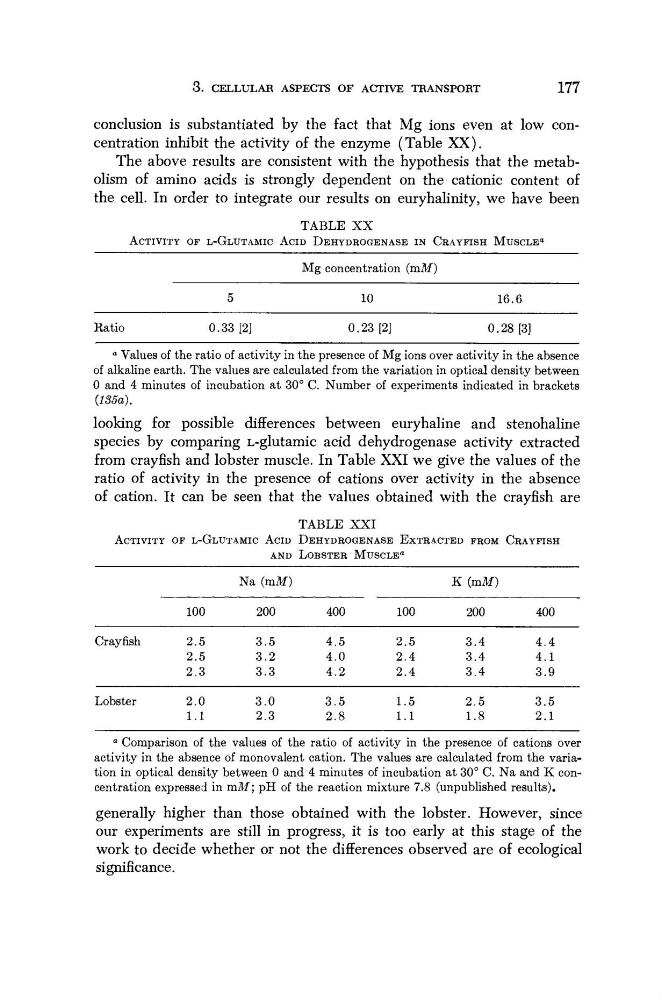
conclusion is substantiated by the fact that Mg ions even at low concentration inhibit the activity of the enzyme (Table XX).
The above results are consistent with the hypothesis that the metabolism of amino acids is strongly dependent on the cationic content of
the cell. In order to integrate our results on euryhalinity, we have been
TABLE XX
ACTIVITY OF L-GLUTAMIC ACID DEHYDROGENASE IN CRAYFISH MUSCLE"
Mg concentration (mM)
5
10
16.6
Ratio
0.33 [2]
0.23 [2]
0.28 [3]
a Values of the ratio of activity in the presence of Mg ions over activity in the absence
of alkaline earth. The values are calculated from the variation in optical density between
0 and 4 minutes of incubation at 30° C. Number of experiments indicated in brackets
(135a).
looking for possible differences between euryhaline and stenohaline
species by comparing L-glutamic acid dehydrogenase activity extracted
from crayfish and lobster muscle. In Table XXI we give the values of the
ratio of activity in the presence of cations over activity in the absence
of cation. It can be seen that the values obtained with the crayfish are
TABLE XXI
ACTIVITY OF L-GLUTAMIC ACID DEHYDROGENASE EXTRACTED FROM CRAYFISH
AND LOBSTER MUSCLE
0
Na (mM)
Κ (mM)
100
200
400
100
200
400
Crayfish
2.5
3.5
4.5
2.5
3.4
4.4
2.5
3.2
4.0
2.4
3.4
4.1
2.3
3.3
4.2
2.4
3.4
3.9
Lobster
2.0
3.0
3.5
1.5
2.5
3.5
1.1
2.3
2.8
1.1
1.8
2.1
° Comparison of the values of the ratio of activity in the presence of cations over
activity in the absence of monovalent cation. The values are calculated from the variation in optical density between 0 and 4 minutes of incubation at 30° C. Na and Κ concentration expressed in mM; pH of the reaction mixture 7.8 (unpublished results).
generally higher than those obtained with the lobster. However, since
our experiments are still in progress, it is too early at this stage of the
work to decide whether or not the differences observed are of ecological
significance.
177
conclusion is substantiated by the fact that Mg ions even at low concentration inhibit the activity of the enzyme (Table XX).
The above results are consistent with the hypothesis that the metabolism of amino acids is strongly dependent on the cationic content of
the cell. In order to integrate our results on euryhalinity, we have been
TABLE XX
ACTIVITY OF L-GLUTAMIC ACID DEHYDROGENASE IN CRAYFISH MUSCLE"
Mg concentration (mM)
5
10
16.6
Ratio
0.33 [2]
0.23 [2]
0.28 [3]
a Values of the ratio of activity in the presence of Mg ions over activity in the absence
of alkaline earth. The values are calculated from the variation in optical density between
0 and 4 minutes of incubation at 30° C. Number of experiments indicated in brackets
(135a).
looking for possible differences between euryhaline and stenohaline
species by comparing L-glutamic acid dehydrogenase activity extracted
from crayfish and lobster muscle. In Table XXI we give the values of the
ratio of activity in the presence of cations over activity in the absence
of cation. It can be seen that the values obtained with the crayfish are
TABLE XXI
ACTIVITY OF L-GLUTAMIC ACID DEHYDROGENASE EXTRACTED FROM CRAYFISH
AND LOBSTER MUSCLE
0
Na (mM)
Κ (mM)
100
200
400
100
200
400
Crayfish
2.5
3.5
4.5
2.5
3.4
4.4
2.5
3.2
4.0
2.4
3.4
4.1
2.3
3.3
4.2
2.4
3.4
3.9
Lobster
2.0
3.0
3.5
1.5
2.5
3.5
1.1
2.3
2.8
1.1
1.8
2.1
° Comparison of the values of the ratio of activity in the presence of cations over
activity in the absence of monovalent cation. The values are calculated from the variation in optical density between 0 and 4 minutes of incubation at 30° C. Na and Κ concentration expressed in mM; pH of the reaction mixture 7.8 (unpublished results).
generally higher than those obtained with the lobster. However, since
our experiments are still in progress, it is too early at this stage of the
work to decide whether or not the differences observed are of ecological
significance.