

178
ERNEST SCHOFFENIELS
It is also worth noticing that the rates of the two possible reactions
catalyzed by L-glutamic acid dehydrogenase are in our experimental
conditions very different. If we compare the rate of the reaction
Glu + DPN -» α-Ketoglutarate + NH 3 + DPNH
(1)
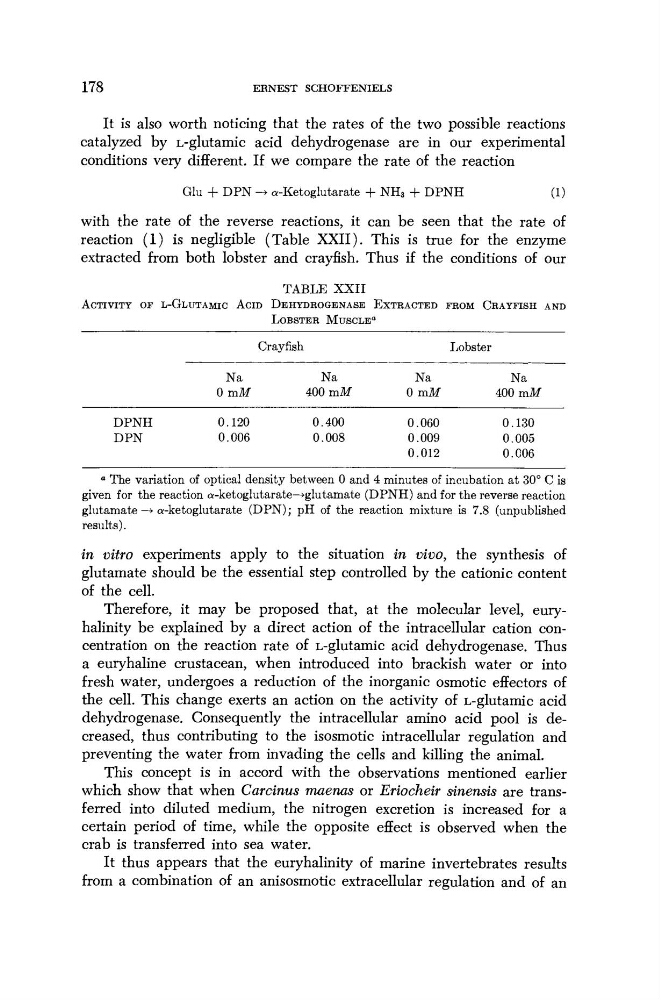
with the rate of the reverse reactions, it can be seen that the rate of
reaction (1) is negligible (Table XXII). This is true for the enzyme
extracted from both lobster and crayfish. Thus if the conditions of our
TABLE XXII
ACTIVITY OF L-GLUTAMIC ACID DEHYDROGENASE EXTRACTED FROM CRAYFISH AND
LOBSTER MUSCLE"
Crayfish
Lobster
Na
Na
Na
Na
0 mM
400 mM
0 mM
400 mM
DPNH
0.120
0.400
0.060
0.130
DPN
0.006
0.008
0.009
0.005
0.012
0.006
α The variation of optical density between 0 and 4 minutes of incubation at 30° C is
given for the reaction a-ketoglutarate->glutamate (DPNH) and for the reverse reaction
glutamate —> α-ketoglutarate (DPN); pH of the reaction mixture is 7.8 (unpublished
results).
in vitro experiments apply to the situation in vivo, the synthesis of
glutamate should be the essential step controlled by the cationic content
of the cell.
Therefore, it may be proposed that, at the molecular level, euryhalinity be explained by a direct action of the intracellular cation concentration on the reaction rate of L-glutamic acid dehydrogenase. Thus
a euryhaline crustacean, when introduced into brackish water or into
fresh water, undergoes a reduction of the inorganic osmotic effectors of
the cell. This change exerts an action on the activity of L-glutamic acid
dehydrogenase. Consequently the intracellular amino acid pool is decreased, thus contributing to the isosmotic intracellular regulation and
preventing the water from invading the cells and killing the animal.
This concept is in accord with the observations mentioned earlier
which show that when Carcinus maenas or Eriocheir sinensis are transferred into diluted medium, the nitrogen excretion is increased for a
certain period of time, while the opposite effect is observed when the
crab is transferred into sea water.
It thus appears that the euryhalinity of marine invertebrates results
from a combination of an anisosmotic extracellular regulation and of an
ERNEST SCHOFFENIELS
It is also worth noticing that the rates of the two possible reactions
catalyzed by L-glutamic acid dehydrogenase are in our experimental
conditions very different. If we compare the rate of the reaction
Glu + DPN -» α-Ketoglutarate + NH 3 + DPNH
(1)
with the rate of the reverse reactions, it can be seen that the rate of
reaction (1) is negligible (Table XXII). This is true for the enzyme
extracted from both lobster and crayfish. Thus if the conditions of our
TABLE XXII
ACTIVITY OF L-GLUTAMIC ACID DEHYDROGENASE EXTRACTED FROM CRAYFISH AND
LOBSTER MUSCLE"
Crayfish
Lobster
Na
Na
Na
Na
0 mM
400 mM
0 mM
400 mM
DPNH
0.120
0.400
0.060
0.130
DPN
0.006
0.008
0.009
0.005
0.012
0.006
α The variation of optical density between 0 and 4 minutes of incubation at 30° C is
given for the reaction a-ketoglutarate->glutamate (DPNH) and for the reverse reaction
glutamate —> α-ketoglutarate (DPN); pH of the reaction mixture is 7.8 (unpublished
results).
in vitro experiments apply to the situation in vivo, the synthesis of
glutamate should be the essential step controlled by the cationic content
of the cell.
Therefore, it may be proposed that, at the molecular level, euryhalinity be explained by a direct action of the intracellular cation concentration on the reaction rate of L-glutamic acid dehydrogenase. Thus
a euryhaline crustacean, when introduced into brackish water or into
fresh water, undergoes a reduction of the inorganic osmotic effectors of
the cell. This change exerts an action on the activity of L-glutamic acid
dehydrogenase. Consequently the intracellular amino acid pool is decreased, thus contributing to the isosmotic intracellular regulation and
preventing the water from invading the cells and killing the animal.
This concept is in accord with the observations mentioned earlier
which show that when Carcinus maenas or Eriocheir sinensis are transferred into diluted medium, the nitrogen excretion is increased for a
certain period of time, while the opposite effect is observed when the
crab is transferred into sea water.
It thus appears that the euryhalinity of marine invertebrates results
from a combination of an anisosmotic extracellular regulation and of an