

3. CELLULAR ASPECTS OF ACTIVE TRANSPORT
171
fibers can prevent excessive water loss by the addition of nitrogenous
substances, the process being reversible.
The question arises as to the origin of the amino acids. There are at
least two possibilities: the amino acids could be of extracellular origin
and transported (actively or not) in the cell; or they could come from
within the cell.
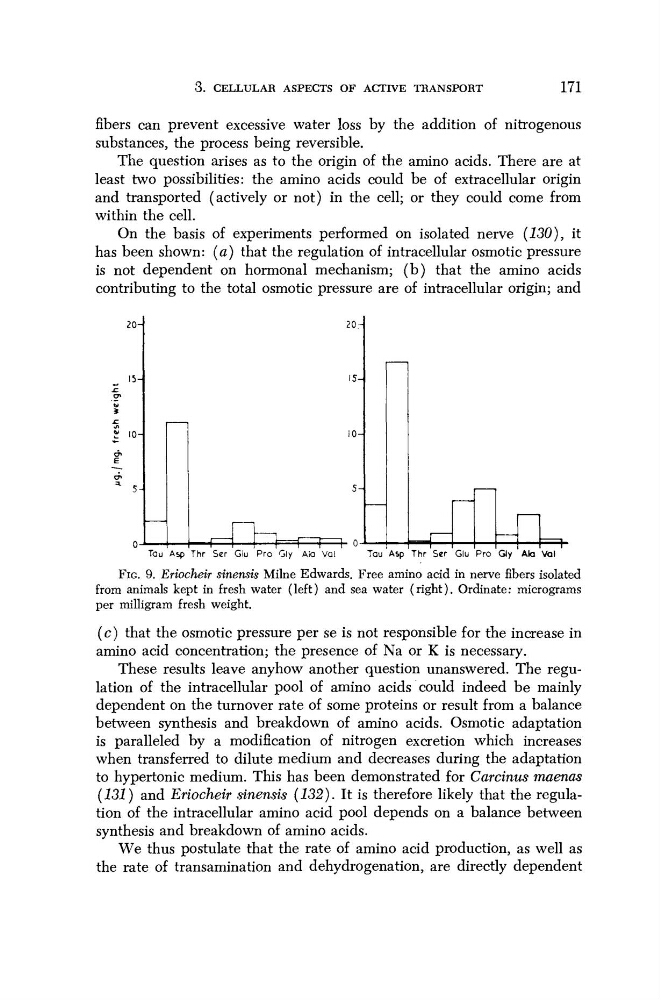
On the basis of experiments performed on isolated nerve (130), it
has been shown: (a) that the regulation of intracellular osmotic pressure
is not dependent on hormonal mechanism; (b) that the amino acids
contributing to the total osmotic pressure are of intracellular origin; and
20I5H
S! 105H
20:
'5^
Ταυ Asp Thr Ser Glu Pro Gly Ala Val
Tau Asp Thr Ser Glu Pro Gly Ala Val
FIG. 9. Eriocheir sinensis Milne Edwards. Free amino acid in nerve fibers isolated
from animals kept in fresh water (left) and sea water (right). Ordinate: micrograms
per milligram fresh weight.
(c) that the osmotic pressure per se is not responsible for the increase in
amino acid concentration; the presence of Na or Κ is necessary.
These results leave anyhow another question unanswered. The regulation of the intracellular pool of amino acids could indeed be mainly
dependent on the turnover rate of some proteins or result from a balance
between synthesis and breakdown of amino acids. Osmotic adaptation
is paralleled by a modification of nitrogen excretion which increases
when transferred to dilute medium and decreases during the adaptation
to hypertonic medium. This has been demonstrated for Carduus maenas
(131) and Eriocheir sinensis (132). It is therefore likely that the regulation of the intracellular amino acid pool depends on a balance between
synthesis and breakdown of amino acids.
We thus postulate that the rate of amino acid production, as well as
the rate of transamination and dehydrogenation, are directly dependent
171
fibers can prevent excessive water loss by the addition of nitrogenous
substances, the process being reversible.
The question arises as to the origin of the amino acids. There are at
least two possibilities: the amino acids could be of extracellular origin
and transported (actively or not) in the cell; or they could come from
within the cell.
On the basis of experiments performed on isolated nerve (130), it
has been shown: (a) that the regulation of intracellular osmotic pressure
is not dependent on hormonal mechanism; (b) that the amino acids
contributing to the total osmotic pressure are of intracellular origin; and
20I5H
S! 105H
20:
'5^
Ταυ Asp Thr Ser Glu Pro Gly Ala Val
Tau Asp Thr Ser Glu Pro Gly Ala Val
FIG. 9. Eriocheir sinensis Milne Edwards. Free amino acid in nerve fibers isolated
from animals kept in fresh water (left) and sea water (right). Ordinate: micrograms
per milligram fresh weight.
(c) that the osmotic pressure per se is not responsible for the increase in
amino acid concentration; the presence of Na or Κ is necessary.
These results leave anyhow another question unanswered. The regulation of the intracellular pool of amino acids could indeed be mainly
dependent on the turnover rate of some proteins or result from a balance
between synthesis and breakdown of amino acids. Osmotic adaptation
is paralleled by a modification of nitrogen excretion which increases
when transferred to dilute medium and decreases during the adaptation
to hypertonic medium. This has been demonstrated for Carduus maenas
(131) and Eriocheir sinensis (132). It is therefore likely that the regulation of the intracellular amino acid pool depends on a balance between
synthesis and breakdown of amino acids.
We thus postulate that the rate of amino acid production, as well as
the rate of transamination and dehydrogenation, are directly dependent