

170
ERNEST SCHOFFENIELS
lower than that in the intracellular fluid; (b) the total concentration of
the 15 amino acids studied is higher in the marine species than in the
freshwater species. This observation suggests that free amino acids play
an important role in the osmoregulation of the intracellular fluid and
could explain the osmotic deficit already noticed by Leon Fredericq in
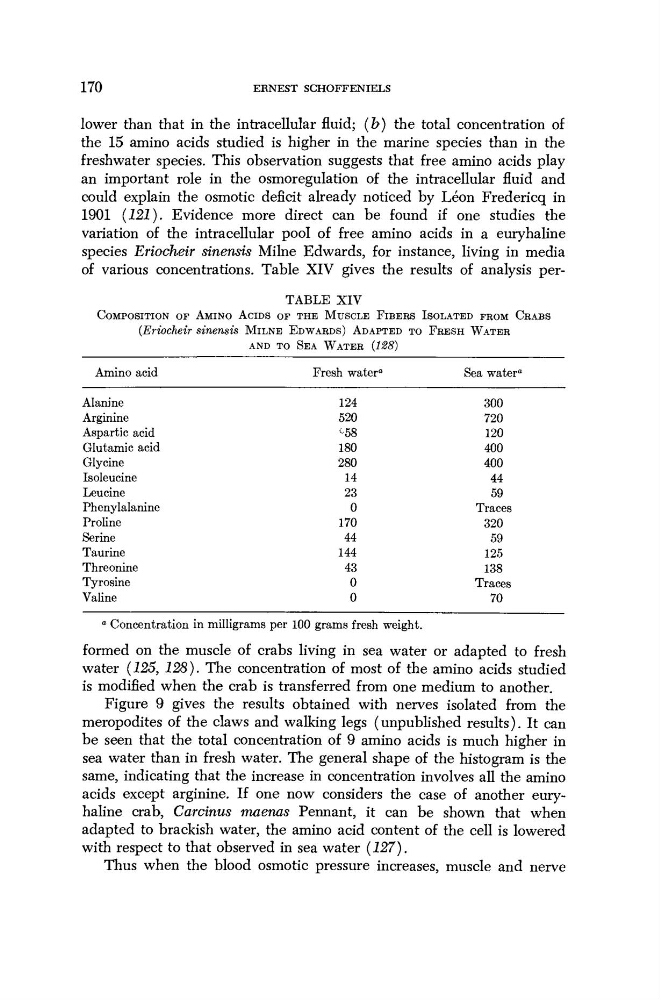
1901 (121). Evidence more direct can be found if one studies the
variation of the intracellular pool of free amino acids in a euryhaline
species Eriocheir sinensis Milne Edwards, for instance, living in media
of various concentrations. Table XIV gives the results of analysis perTABLE XIV
COMPOSITION OF AMINO ACIDS OF THE MUSCLE FIBERS ISOLATED FROM CRABS
(Eriocheir sinensis MILNE EDWARDS) ADAPTED TO FRESH WATER
AND το SEA WATER (128)
Amino acid
Fresh water
0
Sea water
0
Alanine
124
300
Arginine
520
720
Aspartic acid
-58
120
Glutamic acid
180
400
Glycine
280
400
Isoleucine
14
44
Leucine
23
59
Phenylalanine
0
Traces
Proline
170
320
Serine
44
59
Taurine
144
125
Threonine
43
138
Tyrosine
0
Traces
Valine
0
70
° Concentration in milligrams per 100 grams fresh weight.
formed on the muscle of crabs living in sea water or adapted to fresh
water (125, 128). The concentration of most of the amino acids studied
is modified when the crab is transferred from one medium to another.
Figure 9 gives the results obtained with nerves isolated from the
meropodites of the claws and walking legs (unpublished results). It can
be seen that the total concentration of 9 amino acids is much higher in
sea water than in fresh water. The general shape of the histogram is the
same, indicating that the increase in concentration involves all the amino
acids except arginine. If one now considers the case of another euryhaline crab, Carcinus maenas Pennant, it can be shown that when
adapted to brackish water, the amino acid content of the cell is lowered
with respect to that observed in sea water (127).
Thus when the blood osmotic pressure increases, muscle and nerve
ERNEST SCHOFFENIELS
lower than that in the intracellular fluid; (b) the total concentration of
the 15 amino acids studied is higher in the marine species than in the
freshwater species. This observation suggests that free amino acids play
an important role in the osmoregulation of the intracellular fluid and
could explain the osmotic deficit already noticed by Leon Fredericq in
1901 (121). Evidence more direct can be found if one studies the
variation of the intracellular pool of free amino acids in a euryhaline
species Eriocheir sinensis Milne Edwards, for instance, living in media
of various concentrations. Table XIV gives the results of analysis perTABLE XIV
COMPOSITION OF AMINO ACIDS OF THE MUSCLE FIBERS ISOLATED FROM CRABS
(Eriocheir sinensis MILNE EDWARDS) ADAPTED TO FRESH WATER
AND το SEA WATER (128)
Amino acid
Fresh water
0
Sea water
0
Alanine
124
300
Arginine
520
720
Aspartic acid
-58
120
Glutamic acid
180
400
Glycine
280
400
Isoleucine
14
44
Leucine
23
59
Phenylalanine
0
Traces
Proline
170
320
Serine
44
59
Taurine
144
125
Threonine
43
138
Tyrosine
0
Traces
Valine
0
70
° Concentration in milligrams per 100 grams fresh weight.
formed on the muscle of crabs living in sea water or adapted to fresh
water (125, 128). The concentration of most of the amino acids studied
is modified when the crab is transferred from one medium to another.
Figure 9 gives the results obtained with nerves isolated from the
meropodites of the claws and walking legs (unpublished results). It can
be seen that the total concentration of 9 amino acids is much higher in
sea water than in fresh water. The general shape of the histogram is the
same, indicating that the increase in concentration involves all the amino
acids except arginine. If one now considers the case of another euryhaline crab, Carcinus maenas Pennant, it can be shown that when
adapted to brackish water, the amino acid content of the cell is lowered
with respect to that observed in sea water (127).
Thus when the blood osmotic pressure increases, muscle and nerve