

172
ERNEST SCHOFFENIELS
on the ionic composition of the intracellular liquid. There are experimental arguments in favor of this view.
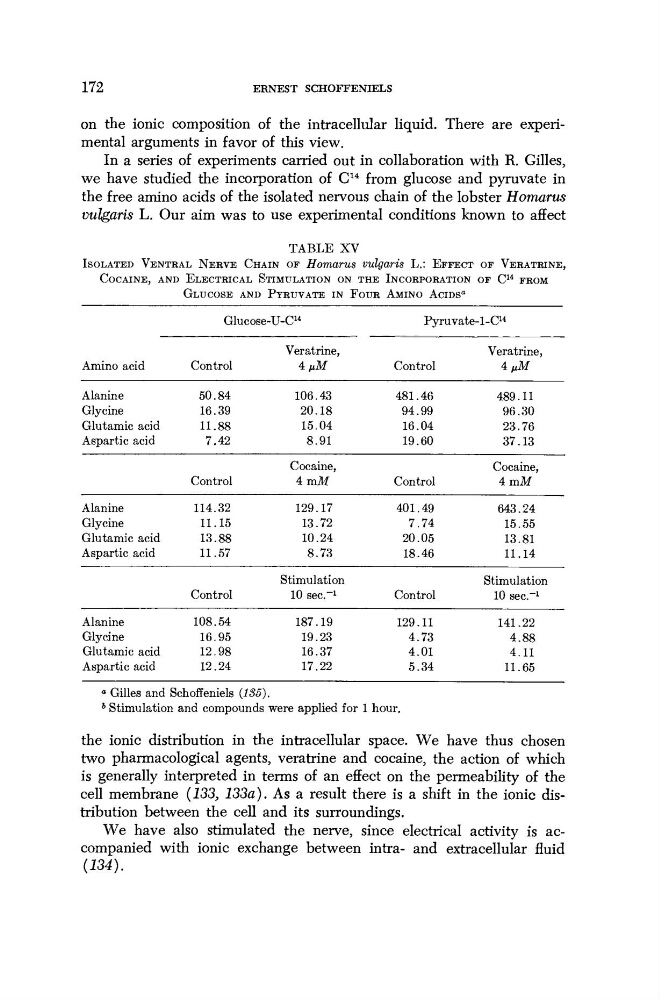
In a series of experiments carried out in collaboration with R. Gilles,
we have studied the incorporation of C
14 from glucose and pyruvate in
the free amino acids of the isolated nervous chain of the lobster Homarus
vulgaris L. Our aim was to use experimental conditions known to affect
TABLE XV
ISOLATED VENTRAL NERVE CHAIN OF Homarus vulgaris L.: EFFECT OF VERATRINE,
COCAINE, AND ELECTRICAL STIMULATION ON THE INCORPORATION OF C
14 FROM
GLUCOSE AND PYRUVATE IN FOUR AMINO ACIDS"
Glucose-U-C
14
Pyruvate-l-C
14
Veratrine,
Veratrine,
Amino acid
Control
4 μΜ
Control
4 M ilf
Alanine
50.84
106.43
481.46
489.11
Glycine
16.39
20.18
94.99
96.30
Glutamic acid
11.88
15.04
16.04
23.76
Aspartic acid
7.42
8.91
19.60
37.13
Cocaine,
Cocaine,
Control
4 mM
Control
4 mM
Alanine
114.32
129.17
401.49
643.24
Glycine
11.15
13.72
7.74
15.55
Glutamic acid
13.88
10.24
20.05
13.81
Aspartic acid
11.57
8.73
18.46
11.14
Stimulation
Stimulation
Control
10 sec."
1
Control
10 sec."
1
Alanine
108.54
187.19
129.11
141.22
Glycine
16.95
19.23
4.73
4.88
Glutamic acid
12.98
16.37
4.01
4.11
Aspartic acid
12.24
17.22
5.34
11.65
° Gilles and Schoffeniels (185).
b Stimulation and compounds were applied for 1 hour.
the ionic distribution in the intracellular space. We have thus chosen
two pharmacological agents, veratrine and cocaine, the action of which
is generally interpreted in terms of an effect on the permeability of the
cell membrane (133, 133a). As a result there is a shift in the ionic distribution between the cell and its surroundings.
We have also stimulated the nerve, since electrical activity is accompanied with ionic exchange between intra- and extracellular fluid
(134).
ERNEST SCHOFFENIELS
on the ionic composition of the intracellular liquid. There are experimental arguments in favor of this view.
In a series of experiments carried out in collaboration with R. Gilles,
we have studied the incorporation of C
14 from glucose and pyruvate in
the free amino acids of the isolated nervous chain of the lobster Homarus
vulgaris L. Our aim was to use experimental conditions known to affect
TABLE XV
ISOLATED VENTRAL NERVE CHAIN OF Homarus vulgaris L.: EFFECT OF VERATRINE,
COCAINE, AND ELECTRICAL STIMULATION ON THE INCORPORATION OF C
14 FROM
GLUCOSE AND PYRUVATE IN FOUR AMINO ACIDS"
Glucose-U-C
14
Pyruvate-l-C
14
Veratrine,
Veratrine,
Amino acid
Control
4 μΜ
Control
4 M ilf
Alanine
50.84
106.43
481.46
489.11
Glycine
16.39
20.18
94.99
96.30
Glutamic acid
11.88
15.04
16.04
23.76
Aspartic acid
7.42
8.91
19.60
37.13
Cocaine,
Cocaine,
Control
4 mM
Control
4 mM
Alanine
114.32
129.17
401.49
643.24
Glycine
11.15
13.72
7.74
15.55
Glutamic acid
13.88
10.24
20.05
13.81
Aspartic acid
11.57
8.73
18.46
11.14
Stimulation
Stimulation
Control
10 sec."
1
Control
10 sec."
1
Alanine
108.54
187.19
129.11
141.22
Glycine
16.95
19.23
4.73
4.88
Glutamic acid
12.98
16.37
4.01
4.11
Aspartic acid
12.24
17.22
5.34
11.65
° Gilles and Schoffeniels (185).
b Stimulation and compounds were applied for 1 hour.
the ionic distribution in the intracellular space. We have thus chosen
two pharmacological agents, veratrine and cocaine, the action of which
is generally interpreted in terms of an effect on the permeability of the
cell membrane (133, 133a). As a result there is a shift in the ionic distribution between the cell and its surroundings.
We have also stimulated the nerve, since electrical activity is accompanied with ionic exchange between intra- and extracellular fluid
(134).