

146
ERNEST SCHOFFENIELS
pyridoxal would stimulate the influx across the cellular membranes facing
the solution containing this compound.
A technique introduced more recently (16) meets all the requirements necessary to ascertain unequivocally the nature of the forces
responsible for the movement of an ion or molecule across the intestinal
epithelium. It is patterned on the method used with the single isolated
electroplax of Electrophorus electricus L. (47, 48, 49). A segment of intestine is opened flat and the epithelium is gently stripped off the muscle
layers. This operation can be done with many species without harm to
the epithelium, but it is more easily performed with the guinea pig and
various species of turtle. Histological sections of the epithelium have
shown that this procedure does not alter visibly the microscopic morphology of the tissue. This observation is furthermore substantiated by permeability studies showing that the functional integrity of the epithelium is
well preserved. The epithelium is then inserted between two Plexiglas
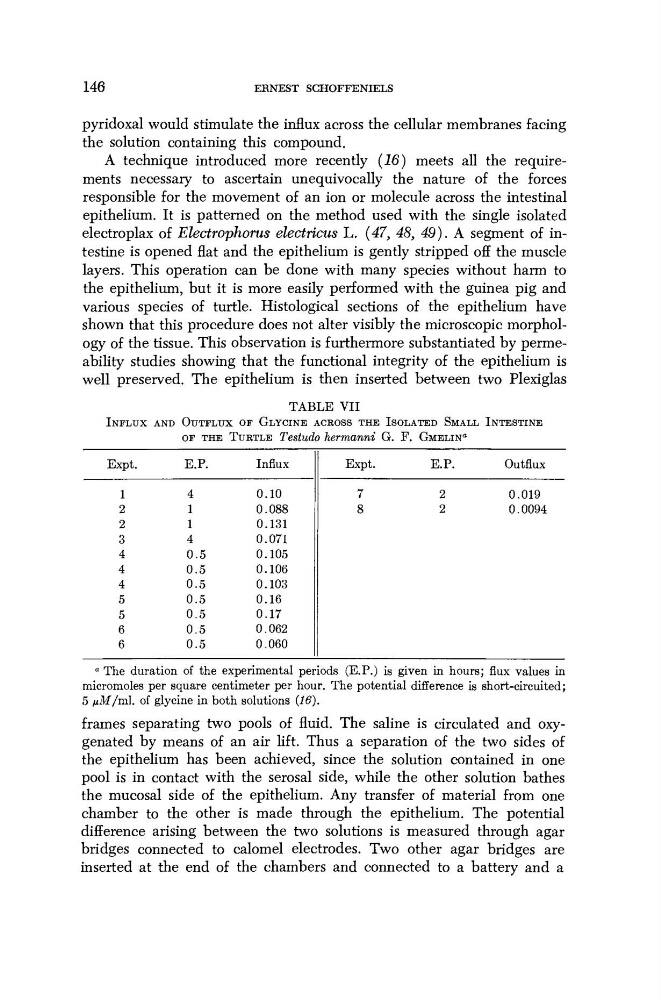
TABLE VII
INFLUX AND OUTFLUX OF GLYCINE ACROSS THE ISOLATED SMALL INTESTINE
OF THE TURTLE Testudo hermanni G. F. GMELIN"
Expt.
E.P.
Influx
Expt.
E.P.
Outflux
1
4
0 10
7
2
0.019
2
1
0 088
8
2
0.0094
2
1
0 131
3
4
0 071
4
0.5
0 105
4
0.5
0 106
4
0.5
0 103
5
0.5
0 16
5
0.5
0 17
6
0.5
0 062
6
0.5
0 060
α The duration of the experimental periods (E.P.) is given in hours; flux values in
micromoles per square centimeter per hour. The potential difference is short-circuited;
5 μΜ/τώ. of glycine in both solutions (16).
frames separating two pools of fluid. The saline is circulated and oxygenated by means of an air lift. Thus a separation of the two sides of
the epithelium has been achieved, since the solution contained in one
pool is in contact with the serosal side, while the other solution bathes
the mucosal side of the epithelium. Any transfer of material from one
chamber to the other is made through the epithelium. The potential
difference arising between the two solutions is measured through agar
bridges connected to calomel electrodes. Two other agar bridges are
inserted at the end of the chambers and connected to a battery and a
ERNEST SCHOFFENIELS
pyridoxal would stimulate the influx across the cellular membranes facing
the solution containing this compound.
A technique introduced more recently (16) meets all the requirements necessary to ascertain unequivocally the nature of the forces
responsible for the movement of an ion or molecule across the intestinal
epithelium. It is patterned on the method used with the single isolated
electroplax of Electrophorus electricus L. (47, 48, 49). A segment of intestine is opened flat and the epithelium is gently stripped off the muscle
layers. This operation can be done with many species without harm to
the epithelium, but it is more easily performed with the guinea pig and
various species of turtle. Histological sections of the epithelium have
shown that this procedure does not alter visibly the microscopic morphology of the tissue. This observation is furthermore substantiated by permeability studies showing that the functional integrity of the epithelium is
well preserved. The epithelium is then inserted between two Plexiglas
TABLE VII
INFLUX AND OUTFLUX OF GLYCINE ACROSS THE ISOLATED SMALL INTESTINE
OF THE TURTLE Testudo hermanni G. F. GMELIN"
Expt.
E.P.
Influx
Expt.
E.P.
Outflux
1
4
0 10
7
2
0.019
2
1
0 088
8
2
0.0094
2
1
0 131
3
4
0 071
4
0.5
0 105
4
0.5
0 106
4
0.5
0 103
5
0.5
0 16
5
0.5
0 17
6
0.5
0 062
6
0.5
0 060
α The duration of the experimental periods (E.P.) is given in hours; flux values in
micromoles per square centimeter per hour. The potential difference is short-circuited;
5 μΜ/τώ. of glycine in both solutions (16).
frames separating two pools of fluid. The saline is circulated and oxygenated by means of an air lift. Thus a separation of the two sides of
the epithelium has been achieved, since the solution contained in one
pool is in contact with the serosal side, while the other solution bathes
the mucosal side of the epithelium. Any transfer of material from one
chamber to the other is made through the epithelium. The potential
difference arising between the two solutions is measured through agar
bridges connected to calomel electrodes. Two other agar bridges are
inserted at the end of the chambers and connected to a battery and a