

3. CELLULAR ASPECTS OF ACTIVE TRANSPORT
147
variable resistor. It is thus possible to pass an electric current through
the preparation in such a way that the potential difference existing across
the epithelium is abolished. This is the short circuit current. The intensity
of the current is read on a microammeter.
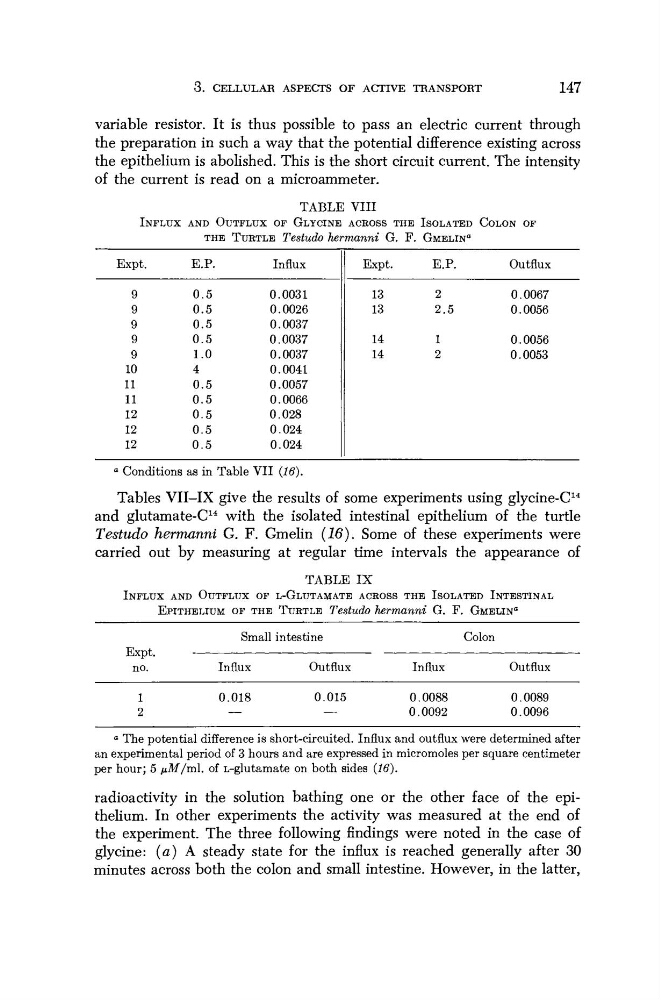
TABLE VIII
INFLUX AND OUTFLUX OF GLYCINE ACROSS THE ISOLATED COLON OF
THE TURTLE Testudo hermanni G. F. GMELIN"
Expt.
E.P.
Influx
Expt.
E.P.
Outflux
9
0.5
0.0031
13
2
0.0067
9
0.5
0.0026
13
2.5
0.0056
9
0.5
0.0037
9
0.5
0.0037
14
1
0.0056
9
1.0
0.0037
14
2
0.0053
10
4
0.0041
11
0.5
0.0057
11
0.5
0.0066
12
0.5
0.028
12
0.5
0.024
12
0.5
0.024
° Conditions as in Table VII (16).
Tables VII-IX give the results of some experiments using glycine-C
14
and glutamate-C
14
with the isolated intestinal epithelium of the turtle
Testudo hermanni G. F. Gmelin (16). Some of these experiments were
carried out by measuring at regular time intervals the appearance of
TABLE IX
INFLUX AND OUTFLUX OF L-GLUTAMATE ACROSS THE ISOLATED INTESTINAL
EPITHELIUM OF THE TURTLE Testudo hermanni G. F. GMELIN
0
Expt.
no.
Small intestine
Colon
Expt.
no.
Influx
Outflux
Influx
Outflux
1
2
0.018
0.015
0.0088
0.0092
0.0089
0.0096
a The potential difference is short-circuited. Influx and outflux were determined after
an experimental period of 3 hours and are expressed in micromoles per square centimeter
per hour; 5 μΜ/ml. of L-glutamate on both sides (16).
radioactivity in the solution bathing one or the other face of the epithelium. In other experiments the activity was measured at the end of
the experiment. The three following findings were noted in the case of
glycine: (a) A steady state for the influx is reached generally after 30
minutes across both the colon and small intestine. However, in the latter,
147
variable resistor. It is thus possible to pass an electric current through
the preparation in such a way that the potential difference existing across
the epithelium is abolished. This is the short circuit current. The intensity
of the current is read on a microammeter.
TABLE VIII
INFLUX AND OUTFLUX OF GLYCINE ACROSS THE ISOLATED COLON OF
THE TURTLE Testudo hermanni G. F. GMELIN"
Expt.
E.P.
Influx
Expt.
E.P.
Outflux
9
0.5
0.0031
13
2
0.0067
9
0.5
0.0026
13
2.5
0.0056
9
0.5
0.0037
9
0.5
0.0037
14
1
0.0056
9
1.0
0.0037
14
2
0.0053
10
4
0.0041
11
0.5
0.0057
11
0.5
0.0066
12
0.5
0.028
12
0.5
0.024
12
0.5
0.024
° Conditions as in Table VII (16).
Tables VII-IX give the results of some experiments using glycine-C
14
and glutamate-C
14
with the isolated intestinal epithelium of the turtle
Testudo hermanni G. F. Gmelin (16). Some of these experiments were
carried out by measuring at regular time intervals the appearance of
TABLE IX
INFLUX AND OUTFLUX OF L-GLUTAMATE ACROSS THE ISOLATED INTESTINAL
EPITHELIUM OF THE TURTLE Testudo hermanni G. F. GMELIN
0
Expt.
no.
Small intestine
Colon
Expt.
no.
Influx
Outflux
Influx
Outflux
1
2
0.018
0.015
0.0088
0.0092
0.0089
0.0096
a The potential difference is short-circuited. Influx and outflux were determined after
an experimental period of 3 hours and are expressed in micromoles per square centimeter
per hour; 5 μΜ/ml. of L-glutamate on both sides (16).
radioactivity in the solution bathing one or the other face of the epithelium. In other experiments the activity was measured at the end of
the experiment. The three following findings were noted in the case of
glycine: (a) A steady state for the influx is reached generally after 30
minutes across both the colon and small intestine. However, in the latter,