

144
ERNEST SCHOFFENIELS
amino acid being unaffected (36, 37). Previous in vitro studies of the
intestine indicated that while L-cystine was actively transported against
a concentration gradient (38), L-lysine and L-ornithine were not thus
transported (31). On the other hand, L-lysine was absorbed more rapidly
than its D enantiomorph under in vivo conditions (39). It was also
shown that intravenous injection of pyridoxine stimulated L-lysine absorption in vitamin B 6 -deficient rats (15). These latter results suggest
that the absorption of at least one of the basic amino acids might be
mediated by a special carrier. Recently an important observation was
made by Milne et al. (40), who reported that patients with cystinuria
showed a defect in the intestinal absorption of L-lysine and L-ornithine.
From this observation it would appear that the epithelial cells of the
intestine may possess the same carrier system for the basic amino acid
which is present in the proximal tubules of the kidney, and that the same
mutation affects both systems. In view of these findings Hagihira et al.
(41) have reinvestigated the problem, using the technique of the everted
sacs of hamster intestine in order to see if an absorption of basic amino
acids could be demonstrated in the intestinal epithelium.
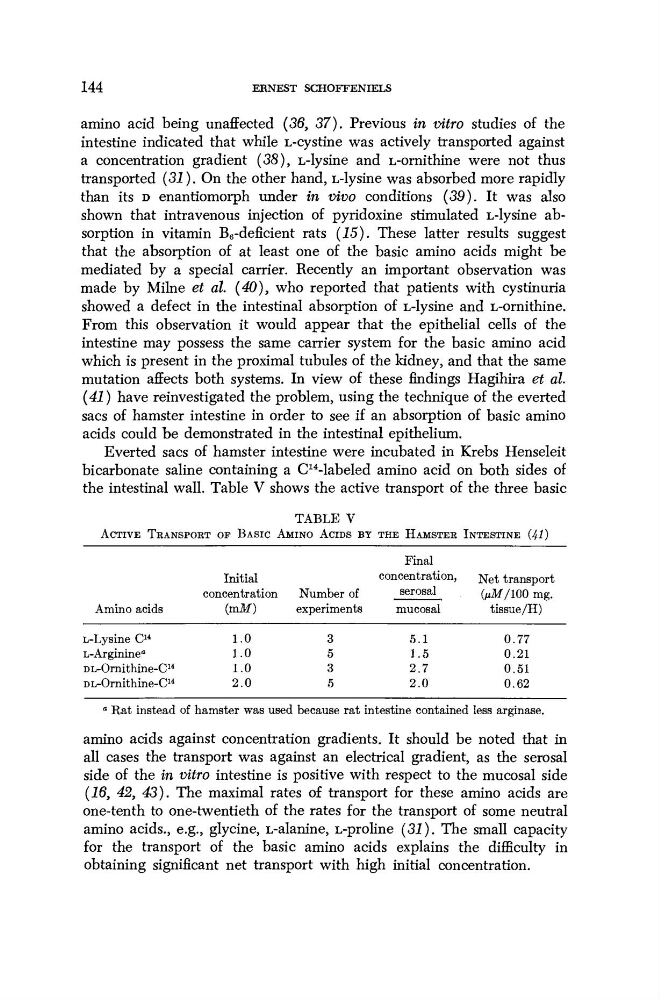
Everted sacs of hamster intestine were incubated in Krebs Henseleit
bicarbonate saline containing a C
14
-labeled amino acid on both sides of
the intestinal wall. Table V shows the active transport of the three basic
TABLE V
ACTIVE TRANSPORT OF BASIC AMINO ACIDS BY THE HAMSTER INTESTINE (41)
Final
Initial
concentration,
Net transport
concentration
Number of
serosal
GuM/100 mg.
Amino acids
(mM)
experiments
mucosal
tissue/H)
L-Lysine C
14
1.0
3
5.1
0.77
L-Arginine°
1.0
5
1.5
0.21
DL-Ornithine-C
14
1.0
3
2.7
0.51
DL-Ornithine-C
14
2.0
5
2.0
0.62
° Rat instead of hamster was used because rat intestine contained less arginase.
amino acids against concentration gradients. It should be noted that in
all cases the transport was against an electrical gradient, as the serosal
side of the in vitro intestine is positive with respect to the mucosal side
(16, 42, 43). The maximal rates of transport for these amino acids are
one-tenth to one-twentieth of the rates for the transport of some neutral
amino acids., e.g., glycine, L-alanine, L-proline (31). The small capacity
for the transport of the basic amino acids explains the difficulty in
obtaining significant net transport with high initial concentration.
ERNEST SCHOFFENIELS
amino acid being unaffected (36, 37). Previous in vitro studies of the
intestine indicated that while L-cystine was actively transported against
a concentration gradient (38), L-lysine and L-ornithine were not thus
transported (31). On the other hand, L-lysine was absorbed more rapidly
than its D enantiomorph under in vivo conditions (39). It was also
shown that intravenous injection of pyridoxine stimulated L-lysine absorption in vitamin B 6 -deficient rats (15). These latter results suggest
that the absorption of at least one of the basic amino acids might be
mediated by a special carrier. Recently an important observation was
made by Milne et al. (40), who reported that patients with cystinuria
showed a defect in the intestinal absorption of L-lysine and L-ornithine.
From this observation it would appear that the epithelial cells of the
intestine may possess the same carrier system for the basic amino acid
which is present in the proximal tubules of the kidney, and that the same
mutation affects both systems. In view of these findings Hagihira et al.
(41) have reinvestigated the problem, using the technique of the everted
sacs of hamster intestine in order to see if an absorption of basic amino
acids could be demonstrated in the intestinal epithelium.
Everted sacs of hamster intestine were incubated in Krebs Henseleit
bicarbonate saline containing a C
14
-labeled amino acid on both sides of
the intestinal wall. Table V shows the active transport of the three basic
TABLE V
ACTIVE TRANSPORT OF BASIC AMINO ACIDS BY THE HAMSTER INTESTINE (41)
Final
Initial
concentration,
Net transport
concentration
Number of
serosal
GuM/100 mg.
Amino acids
(mM)
experiments
mucosal
tissue/H)
L-Lysine C
14
1.0
3
5.1
0.77
L-Arginine°
1.0
5
1.5
0.21
DL-Ornithine-C
14
1.0
3
2.7
0.51
DL-Ornithine-C
14
2.0
5
2.0
0.62
° Rat instead of hamster was used because rat intestine contained less arginase.
amino acids against concentration gradients. It should be noted that in
all cases the transport was against an electrical gradient, as the serosal
side of the in vitro intestine is positive with respect to the mucosal side
(16, 42, 43). The maximal rates of transport for these amino acids are
one-tenth to one-twentieth of the rates for the transport of some neutral
amino acids., e.g., glycine, L-alanine, L-proline (31). The small capacity
for the transport of the basic amino acids explains the difficulty in
obtaining significant net transport with high initial concentration.