

3. CELLULAR ASPECTS OF ACTIVE TRANSPORT
143
tion of D-methionine during absorption could not be demonstrated. The
L isomers of both methionine and histidine appear to be absorbed from
the chicken intestine by a common specific transport mechanism, Dmethionine being able to participate in at least one stage of this mechanism (26).
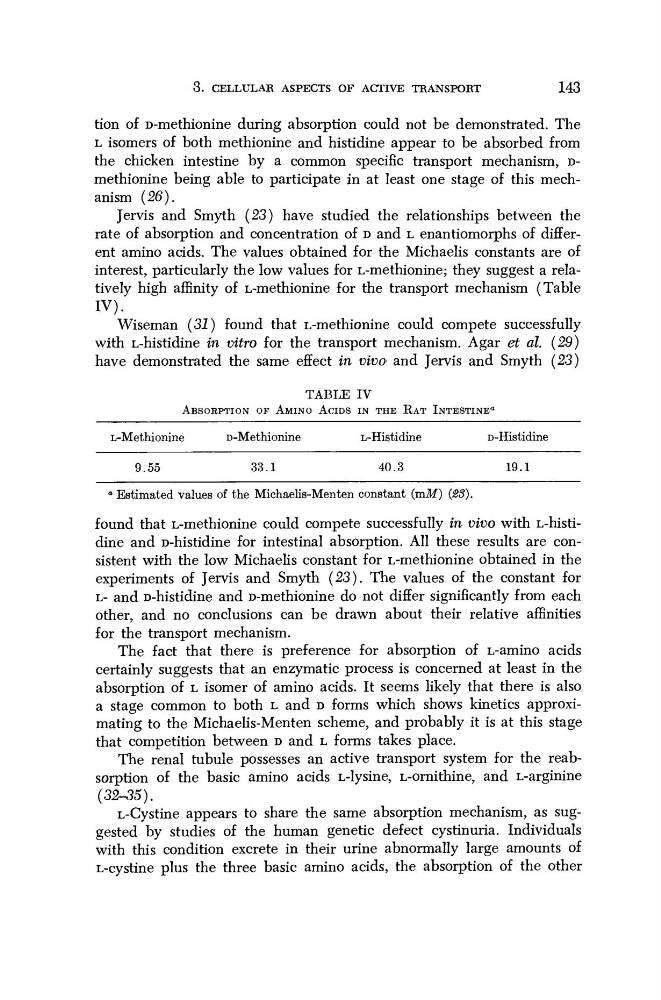
Jervis and Smyth (23) have studied the relationships between the
rate of absorption and concentration of D and L enantiomorphs of different amino acids. The values obtained for the Michaelis constants are of
interest, particularly the low values for L-methionine; they suggest a relatively high affinity of L-methionine for the transport mechanism (Table
IV).
Wiseman (31) found that L-methionine could compete successfully
with L-histidine in vitro for the transport mechanism. Agar et al. (29)
have demonstrated the same effect in vivo and Jervis and Smyth (23)
TABLE IV
ABSORPTION OF AMINO ACIDS IN THE RAT INTESTINE
0
L-Methionine
D-Methionine
L-Histidine
D-Histidine
9.55
33.1
40.3
19.1
α Estimated values of the Michaelis-Menten constant (mM) (28).
found that L-methionine could compete successfully in vivo with L-histidine and D-histidine for intestinal absorption. All these results are consistent with the low Michaelis constant for L-methionine obtained in the
experiments of Jervis and Smyth (23). The values of the constant for
L- and D-histidine and D-methionine do not differ significantly from each
other, and no conclusions can be drawn about their relative affinities
for the transport mechanism.
The fact that there is preference for absorption of L-amino acids
certainly suggests that an enzymatic process is concerned at least in the
absorption of L isomer of amino acids. It seems likely that there is also
a stage common to both L and D forms which shows kinetics approximating to the Michaelis-Menten scheme, and probably it is at this stage
that competition between D and L forms takes place.
The renal tubule possesses an active transport system for the reabsorption of the basic amino acids L-lysine, L-ornithine, and L-arginine
(32-35).
L-Cystine appears to share the same absorption mechanism, as suggested by studies of the human genetic defect cystinuria. Individuals
with this condition excrete in their urine abnormally large amounts of
L-cystine plus the three basic amino acids, the absorption of the other
143
tion of D-methionine during absorption could not be demonstrated. The
L isomers of both methionine and histidine appear to be absorbed from
the chicken intestine by a common specific transport mechanism, Dmethionine being able to participate in at least one stage of this mechanism (26).
Jervis and Smyth (23) have studied the relationships between the
rate of absorption and concentration of D and L enantiomorphs of different amino acids. The values obtained for the Michaelis constants are of
interest, particularly the low values for L-methionine; they suggest a relatively high affinity of L-methionine for the transport mechanism (Table
IV).
Wiseman (31) found that L-methionine could compete successfully
with L-histidine in vitro for the transport mechanism. Agar et al. (29)
have demonstrated the same effect in vivo and Jervis and Smyth (23)
TABLE IV
ABSORPTION OF AMINO ACIDS IN THE RAT INTESTINE
0
L-Methionine
D-Methionine
L-Histidine
D-Histidine
9.55
33.1
40.3
19.1
α Estimated values of the Michaelis-Menten constant (mM) (28).
found that L-methionine could compete successfully in vivo with L-histidine and D-histidine for intestinal absorption. All these results are consistent with the low Michaelis constant for L-methionine obtained in the
experiments of Jervis and Smyth (23). The values of the constant for
L- and D-histidine and D-methionine do not differ significantly from each
other, and no conclusions can be drawn about their relative affinities
for the transport mechanism.
The fact that there is preference for absorption of L-amino acids
certainly suggests that an enzymatic process is concerned at least in the
absorption of L isomer of amino acids. It seems likely that there is also
a stage common to both L and D forms which shows kinetics approximating to the Michaelis-Menten scheme, and probably it is at this stage
that competition between D and L forms takes place.
The renal tubule possesses an active transport system for the reabsorption of the basic amino acids L-lysine, L-ornithine, and L-arginine
(32-35).
L-Cystine appears to share the same absorption mechanism, as suggested by studies of the human genetic defect cystinuria. Individuals
with this condition excrete in their urine abnormally large amounts of
L-cystine plus the three basic amino acids, the absorption of the other