

142
ERNEST SCHOFFENIELS
concentration of D-alanine found in the blood irrigating an isolated
intestinal loop is less than the concentration of the L form in the same
conditions (28).
These results are generally interpreted as indicating a fixation of the
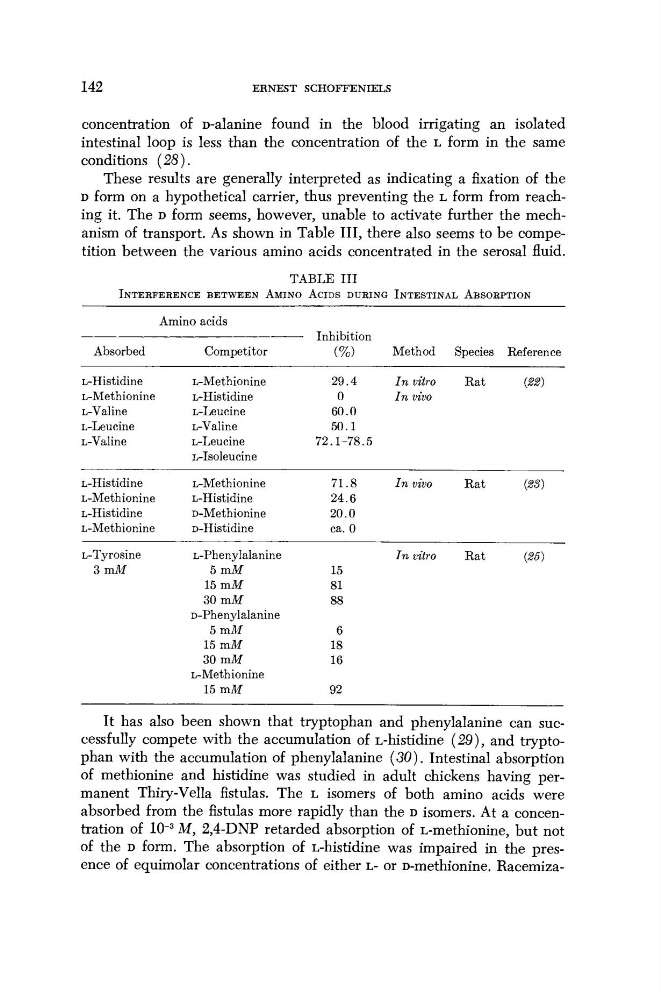
D form on a hypothetical carrier, thus preventing the L form from reaching it. The D form seems, however, unable to activate further the mechanism of transport. As shown in Table III, there also seems to be competition between the various amino acids concentrated in the serosal fluid.
TABLE III
INTERFERENCE BETWEEN AMINO ACIDS DURING INTESTINAL ABSORPTION
Amino acids
Inhibition
Absorbed
Competitor
(%)
Method Species Reference
L-Histidine
L-Methionine
29.4
In vitro
Rat
(22)
L-Methionine
L-Histidine
0
In vivo
L-Valine
L-Leucine
60.0
L-Leucine
L-Valine
50.1
L-Valine
L-Leucine
72.1-78.5
L-Isoleucine
L-Histidine
L-Methionine
71.8
In vivo
Rat
(23)
L-Methionine
L-Histidine
24.6
L-Histidine
D-Methionine
20.0
L-Methionine
D-Histidine
ca. 0
L-Tyrosine
L-Phenyl alanine
In vitro
Rat
(25)
3 ml
5 ml
15
15 ml
81
30 ml
88
D-Phenylalanine
5 ml
6
15 ml
18
30 ml
16
L-Methionine
15 ml
92
It has also been shown that tryptophan and phenylalanine can suecessfully compete with the accumulation of L-histidine (29), and tryptophan with the accumulation of phenylalanine (30). Intestinal absorption
of methionine and histidine was studied in adult chickens having permanent Thiry-Vella fistulas. The L isomers of both amino acids were
absorbed from the fistulas more rapidly than the D isomers. At a concentration of 10~
3 M, 2,4-DNP retarded absorption of L-methionine, but not
of the D form. The absorption of L-histidine was impaired in the presence of equimolar concentrations of either L- or D-methionine. Racemiza-
ERNEST SCHOFFENIELS
concentration of D-alanine found in the blood irrigating an isolated
intestinal loop is less than the concentration of the L form in the same
conditions (28).
These results are generally interpreted as indicating a fixation of the
D form on a hypothetical carrier, thus preventing the L form from reaching it. The D form seems, however, unable to activate further the mechanism of transport. As shown in Table III, there also seems to be competition between the various amino acids concentrated in the serosal fluid.
TABLE III
INTERFERENCE BETWEEN AMINO ACIDS DURING INTESTINAL ABSORPTION
Amino acids
Inhibition
Absorbed
Competitor
(%)
Method Species Reference
L-Histidine
L-Methionine
29.4
In vitro
Rat
(22)
L-Methionine
L-Histidine
0
In vivo
L-Valine
L-Leucine
60.0
L-Leucine
L-Valine
50.1
L-Valine
L-Leucine
72.1-78.5
L-Isoleucine
L-Histidine
L-Methionine
71.8
In vivo
Rat
(23)
L-Methionine
L-Histidine
24.6
L-Histidine
D-Methionine
20.0
L-Methionine
D-Histidine
ca. 0
L-Tyrosine
L-Phenyl alanine
In vitro
Rat
(25)
3 ml
5 ml
15
15 ml
81
30 ml
88
D-Phenylalanine
5 ml
6
15 ml
18
30 ml
16
L-Methionine
15 ml
92
It has also been shown that tryptophan and phenylalanine can suecessfully compete with the accumulation of L-histidine (29), and tryptophan with the accumulation of phenylalanine (30). Intestinal absorption
of methionine and histidine was studied in adult chickens having permanent Thiry-Vella fistulas. The L isomers of both amino acids were
absorbed from the fistulas more rapidly than the D isomers. At a concentration of 10~
3 M, 2,4-DNP retarded absorption of L-methionine, but not
of the D form. The absorption of L-histidine was impaired in the presence of equimolar concentrations of either L- or D-methionine. Racemiza-