

128
P. W. KENT
evidence of their participation in connective tissues and in bone (204,
205).
The composition and role of these vertebrate mucosubstances find
parallel counterparts in invertebrate species.
In Helix pomatia, whereas chitin-protein complexes are the basis of
the structural elements of the exoskeleton, a polysaccharide, [α] Ό
20
—
16.1 containing D- and L-galactose acts as a mucin in facilitating the
movement of the body within the shell (206). Hydrolysis of the
methylated galactan yielded 2,3,4,6-tetra-O-methyl-D-galactose, and the
2,4-di-O-methyl-D-sugar. It consisted of a highly branched structure in
which both 1,6 and 1,3 glycosidic bonds feature. L-Galactose was considered to be linked to this structure as side groups (206). A protective
function for mucins appears in the echinoderms, where the ova are protected by molecular complexes containing some 20-25% of protein and
75^80% of polysaccharide (some amino sugar free) esterified by sulfate
groups. Ova of Echinus esculentus (207-209)
secrete metachromatic
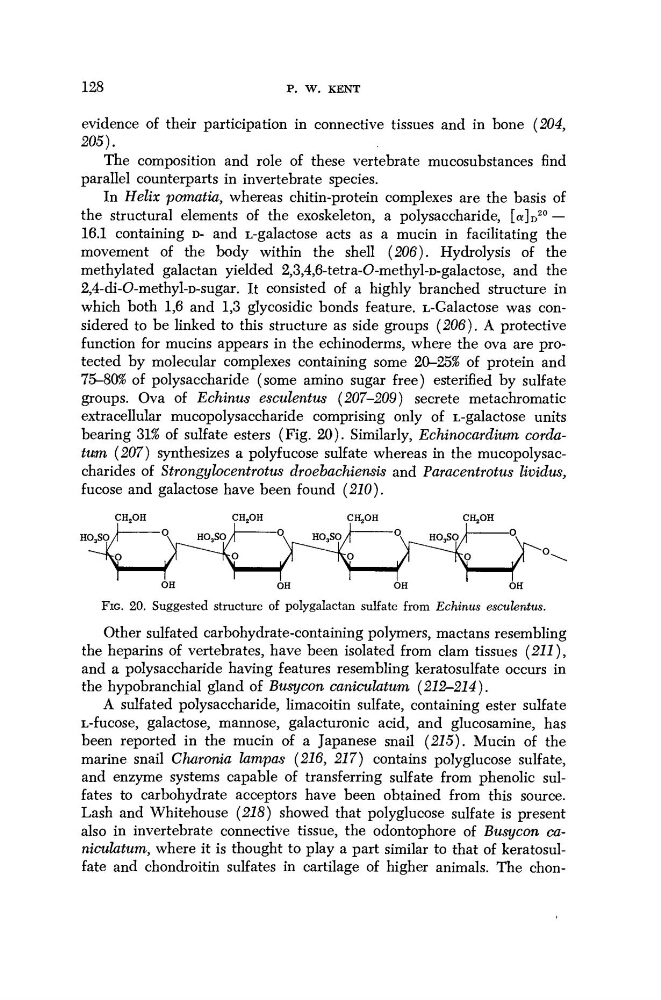
extracellular mucopolysaccharide comprising only of L-galactose units
bearing 31% of sulfate esters (Fig. 20). Similarly, Echinocardium cordatum (207) synthesizes a polyfucose sulfate whereas in the mucopolysaccharides of Strongylocentrotus droebachiensis and Paracentrotus lividus,
fucose and galactose have been found (210).
FIG. 20. Suggested structure of polygalactan sulfate from Echinus esculentus.
Other sulfated carbohydrate-containing polymers, mactans resembling
the heparins of vertebrates, have been isolated from clam tissues (211),
and a polysaccharide having features resembling keratosulfate occurs in
the hypobranchial gland of Busy con caniculatum
(212-214).
A sulfated polysaccharide, limacoitin sulfate, containing ester sulfate
L-fucose, galactose, mannose, galacturonic acid, and glucosamine, has
been reported in the mucin of a Japanese snail (215). Mucin of the
marine snail Charonia lampas (216, 217) contains polyglucose sulfate,
and enzyme systems capable of transferring sulfate from phenolic sulfates to carbohydrate acceptors have been obtained from this source.
Lash and Whitehouse (218) showed that polyglucose sulfate is present
also in invertebrate connective tissue, the odontophore of Busy con caniculatum, where it is thought to play a part similar to that of keratosulfate and chondroitin sulfates in cartilage of higher animals. The chon-
P. W. KENT
evidence of their participation in connective tissues and in bone (204,
205).
The composition and role of these vertebrate mucosubstances find
parallel counterparts in invertebrate species.
In Helix pomatia, whereas chitin-protein complexes are the basis of
the structural elements of the exoskeleton, a polysaccharide, [α] Ό
20
—
16.1 containing D- and L-galactose acts as a mucin in facilitating the
movement of the body within the shell (206). Hydrolysis of the
methylated galactan yielded 2,3,4,6-tetra-O-methyl-D-galactose, and the
2,4-di-O-methyl-D-sugar. It consisted of a highly branched structure in
which both 1,6 and 1,3 glycosidic bonds feature. L-Galactose was considered to be linked to this structure as side groups (206). A protective
function for mucins appears in the echinoderms, where the ova are protected by molecular complexes containing some 20-25% of protein and
75^80% of polysaccharide (some amino sugar free) esterified by sulfate
groups. Ova of Echinus esculentus (207-209)
secrete metachromatic
extracellular mucopolysaccharide comprising only of L-galactose units
bearing 31% of sulfate esters (Fig. 20). Similarly, Echinocardium cordatum (207) synthesizes a polyfucose sulfate whereas in the mucopolysaccharides of Strongylocentrotus droebachiensis and Paracentrotus lividus,
fucose and galactose have been found (210).
FIG. 20. Suggested structure of polygalactan sulfate from Echinus esculentus.
Other sulfated carbohydrate-containing polymers, mactans resembling
the heparins of vertebrates, have been isolated from clam tissues (211),
and a polysaccharide having features resembling keratosulfate occurs in
the hypobranchial gland of Busy con caniculatum
(212-214).
A sulfated polysaccharide, limacoitin sulfate, containing ester sulfate
L-fucose, galactose, mannose, galacturonic acid, and glucosamine, has
been reported in the mucin of a Japanese snail (215). Mucin of the
marine snail Charonia lampas (216, 217) contains polyglucose sulfate,
and enzyme systems capable of transferring sulfate from phenolic sulfates to carbohydrate acceptors have been obtained from this source.
Lash and Whitehouse (218) showed that polyglucose sulfate is present
also in invertebrate connective tissue, the odontophore of Busy con caniculatum, where it is thought to play a part similar to that of keratosulfate and chondroitin sulfates in cartilage of higher animals. The chon-