

2. CHITIN AND MUCOSUBSTANCES
129
droid odontophore has a typical hyaline metachromatic matrix. In addition to this material, the hypobranchial gland of this welk also synthesizes a mucopolysaccharide containing D-glucosamine, D-galactosamine,
and ester sulfate (214). The brittle star Ophiocomina nigra similarly
produces a metachromatic sulfated mucin (219) in connection with a
detritus feeding mechanism. A similar mucin is produced by Amphipholis
squamata.
Mucins are secreted by many types of worm, but as yet comparatively little is known of their structure or composition. In certain annelids,
mucins form a more or less permanent envelope in which the animal
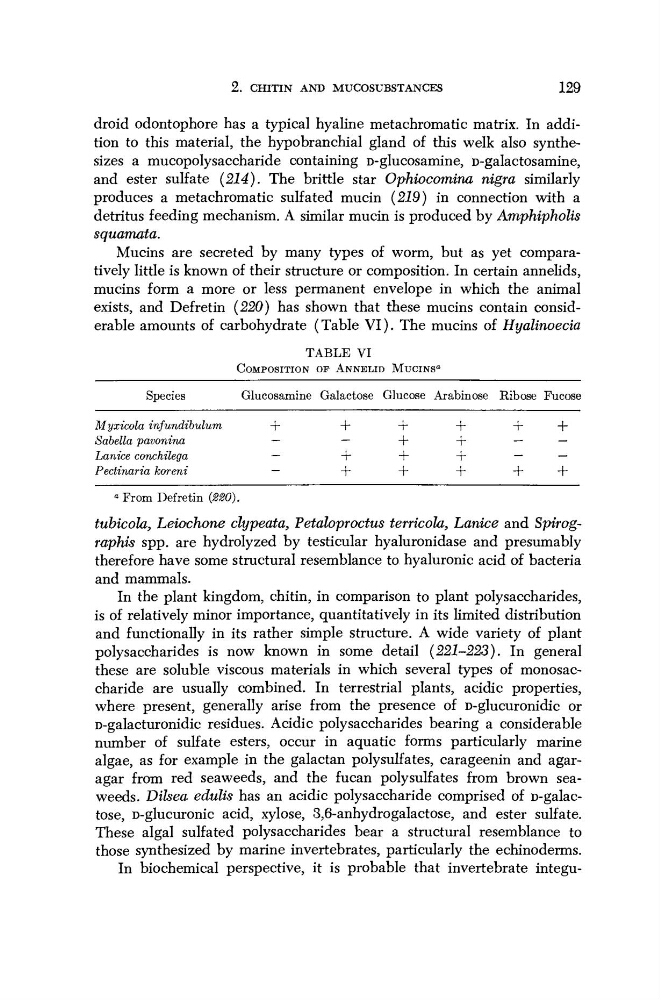
exists, and Defretin (220) has shown that these mucins contain considerable amounts of carbohydrate (Table VI). The mucins of Hyalinoecia
TABLE VI
COMPOSITION OF ANNELID MUCINS
0
Species
Glucosamine Galactose Glucose Arabinose Ribose Fucose
Myxicola infundibulum
+
+
+
+
+
+
Sabella pavonina
-
-
+
+
-
-
Lanice conchilega
—
+
+
+
—
—
Pectinaria koreni
—
+
+
+
+
+
° From Def retin (220).
tubicola, Leiochone clypeata, Petaloproctus terricdla, Lanice and Spirographs spp. are hydrolyzed by testicular hyaluronidase and presumably
therefore have some structural resemblance to hyaluronic acid of bacteria
and mammals.
In the plant kingdom, chitin, in comparison to plant polysaccharides,
is of relatively minor importance, quantitatively in its limited distribution
and functionally in its rather simple structure. A wide variety of plant
polysaccharides is now known in some detail (221-223).
In general
these are soluble viscous materials in which several types of monosaccharide are usually combined. In terrestrial plants, acidic properties,
where present, generally arise from the presence of D-glucuronidic or
D-galacturonidic residues. Acidic polysaccharides bearing a considerable
number of sulfate esters, occur in aquatic forms particularly marine
algae, as for example in the galactan polysulfates, carageenin and agaragar from red seaweeds, and the fucan polysulfates from brown seaweeds. Dilsea edulis has an acidic polysaccharide comprised of D-galactose, D-glucuronic acid, xylose, 3,6-anhydrogalactose, and ester sulfate.
These algal sulfated polysaccharides bear a structural resemblance to
those synthesized by marine invertebrates, particularly the echinoderms.
In biochemical perspective, it is probable that invertebrate integu-
129
droid odontophore has a typical hyaline metachromatic matrix. In addition to this material, the hypobranchial gland of this welk also synthesizes a mucopolysaccharide containing D-glucosamine, D-galactosamine,
and ester sulfate (214). The brittle star Ophiocomina nigra similarly
produces a metachromatic sulfated mucin (219) in connection with a
detritus feeding mechanism. A similar mucin is produced by Amphipholis
squamata.
Mucins are secreted by many types of worm, but as yet comparatively little is known of their structure or composition. In certain annelids,
mucins form a more or less permanent envelope in which the animal
exists, and Defretin (220) has shown that these mucins contain considerable amounts of carbohydrate (Table VI). The mucins of Hyalinoecia
TABLE VI
COMPOSITION OF ANNELID MUCINS
0
Species
Glucosamine Galactose Glucose Arabinose Ribose Fucose
Myxicola infundibulum
+
+
+
+
+
+
Sabella pavonina
-
-
+
+
-
-
Lanice conchilega
—
+
+
+
—
—
Pectinaria koreni
—
+
+
+
+
+
° From Def retin (220).
tubicola, Leiochone clypeata, Petaloproctus terricdla, Lanice and Spirographs spp. are hydrolyzed by testicular hyaluronidase and presumably
therefore have some structural resemblance to hyaluronic acid of bacteria
and mammals.
In the plant kingdom, chitin, in comparison to plant polysaccharides,
is of relatively minor importance, quantitatively in its limited distribution
and functionally in its rather simple structure. A wide variety of plant
polysaccharides is now known in some detail (221-223).
In general
these are soluble viscous materials in which several types of monosaccharide are usually combined. In terrestrial plants, acidic properties,
where present, generally arise from the presence of D-glucuronidic or
D-galacturonidic residues. Acidic polysaccharides bearing a considerable
number of sulfate esters, occur in aquatic forms particularly marine
algae, as for example in the galactan polysulfates, carageenin and agaragar from red seaweeds, and the fucan polysulfates from brown seaweeds. Dilsea edulis has an acidic polysaccharide comprised of D-galactose, D-glucuronic acid, xylose, 3,6-anhydrogalactose, and ester sulfate.
These algal sulfated polysaccharides bear a structural resemblance to
those synthesized by marine invertebrates, particularly the echinoderms.
In biochemical perspective, it is probable that invertebrate integu-