

114
P. W. KENT
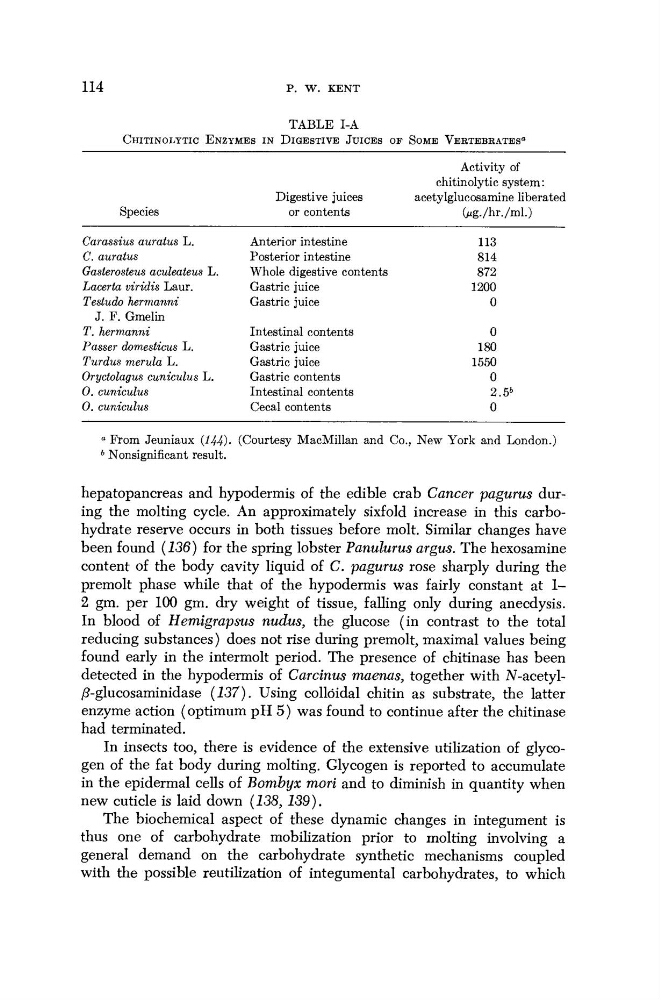
TABLE I-A
CHITINOLYTIC ENZYMES IN DIGESTIVE JUICES OF SOME VERTEBRATES
0
Activity of
chitinolytic system:
Species
Digestive juices
or contents
acetylglucosamine liberated
Gug./hr./ml.)
Carassius auratus L.
Anterior intestine
113
C. auratus
Posterior intestine
814
Gasterosteus aculeateus L. Whole digestive contents
872
Lacerta viridis Laur.
Gastric juice
1200
Testudo hermanni
Gastric juice
0
J. F. Gmelin
T. hermanni
Intestinal contents
0
Passer domesticus L.
Gastric juice
180
Turdus merula L.
Gastric juice
1550
Oryctolagus cuniculus L.
Gastric contents
0
0. cuniculus
Intestinal contents
2.5
δ
0. cuniculus
Cecal contents
0
° From Jeuniaux (144)· (Courtesy MacMillan and Co., New York and London.)
6 Nonsignificant result.
hepatopancreas and hypodermis of the edible crab Cancer pagurus during the molting cycle. An approximately sixfold increase in this carbohydrate reserve occurs in both tissues before molt. Similar changes have
been found (136) for the spring lobster Panulurus argus. The hexosamine
content of the body cavity liquid of C. pagurus rose sharply during the
premolt phase while that of the hypodermis was fairly constant at 12 gm. per 100 gm. dry weight of tissue, falling only during anecdysis.
In blood of Hemigrapsus nudus, the glucose (in contrast to the total
reducing substances) does not rise during premolt, maximal values being
found early in the intermolt period. The presence of chitinase has been
detected in the hypodermis of Carcinus maenas, together with N-acetyl^-glucosaminidase (137). Using colloidal chitin as substrate, the latter
enzyme action (optimum ρ Η 5) was found to continue after the chitinase
had terminated.
In insects too, there is evidence of the extensive utilization of glycogen of the fat body during molting. Glycogen is reported to accumulate
in the epidermal cells of Bombyx mori and to diminish in quantity when
new cuticle is laid down (J38,139).
The biochemical aspect of these dynamic changes in integument is
thus one of carbohydrate mobilization prior to molting involving a
general demand on the carbohydrate synthetic mechanisms coupled
with the possible reutilization of integumental carbohydrates, to which
P. W. KENT
TABLE I-A
CHITINOLYTIC ENZYMES IN DIGESTIVE JUICES OF SOME VERTEBRATES
0
Activity of
chitinolytic system:
Species
Digestive juices
or contents
acetylglucosamine liberated
Gug./hr./ml.)
Carassius auratus L.
Anterior intestine
113
C. auratus
Posterior intestine
814
Gasterosteus aculeateus L. Whole digestive contents
872
Lacerta viridis Laur.
Gastric juice
1200
Testudo hermanni
Gastric juice
0
J. F. Gmelin
T. hermanni
Intestinal contents
0
Passer domesticus L.
Gastric juice
180
Turdus merula L.
Gastric juice
1550
Oryctolagus cuniculus L.
Gastric contents
0
0. cuniculus
Intestinal contents
2.5
δ
0. cuniculus
Cecal contents
0
° From Jeuniaux (144)· (Courtesy MacMillan and Co., New York and London.)
6 Nonsignificant result.
hepatopancreas and hypodermis of the edible crab Cancer pagurus during the molting cycle. An approximately sixfold increase in this carbohydrate reserve occurs in both tissues before molt. Similar changes have
been found (136) for the spring lobster Panulurus argus. The hexosamine
content of the body cavity liquid of C. pagurus rose sharply during the
premolt phase while that of the hypodermis was fairly constant at 12 gm. per 100 gm. dry weight of tissue, falling only during anecdysis.
In blood of Hemigrapsus nudus, the glucose (in contrast to the total
reducing substances) does not rise during premolt, maximal values being
found early in the intermolt period. The presence of chitinase has been
detected in the hypodermis of Carcinus maenas, together with N-acetyl^-glucosaminidase (137). Using colloidal chitin as substrate, the latter
enzyme action (optimum ρ Η 5) was found to continue after the chitinase
had terminated.
In insects too, there is evidence of the extensive utilization of glycogen of the fat body during molting. Glycogen is reported to accumulate
in the epidermal cells of Bombyx mori and to diminish in quantity when
new cuticle is laid down (J38,139).
The biochemical aspect of these dynamic changes in integument is
thus one of carbohydrate mobilization prior to molting involving a
general demand on the carbohydrate synthetic mechanisms coupled
with the possible reutilization of integumental carbohydrates, to which