

2. CHITIN AND MUCOSUBSTANCES
115
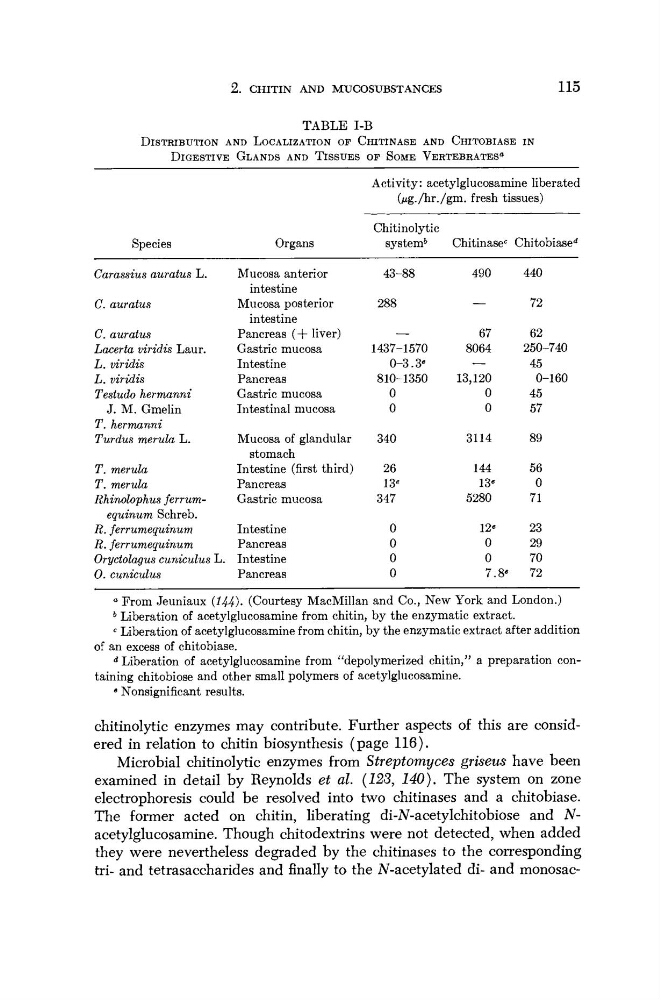
TABLE I-B
DISTRIBUTION AND LOCALIZATION OF CHITINASE AND CHITOBIASE IN
DIGESTIVE GLANDS AND TISSUES OF SOME VERTEBRATES
0
Activity: acetylglucosamine liberated
(^g./hr./gm. fresh tissues)
Chitinolytic
Species
Organs
system
5
Chitinase
0 Chitobiase
d
Carassius auratus L.
Mucosa anterior
43-88
490
440
intestine
C. auratus
Mucosa posterior
288
—
72
intestine
C. auratus
Pancreas (+ liver)
—
67
62
Lacerta viridis Laur.
Gastric mucosa
1437-1570
8064
250-740
L. viridis
Intestine
0-3.3
e
—
45
L. viridis
Pancreas
810-1350
13,120
0-160
Testudo hermanni
Gastric mucosa
0
0
45
J. M. Gmelin
Intestinal mucosa
0
0
57
T. hermanni
Turdus merula L.
Mucosa of glandular
340
3114
89
stomach
T. merula
Intestine (first third)
26
144
56
T. merula
Pancreas
13
e
13
e
0
Rhinolophus ferrumGastric mucosa
347
5280
71
equinum Schreb.
R. ferrumequinum
Intestine
0
12
e
23
R. ferrumequinum
Pancreas
0
0
29
Oryctolagus cuniculus L. Intestine
0
0
70
0. cuniculus
Pancreas
0
7.8«
72
a From Jeuniaux (144)· (Courtesy MacMillan and Co., New York and London.)
6 Liberation of acetylglucosamine from chitin, by the enzymatic extract.
c Liberation of acetylglucosamine from chitin, by the enzymatic extract after addition
of an excess of chitobiase.
d Liberation of acetylglucosamine from "depolymerized chitin," a preparation containing chitobiose and other small polymers of acetylglucosamine.
e Nonsignificant results.
chitinolytic enzymes may contribute. Further aspects of this are considered in relation to chitin biosynthesis (page 116).
Microbial chitinolytic enzymes from Streptomyces griseus have been
examined in detail by Reynolds et al. (123, 140). The system on zone
electrophoresis could be resolved into two chitinases and a chitobiase.
The former acted on chitin, liberating di-N-acetylchitobiose and Nacetylglucosamine. Though chitodextrins were not detected, when added
they were nevertheless degraded by the chitinases to the corresponding
tri- and tetrasaccharides and finally to the N-acetylated di- and monosac-
115
TABLE I-B
DISTRIBUTION AND LOCALIZATION OF CHITINASE AND CHITOBIASE IN
DIGESTIVE GLANDS AND TISSUES OF SOME VERTEBRATES
0
Activity: acetylglucosamine liberated
(^g./hr./gm. fresh tissues)
Chitinolytic
Species
Organs
system
5
Chitinase
0 Chitobiase
d
Carassius auratus L.
Mucosa anterior
43-88
490
440
intestine
C. auratus
Mucosa posterior
288
—
72
intestine
C. auratus
Pancreas (+ liver)
—
67
62
Lacerta viridis Laur.
Gastric mucosa
1437-1570
8064
250-740
L. viridis
Intestine
0-3.3
e
—
45
L. viridis
Pancreas
810-1350
13,120
0-160
Testudo hermanni
Gastric mucosa
0
0
45
J. M. Gmelin
Intestinal mucosa
0
0
57
T. hermanni
Turdus merula L.
Mucosa of glandular
340
3114
89
stomach
T. merula
Intestine (first third)
26
144
56
T. merula
Pancreas
13
e
13
e
0
Rhinolophus ferrumGastric mucosa
347
5280
71
equinum Schreb.
R. ferrumequinum
Intestine
0
12
e
23
R. ferrumequinum
Pancreas
0
0
29
Oryctolagus cuniculus L. Intestine
0
0
70
0. cuniculus
Pancreas
0
7.8«
72
a From Jeuniaux (144)· (Courtesy MacMillan and Co., New York and London.)
6 Liberation of acetylglucosamine from chitin, by the enzymatic extract.
c Liberation of acetylglucosamine from chitin, by the enzymatic extract after addition
of an excess of chitobiase.
d Liberation of acetylglucosamine from "depolymerized chitin," a preparation containing chitobiose and other small polymers of acetylglucosamine.
e Nonsignificant results.
chitinolytic enzymes may contribute. Further aspects of this are considered in relation to chitin biosynthesis (page 116).
Microbial chitinolytic enzymes from Streptomyces griseus have been
examined in detail by Reynolds et al. (123, 140). The system on zone
electrophoresis could be resolved into two chitinases and a chitobiase.
The former acted on chitin, liberating di-N-acetylchitobiose and Nacetylglucosamine. Though chitodextrins were not detected, when added
they were nevertheless degraded by the chitinases to the corresponding
tri- and tetrasaccharides and finally to the N-acetylated di- and monosac-