

2. CHITIN AND MUCOSUBSTANCES
113
Jeuniaux (131, 132), who showed that in Helix pomatia these enzymes
arise predominantly from bacterial flora of the gut, rather than as secretions of the hepatopancreas.
Chitinases are also found in the molting fluids of insects (132), particularly in the larval nymph stages, those of Carabus and Tenebrio
being notably active. The chitinases from these sources resemble the
bacterial enzymes in pH optima (4.9-5.5) and in temperature optima
(ca. 37°). The kinetics of hydrolysis are uncertain owing to the
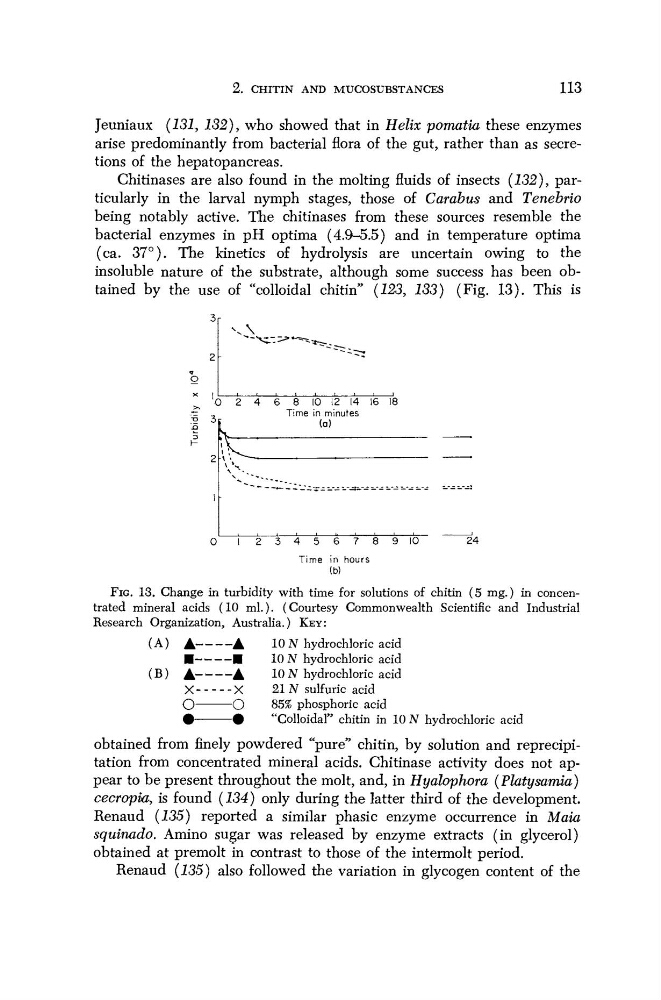
insoluble nature of the substrate, although some success has been obtained by the use of "colloidal chitin" (123, 133) (Fig. 13). This is
6
8
10 12 14 16 18
Time in minutes
(a)
0
123456789
10
24
Time in hours
(b)
FIG. 13. Change in turbidity with time for solutions of chitin (5 mg.) in concentrated mineral acids (10 ml.). (Courtesy Commonwealth Scientific and Industrial
Research Organization, Australia.) KEY:
(A) A
•
10 Ν hydrochloric acid
•
•
10 Ν hydrochloric acid
(B) A
A
10 Ν hydrochloric acid
x
X
21 Ν sulfuric acid
Ο
Ο
85% phosphoric acid
• ·
"Colloidal" chitin in 10 Ν hydrochloric acid
obtained from finely powdered "pure" chitin, by solution and reprecipitation from concentrated mineral acids. Chitinase activity does not appear to be present throughout the molt, and, in Hyalophora (Vlatysamia)
cecropki, is found (134) only during the latter third of the development.
Renaud (135) reported a similar phasic enzyme occurrence in Maia
squinado. Amino sugar was released by enzyme extracts (in glycerol)
obtained at premolt in contrast to those of the intermolt period.
Renaud (135) also followed the variation in glycogen content of the
113
Jeuniaux (131, 132), who showed that in Helix pomatia these enzymes
arise predominantly from bacterial flora of the gut, rather than as secretions of the hepatopancreas.
Chitinases are also found in the molting fluids of insects (132), particularly in the larval nymph stages, those of Carabus and Tenebrio
being notably active. The chitinases from these sources resemble the
bacterial enzymes in pH optima (4.9-5.5) and in temperature optima
(ca. 37°). The kinetics of hydrolysis are uncertain owing to the
insoluble nature of the substrate, although some success has been obtained by the use of "colloidal chitin" (123, 133) (Fig. 13). This is
6
8
10 12 14 16 18
Time in minutes
(a)
0
123456789
10
24
Time in hours
(b)
FIG. 13. Change in turbidity with time for solutions of chitin (5 mg.) in concentrated mineral acids (10 ml.). (Courtesy Commonwealth Scientific and Industrial
Research Organization, Australia.) KEY:
(A) A
•
10 Ν hydrochloric acid
•
•
10 Ν hydrochloric acid
(B) A
A
10 Ν hydrochloric acid
x
X
21 Ν sulfuric acid
Ο
Ο
85% phosphoric acid
• ·
"Colloidal" chitin in 10 Ν hydrochloric acid
obtained from finely powdered "pure" chitin, by solution and reprecipitation from concentrated mineral acids. Chitinase activity does not appear to be present throughout the molt, and, in Hyalophora (Vlatysamia)
cecropki, is found (134) only during the latter third of the development.
Renaud (135) reported a similar phasic enzyme occurrence in Maia
squinado. Amino sugar was released by enzyme extracts (in glycerol)
obtained at premolt in contrast to those of the intermolt period.
Renaud (135) also followed the variation in glycogen content of the